
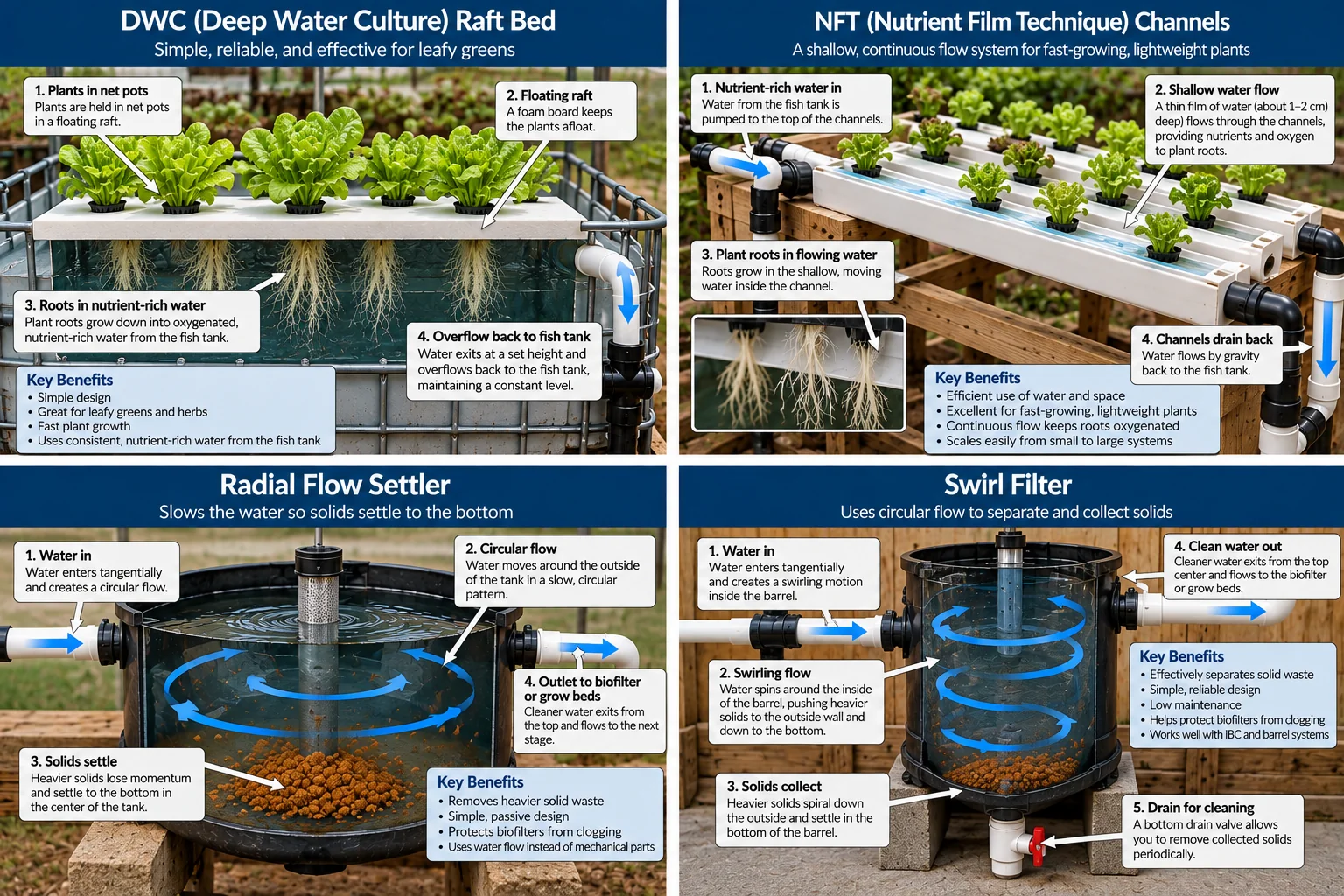
A swirl filter uses a tangential inlet to promote the settling of larger suspended solids, but its performance depends on water flow and geometry.
Water enters a round barrel tangentially and circulates around the vessel. Heavier settleable waste drops toward the bottom, while cleaner water leaves higher up.
The important part is what a swirl filter isn’t: a tiny centrifuge that works better the harder you spin it.
> Experience note: I did not build or test a swirl filter in my IBC system. This guide is research-led.
Gravity is doing the real work
A swirl or vortex filter creates rotational flow, but the particles still have to settle under gravity.
If the water spins too aggressively, solids can stay suspended and ride straight out of the vessel.
That means the design goal is a gentle, organized flow pattern with enough calm volume for settling, not the most dramatic vortex you can produce.
Basic swirl-filter layout
A practical vessel needs:
- a round or cylindrical tank;
- a tangential inlet below the outlet elevation;
- enough vessel volume for water to slow;
- a clarified-water outlet high in the vessel;
- a sludge drain at the bottom;
- access for inspection and cleaning;
- a safe overflow or bypass path.
The approved page graphic shows the basic relationship between those parts.
Tangential inlet: make it swirl, not blend
The inlet should enter along the wall rather than firing straight across the vessel.
That establishes rotation.
But stronger is not automatically better. If particles remain visibly suspended lap after lap, the flow may be too high for the vessel or the internal pattern may be working against settling.
Flow is the constraint
As flow increases through the same barrel, the opportunity for particles to settle decreases.
If solids are escaping:
- reduce flow through the separator;
- increase vessel size;
- split the stream;
- improve inlet/outlet placement;
- or use a more efficient separator.
Do not keep adding elbows to make the vortex more violent.
Keep the outlet away from the sludge
Withdraw clarified water high enough that the outlet is not pulling directly from the settling zone.
A broad, low-velocity withdrawal is preferable to a small aggressive suction point.
Keep it accessible. Roots, biofilm, leaves, and debris do not care that the plumbing looked clean on build day.
Drain the waste
Put the sludge drain at the lowest practical point.
A flat-bottom barrel can work, but it may leave more material behind than a cone-bottom vessel unless the bottom is rinsed toward the drain.
Purge captured solids often enough that the barrel does not become a decomposition tank.
See Aquaponics Sludge and Mineralization.
Where the swirl filter belongs
This is a mechanical solids separator.
It belongs upstream of biological filtration and solids-sensitive plant stages when the system design needs a dedicated settling stage.
See Aquaponics Solids Filtration Basics and How to Arrange Mechanical and Biological Filtration.
Swirl vs radial flow
This is where the two barrels stop being interchangeable.
Published aquaculture research compared a swirl separator with a radial-flow settler under equivalent loading. The radial-flow settler achieved substantially better average total suspended solids removal in that test. (Davidson & Summerfelt, Aquacultural Engineering)
That does not make a swirl filter useless.
It means you should choose it for its simplicity when its observed solids capture is adequate, not because “vortex” sounds more powerful.
For higher solids loads or when separation performance matters more, consider How to Build a Radial Flow Settler.
Commission it instead of assuming
Watch the separator under real flow.
Check:
- whether solids settle or orbit indefinitely;
- whether the outlet draws visible waste;
- whether sludge reaches the drain;
- whether draining stirs everything back up;
- whether the vessel overflows safely if the outlet restricts;
- whether actual solids capture justifies the extra plumbing.
Clear-looking water is not proof that fine suspended solids have been removed.
Swirl-filter build checklist
Verify:
- the vessel is structurally suitable;
- inlet flow is tangential but not excessively turbulent;
- the barrel provides a calm settling region;
- the outlet is high and low-velocity;
- the bottom drain is easy to use;
- overflow behavior is safe;
- the separator can be isolated and cleaned;
- actual solids capture has been observed under operating flow.
Bottom line
A swirl filter is appealing because it is simple.
Keep it simple.
Give gravity enough time and space to work, keep the outlet away from the settled waste, drain the sludge, and judge the filter by what it actually captures. If you need more separation than the barrel can provide, a radial-flow settler is the more defensible next step.
For related practical guidance, see Solids filtration basics and Pump sizing.