
Affiliate disclosure: This guide contains Amazon affiliate links. If you purchase through one of these links, Aquaponics411 may earn a commission at no additional cost to you. As an Amazon Associate, Aquaponics411 earns from qualifying purchases.
Aquaponics equipment does not need to be complicated, but it does need to work together. A strong pump cannot rescue a system with poor aeration. A perfect water test does not remove accumulated solids. An expensive grow light cannot compensate for unhealthy fish water. The system succeeds when circulation, oxygen, filtration, temperature, water quality, fish load, and plant demand stay in balance.
This guide explains the equipment most backyard and greenhouse aquaponics systems actually need, what each component does, where beginners commonly overspend, and where cutting corners creates avoidable problems. It is written for hobby systems, small food-production systems, converted stock tanks, IBC systems, media beds, raft beds, and mixed systems.
You do not need to buy everything on this page at once. Start with the equipment that keeps fish alive and water moving. Add convenience equipment after the biological system is stable. Aquaponics has enough moving parts without turning the shopping list into a second ecosystem.
The Essential Aquaponics Equipment List
At minimum, a working aquaponics system needs a fish-holding pond or container, a plant-growing area, water circulation, oxygen, biological filtration, plumbing, and a way to monitor water quality. Depending on the design, the grow bed may provide both plant support and biological filtration. Larger or more heavily stocked systems usually need dedicated solids filtration and additional aeration.
Core equipment
- Fish-holding pond or container
- Grow bed, raft bed, nutrient-film channels, or another plant-growing component
- Water pump
- Air pump with tubing and diffusers
- Mechanical and biological filtration
- Freshwater liquid test kit
- Water thermometer
- Aquaponics-safe plumbing, valves, and fittings
- Grow media or plant-support materials
- Fish feed
Often necessary
- Tank heater or water-heating system
- Grow lights
- Backup aeration or backup power
- Water conditioner for chlorine or chloramine
- Solids separator or filter
- Timer or environmental controller
- Greenhouse ventilation and temperature equipment
The equipment list changes with system size, climate, fish species, plant choices, and how much risk you are willing to accept. A decorative ten-gallon system with a few goldfish does not need the same equipment as a two-hundred-gallon greenhouse system stocked with tilapia. Size the supporting equipment for the actual water volume and fish load, not for the photo on the product box.
Ponds, Stock Tanks, and Converted IBC Containers
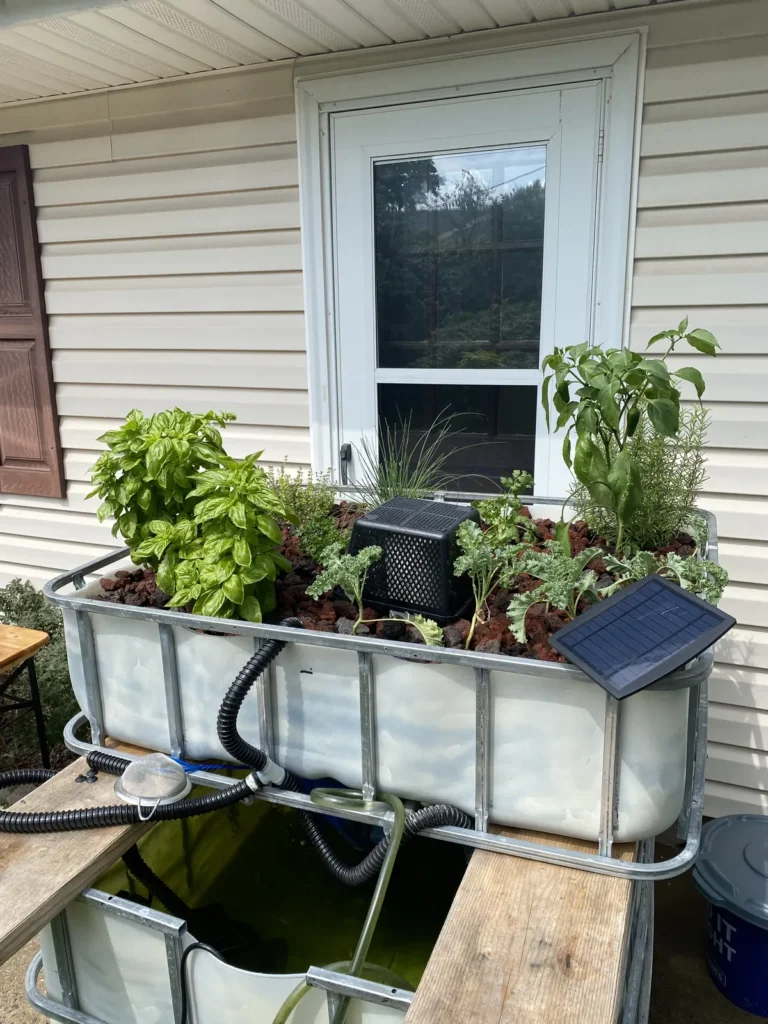
The fish-holding side of a backyard aquaponics system is usually an existing pond, a large livestock stock tank, a purpose-built aquaculture tank, or a converted IBC container. The goal is not to fabricate a decorative aquarium. The goal is to use a durable, accessible body of water that safely holds fish, connects cleanly to filtration and grow beds, and provides enough volume to keep temperature and water chemistry reasonably stable.
What makes a good aquaponics pond or fish-holding container?
- Food-safe material: Use a tank made for potable water, food storage, aquaculture, livestock watering, or another known-safe application.
- Opaque walls: Blocking sunlight helps reduce algae growth.
- Accessible shape: You must be able to inspect fish, remove dead fish, clean the bottom, and reach plumbing connections.
- Enough depth: Fish need usable swimming space and some protection from rapid temperature swings.
- Structural strength: Water weighs roughly 8.34 pounds per gallon. A 200-gallon tank holds about 1,668 pounds of water before adding the tank, fish, plumbing, and nearby equipment.
- Safe edges and fittings: Sharp cut plastic, exposed wire, or poorly installed bulkheads can injure fish or create leaks.
Common choices include lined ponds, large livestock stock tanks, purpose-built aquaculture tanks, and properly prepared IBC containers. Used containers require caution. Never convert an IBC or other reused container that held unknown chemicals, pesticides, petroleum products, industrial cleaners, or anything you would not want circulating through fish and edible plants. The IBC tote aquaponics chop-and-flip build guide covers the complete construction sequence.
View food-safe fish-holding pond or container options on Amazon
Round versus rectangular tanks
Round tanks often produce more predictable water circulation and fewer dead corners. Rectangular stock tanks are easier to place against a wall and may use greenhouse space more efficiently. Either shape can work. The practical question is whether water, solids, fish, and equipment remain accessible.
Tank covers
A partial cover can reduce fish jumping, keep leaves and animals out, block some sunlight, and reduce heat loss. Do not seal a fish-holding pond or container airtight. The water surface still needs gas exchange, and you need quick access during an emergency.
Grow Beds and Plant Support
The plant side of the system may use media beds, deep-water culture rafts, nutrient-film channels, vertical towers, or a combination of methods. The correct equipment depends on what you want to grow and how much maintenance you will tolerate.
Media beds
Media beds support plants in gravel-like material while water floods, drains, or flows through the root zone. They are popular in backyard systems because they can support plants, trap some solids, and provide biological surface area in one component.
A media bed needs:
- A structurally strong, water-safe container
- A drain or standpipe
- A bell siphon if the system uses automatic flood-and-drain cycling
- Washed, inert, aquaponics-appropriate media
- Plumbing sized to handle the intended flow
- Easy access for clearing roots and debris
Read how a bell siphon works in an aquaponics system before choosing a flood-and-drain layout. Bell siphons work well when flow, pipe diameter, bed depth, and drain geometry agree with one another. When they do not, they become little plastic philosophers that spend all day asking whether they should start or stop.
Deep-water culture
Deep-water culture uses floating rafts above oxygenated water. It works well for lettuce, basil, and other relatively light plants. Raft systems need strong aeration, solids removal before water enters the plant channels, and enough water movement to avoid stagnant areas around roots.
Nutrient-film technique
Nutrient-film channels move a shallow stream of water past plant roots. They use space efficiently but are less forgiving of pump failure, root blockage, and solids. They work best when water has already passed through effective mechanical and biological filtration.
Water Pumps and Circulation
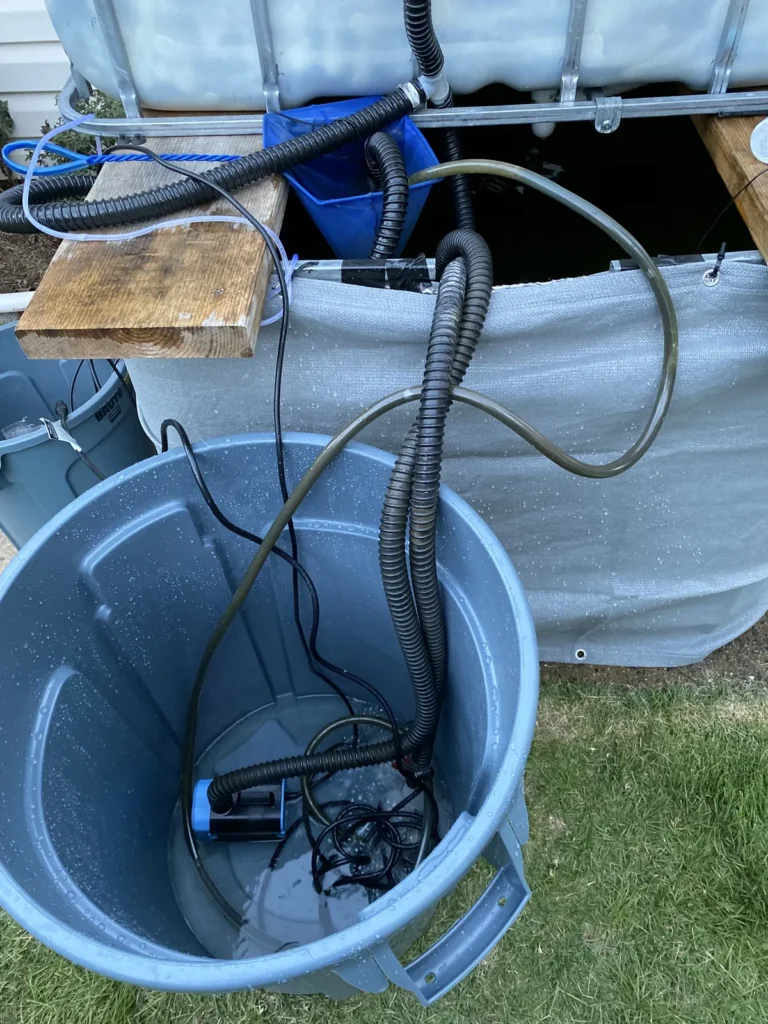
The water pump moves fish waste toward filtration, delivers nutrients to plants, returns treated water, and keeps the system connected. Pump failure can stop nutrient transport, reduce filtration, and lower oxygen faster than many beginners expect.
The pump must provide enough flow after accounting for vertical lift, pipe length, elbows, valves, restrictions, and filter resistance. The maximum flow printed on the box is usually measured under easy conditions. Your aquaponics system will not provide easy conditions because apparently plumbing enjoys character development.
Submersible pumps
Submersible pumps sit in the pond, stock tank, IBC container, sump, or another water reservoir. They are common in small and medium systems because they are simple to install, relatively quiet, and widely available.
Advantages:
- Simple installation
- No priming in most applications
- Broad selection of sizes
- Useful for sump-based systems and water changes
Limitations:
- Adds a small amount of heat to the water
- May clog when exposed to solids or roots
- Requires removal from the water for inspection
- Electrical cable and seals remain continuously submerged
External pumps
External pumps sit outside the water. They can be efficient and easier to service in larger systems, but installation is less forgiving. Intake plumbing must remain airtight, the pump may need priming, and dry-running can damage some models quickly.
How much flow do you need?
A common starting point is to circulate approximately the fish-tank volume once per hour, but that is not a universal law. The required flow depends on fish density, filtration design, tank shape, drain layout, plant area, and whether separate pumps handle different parts of the system.
Use the detailed guide on how to size a pump for an aquaponics system before buying. Measure the vertical distance from the pond, stock tank, sump, or IBC water level to the highest discharge point, then compare the pump’s flow chart at that head height.
View submersible water pumps on Amazon
Useful pump features
- Published flow chart rather than only a maximum-flow number
- Removable intake cover for cleaning
- Ability to pass small solids where appropriate
- Standard threaded outlet size
- Replaceable impeller or available spare parts
- Thermal protection
- A power cord long enough to reach a protected outlet without an unsafe connection near water
Keep a spare pump or at least a transfer pump that can temporarily move water. Pumps tend to fail at the same time hardware stores close, storms arrive, and family members ask why the fish are swimming funny.
Air Pumps, Airline Tubing, and Air Stones
Aquaponics systems need oxygen for fish, nitrifying bacteria, and healthy roots. Water movement adds some oxygen, but most stocked backyard systems should use dedicated aeration rather than trusting a waterfall or return pipe to handle everything.
The basic aeration system includes:
- Air pump
- Airline tubing
- Manifold or distribution valves
- Check valves where needed
- Air stones, diffuser discs, or diffuser tubing
Read the full guide to aeration in aquaponics systems for the relationship between fish load, warm water, algae, power failures, and oxygen demand.
Choosing an air pump
Choose an air pump based on water depth, number of diffusers, fish load, and whether the pump is designed for continuous duty. Deep tanks create more back pressure. Long airline runs and fine-pore diffusers also increase resistance.
For outdoor or greenhouse use, verify that the pump is appropriate for the installation. Many inexpensive aquarium pumps are intended for dry indoor locations. Place air pumps above the water line when possible, keep them protected from splashes and weather, and follow the manufacturer’s electrical instructions.
View pond and aquaponics air pumps on Amazon
Air stones and diffusers
Smaller bubbles generally provide more surface area, but a diffuser that clogs every few weeks is not automatically better than a coarser, more reliable option. Use multiple diffusers to distribute oxygen and create redundancy. Place at least one where fish congregate and another where circulation tends to be weaker.
View air stones and diffusers on Amazon
Check valves
A check valve helps prevent water from siphoning backward through airline tubing when the pump stops. Do not treat a cheap check valve as the only protection against flooding an air pump. Correct pump placement and a drip loop remain important.
Mechanical and Biological Filtration
Fish produce dissolved waste and solid waste. Aquaponics relies on beneficial bacteria to convert ammonia into forms plants can use, but bacteria do not make every solid disappear. A stable system needs both biological processing and a plan for uneaten feed, feces, root fragments, dead organisms, and settled debris.
Mechanical filtration
Mechanical filtration captures or separates solids before they clog grow beds, coat roots, consume oxygen, and break down in inconvenient places.
Common methods include:
- Swirl separators
- Radial-flow settlers
- Screen filters
- Brush filters
- Filter socks
- Settling tanks
- Media-bed capture in lightly stocked systems
A dedicated solids filter becomes more important as fish density rises or when the plant system uses raft beds and narrow channels. Read aquaponics solids filtration basics before choosing equipment.
Biological filtration
Biological filtration provides oxygenated surface area where nitrifying bacteria can establish. Media beds often provide substantial biological surface area. Raft and nutrient-film systems usually need dedicated biofiltration because their plant components provide less reliable bacterial habitat.
Common biological media include:
- Moving-bed plastic media
- Static plastic media
- Expanded clay
- Purpose-built filter blocks or mats
- Other inert, high-surface-area materials designed for aquatic filtration
Biological filters need water flow and oxygen. A large barrel full of media becomes a poor biofilter when water channels around it or oxygen falls too low.
UV clarifiers
UV equipment can help control free-floating algae and improve green-water clarity, but it does not replace solids filtration, biological filtration, water testing, shade, or adequate plant uptake. See using UV filters in aquaponics systems for the practical limitations.
View pond UV clarifiers on Amazon
Water Testing Equipment
Water testing is the diagnostic system for aquaponics. Fish behavior and plant appearance matter, but both can change after water quality has already begun moving in the wrong direction.
Most backyard systems should be able to test:
- pH
- Ammonia
- Nitrite
- Nitrate
- Water temperature
A liquid freshwater master test kit is usually the strongest first purchase because it covers the core nitrogen-cycle readings and pH. Test strips are convenient for quick checks, but they may be harder to read accurately and may not include ammonia.
The existing aquaponics water testing guide explains what each reading means, when to test daily, and why trends matter more than chasing one perfect number.
Check the API Freshwater Master Test Kit on Amazon
Digital pH meters
A digital pH meter can be useful when you test frequently, but inexpensive meters require calibration, proper storage, and occasional probe replacement. A neglected meter can provide a precise-looking wrong answer, which is often more dangerous than an obviously approximate color chart.
If you use a digital meter, keep:
- Calibration solutions
- Storage solution if required
- Clean sample cups
- A written calibration date
- A liquid test as a way to verify suspicious readings
View digital pH meters and calibration supplies on Amazon
Water conditioner
Municipal water may contain chlorine or chloramine. Chlorine can often dissipate with time and aeration, but chloramine is more persistent. Use a conditioner that clearly states what it neutralizes and that is suitable for fish systems. Follow the label rather than estimating by enthusiasm.
Check Seachem Prime water conditioner on Amazon
Additional meters
Dissolved-oxygen meters, conductivity meters, alkalinity tests, hardness tests, and other instruments can be useful in larger or more demanding systems. They are not substitutes for understanding the basic nitrogen cycle. Buy advanced meters when the measurement will change a decision, not because the display has more digits.
Heaters and Temperature Control
Water temperature affects fish metabolism, feeding, oxygen availability, bacterial activity, plant growth, and disease risk. The correct temperature depends heavily on fish species. Tilapia and trout do not belong under the same temperature plan.
Read how to heat an aquaponics fish-holding pond or container in winter before buying heaters. Heating water can become one of the largest operating costs in a cold climate, and insulating the system is often cheaper than continuously replacing lost heat.
Submersible aquarium heaters
Aquarium heaters can work in small tanks, conditioning barrels, and lightly heated indoor systems. Large ponds, stock tanks, and IBC systems may require multiple heaters, purpose-built pond heaters, inline heating, heat exchangers, or a different fish strategy.
Useful features include:
- Guard or shatter-resistant construction
- External temperature controller
- Overheat protection
- Clear wattage rating
- Compatibility with the tank volume and minimum water depth
View aquarium heaters and temperature controllers on Amazon
Temperature controllers
An external controller can switch heating or cooling equipment based on a probe reading. It adds a layer of control and may reduce dependence on the small thermostat built into an inexpensive heater. Use equipment within the controller’s electrical rating and protect all connections from water.
Thermometers
Keep a simple independent thermometer in the system even when a controller displays temperature. A second measurement helps catch failed probes and drifting sensors.
View waterproof water thermometers on Amazon
Electrical safety: Water and electricity create serious shock and fire hazards. Use properly grounded equipment, ground-fault circuit-interrupter protection, weather-rated enclosures where required, drip loops, and installation practices appropriate to local electrical codes. Hire a qualified electrician for permanent outdoor or greenhouse circuits.
Aquaponics Plumbing
Plumbing determines whether water goes where intended, whether the pump operates efficiently, and how quickly a small problem becomes a large wet floor. Use the Aquaponics Plumbing Guide for detailed pipe, bulkhead, uniseal, valve, and overflow planning.
Common plumbing components
- PVC pipe or flexible tubing
- Bulkhead fittings or tank connectors
- Ball valves
- Union fittings
- Tees, elbows, reducers, and adapters
- Standpipes and overflows
- Uniseals where appropriate
- Pipe supports and clamps
- Thread sealant suitable for potable-water applications
Do not undersize the pipe
Small pipe increases friction and can reduce pump flow substantially. Gravity drains often require larger pipe than beginners expect because they cannot rely on pump pressure. Roots, biofilm, and solids reduce effective capacity over time.
Use unions and valves
A union allows you to remove a pump or filter without cutting pipe. A valve allows you to isolate equipment, balance flow, and service one section without draining the entire system. These fittings cost more during construction and save much more aggravation later.
View aquaponics plumbing fittings on Amazon
Design for overflow
Every tank and grow component needs a safe response to blockage, excess inflow, pump shutdown, and restart. Plan where water will go when a drain clogs. A backup overflow should discharge somewhere less expensive than the greenhouse floor, electrical outlet, or neighbor’s basement.
Grow-Bed Media
Grow media supports roots, provides bacterial surface area, distributes water, and affects how easily the bed drains. It must be stable in water, reasonably pH-neutral for the intended system, free of harmful contaminants, and comfortable enough to handle during planting and maintenance.
Read aquaponics grow-bed media basics before ordering. Shipping can make lightweight specialty media expensive, while locally available stone may require testing and substantial washing.
Expanded clay pebbles
Expanded clay is lightweight, easy to handle, and popular for aquaponics. It is usually more expensive than local rock and can float initially in some conditions.
View expanded clay pebbles on Amazon
Lava rock
Lava rock can provide good surface area and may be locally affordable. It is rough on hands and roots, can trap debris, and may be unpleasant to remove after years in a bed.
Washed gravel
Washed gravel can be economical but is heavy. Test for carbonate content before use because limestone and similar materials can push pH upward. Also verify that the stone contains no contaminants or sharp material likely to damage liners and plumbing.
Media size
Very fine media compacts and restricts flow. Very large media provides less support to small plants and may create large channels. A medium, relatively uniform particle size is usually easier to manage.
Grow Lights
Outdoor systems may not need grow lights, but indoor systems and winter greenhouses often do. Light requirements depend on crop type, growing area, fixture height, day length, and how much natural light reaches the plants.
LED grow lights
Modern LED fixtures are the common choice because they convert electricity into usable plant light more efficiently than many older technologies and produce less radiant heat. That does not mean every purple panel with a leaf printed on the box will grow a tomato jungle.
Look for:
- Actual power draw
- Coverage map at realistic hanging heights
- PPFD information when available
- Moisture resistance appropriate to the location
- Replaceable or reputable drivers
- A fixture shape matching the grow area
- A warranty from a seller likely to exist next year
View full-spectrum LED grow lights on Amazon
Timers
A simple heavy-duty timer keeps the light schedule consistent. Verify that the timer can handle the fixture’s electrical load. Smart plugs can add scheduling and remote status, but reliability matters more than the number of app notifications.
View grow-light timers on Amazon
Match the light to the crop
Leafy greens and herbs generally need less intense light than fruiting peppers and tomatoes. The existing guides to plants that grow well in aquaponics and growing herbs and peppers can help determine whether the crop fits the planned equipment.
Fish-Feeding and Handling Equipment
Fish equipment is simple compared with pumps and filtration, but poor feeding creates many water-quality problems.
Fish feed
Use a feed appropriate to the species, fish size, and water temperature. Pellet size should match the fish. Store feed in a cool, dry, sealed container and avoid buying more than you can use while it remains fresh.
View aquaponics fish feed on Amazon
Learn more about species requirements in using goldfish in aquaponics systems and using tilapia, catfish, or bass in aquaponics systems.
Automatic feeders
Automatic feeders are useful during travel and in systems that benefit from several small feedings. They can also dump too much feed into the tank when set incorrectly, exposed to moisture, or jammed. Test the feeder over a container before trusting it above live fish.
View automatic fish feeders on Amazon
Nets and inspection tools
Keep a fish net large enough for the species, a smaller net for debris, and a flashlight for inspection. Separate nets used for sick or quarantined fish when possible. Clean and dry equipment before moving it between systems.
Backup Power and Emergency Equipment
Aquaponics depends on electricity more than a conventional soil garden. When power stops, water circulation, aeration, filtration, heating, cooling, and controls may stop together. Fish can run out of oxygen long before plants show visible damage.
The most important emergency load is usually aeration. A small battery air pump may not run the entire system, but keeping oxygen moving can buy time.
Read backup power for aquaponics systems for a full risk-based approach.
Backup options
- Battery-powered aquarium air pumps
- Rechargeable pond aerators
- Uninterruptible power supplies
- Portable power stations
- Generators
- Solar-charged battery systems
- Automatic transfer equipment for larger installations
View battery-backup air pumps on Amazon
View portable power stations on Amazon
Calculate runtime
Do not assume a battery labeled with a large number will run the equipment all night. Add the actual wattage of the devices, account for inverter losses, and leave reserve capacity. Test the backup under real load before an emergency.
Alarm equipment
Temperature alarms, water-level alarms, smart plugs, power-failure alerts, and leak sensors can provide early warning. An alert does not fix the system, but it can prevent a six-hour failure from becoming a two-day surprise.
View power and temperature alarm equipment on Amazon
Greenhouse and Winter Equipment
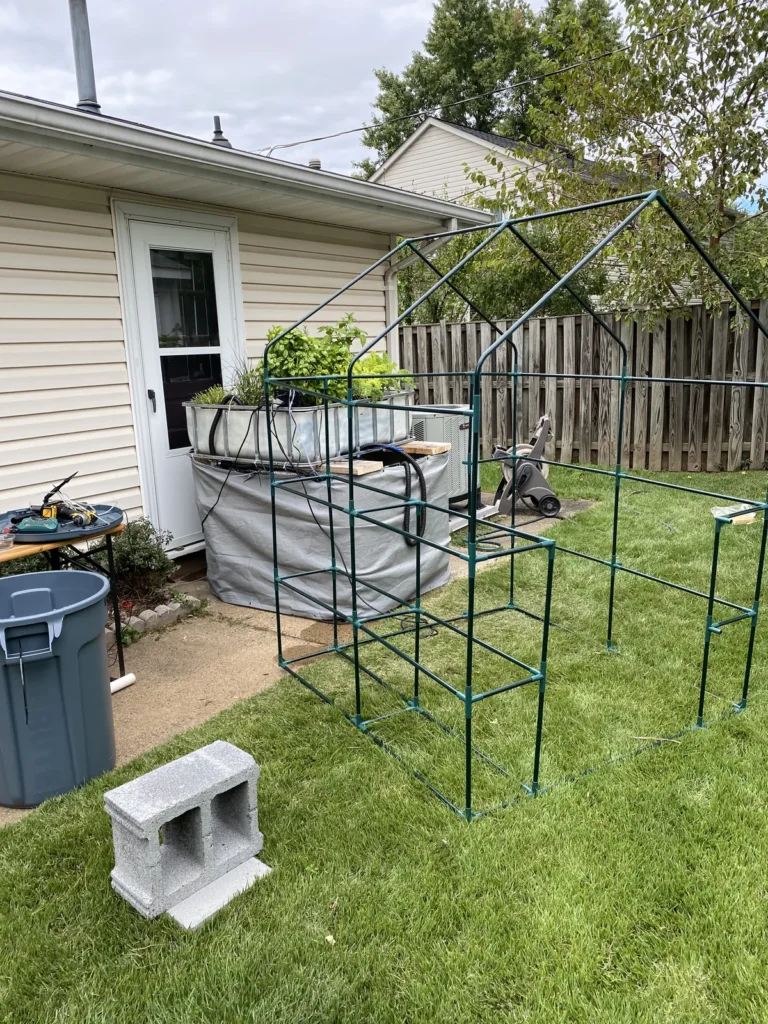
A greenhouse protects equipment and extends the growing season, but it does not create free heat. A sunny greenhouse may overheat during the day and lose heat quickly after sunset. Successful winter operation depends on insulation, air sealing, thermal mass, ventilation, heating strategy, and fish choice.
Greenhouse equipment that matters
- Ventilation fans
- Automatic vent openers
- Shade cloth
- Thermostat or environmental controller
- Air-temperature and water-temperature sensors
- Insulation around tanks and plumbing
- Safe supplemental heat
- Condensation management
- Backup power for critical equipment
View greenhouse ventilation and control equipment on Amazon
Insulate the water first
Water holds substantial heat, but an exposed tank can lose it through the sides, surface, floor, and connected plumbing. Insulate tank walls and pipes where practical. Use a removable cover over exposed water while preserving oxygen exchange and access.
View tank and pipe insulation products on Amazon
Summer cooling
Greenhouses can become dangerous during warm weather. High water temperature lowers oxygen capacity while increasing fish metabolism and oxygen demand. Ventilation, shade, aeration, and reduced feeding may matter more than adding a complicated cooling device.
Maintenance Tools and Supplies
Maintenance equipment rarely appears in attractive system diagrams, but it determines whether routine work takes ten minutes or ruins a Saturday.
Useful maintenance equipment
- Dedicated buckets
- Transfer pump and hose
- Pipe brushes
- Filter-cleaning brushes
- Spare air stones and airline
- Spare pump impeller where available
- Replacement valves and common fittings
- Hose clamps
- Waterproof flashlight or headlamp
- Fish net
- Plant pruners
- Disposable gloves
- Test-kit refill reagents
- Written maintenance log
A small transfer pump is particularly useful for water changes, cleaning settling tanks, emptying conditioning barrels, and temporarily replacing a failed circulation pump.
View utility transfer pumps on Amazon
Keep critical spares
Keep inexpensive failure-prone parts on site. A spare air stone, check valve, short length of tubing, pump adapter, hose clamp, and common PVC fitting can restore operation without waiting for delivery.
What Aquaponics Equipment Should You Buy First?
Buy equipment in the order of biological importance. Fish survival and water stability come before automation and cosmetic upgrades.
- Pond, stock tank, or converted IBC container: Establish the water volume, footprint, and access requirements.
- Water pump and plumbing: Build reliable circulation with accessible valves and unions.
- Aeration: Install enough air capacity for the intended fish load, with redundancy.
- Filtration: Match mechanical and biological filtration to the system design.
- Water test kit and thermometer: Verify cycling and monitor trends.
- Water conditioner: Keep it available when using treated municipal water.
- Heating, cooling, or insulation: Match environmental equipment to species and climate.
- Backup aeration or power: Protect the system from predictable outages.
- Grow lights: Add only when natural light cannot support the intended crops.
- Automation: Add feeders, smart controls, alarms, and monitoring after the basic system is dependable.
A practical starter shopping list
| Equipment | Why it matters | Do not buy until you know |
|---|---|---|
| Water pump | Moves water through the entire system | Required flow at actual head height and total system volume |
| Air pump and diffusers | Supports fish, bacteria, and roots | Tank depth, fish load, and number of outlets |
| Freshwater test kit | Measures cycling and water-quality trends | Whether it includes ammonia, nitrite, nitrate, and pH |
| Thermometer | Tracks a major fish and oxygen variable | Expected water-temperature range |
| Filtration | Manages solids and biological conversion | Fish density and plant-system type |
| Heater | Protects warm-water fish in cold conditions | Tank volume, heat loss, climate, and electrical capacity |
| Grow light | Supports crops with inadequate natural light | Crop, growing area, hanging height, and daily light requirement |
| Backup power | Keeps critical life-support equipment operating | Total wattage and required runtime |
Equipment Beginners Commonly Buy Too Early
- Advanced digital meters: Useful only when calibrated and tied to real decisions.
- Large UV clarifiers: They may improve clarity but will not fix poor filtration or excessive sunlight.
- Automatic dosing systems: Automation can make the wrong adjustment more consistently.
- Oversized fish feeders: Excess feed becomes ammonia and solids.
- Complex monitoring systems: Install basic alarms first and prove the system manually.
- Decorative plumbing: Every unnecessary elbow and gadget adds resistance or another leak point.
Equipment You Should Not Undersize
- Aeration: Oxygen demand rises with warm water, fish growth, feeding, algae, and system stress.
- Gravity drains: A drain should handle more than the expected inflow and remain functional with some biofilm or roots.
- Backup power: Nameplate capacity is not the same as usable runtime.
- Structural support: Water and saturated media are extremely heavy.
- Access: Leave enough room to remove pumps, clean filters, inspect fish, and repair plumbing.
How the Equipment Works as One System
The fish produce ammonia and solids. Water movement carries those wastes toward filtration. Mechanical filtration removes concentrated solids. Biological filtration converts ammonia to nitrite and then nitrate. Plants use dissolved nutrients. Aeration supports fish, bacteria, and roots throughout the process. Testing shows whether the cycle remains stable. Temperature equipment keeps the organisms within workable ranges. Backup power preserves the critical parts when electricity fails.
No single product creates a successful aquaponics system. Reliability comes from compatible equipment, conservative stocking, regular observation, and enough redundancy to survive ordinary failures.
For troubleshooting, use these supporting guides:
- Common aquaponics beginner mistakes
- How to keep aquaponics water clear
- How to prevent algae growth in aquaponics systems
- Aquaponics water testing basics
- Aeration in aquaponics systems
- Backup power for aquaponics systems
Frequently Asked Questions
What equipment is required for aquaponics?
A basic aquaponics system requires a fish-holding pond or container, plant-growing component, water pump, plumbing, aeration, biological filtration, water-testing equipment, and a thermometer. Many systems also need mechanical solids filtration, heating or cooling, supplemental lighting, and backup power.
Can an aquaponics system run without an air pump?
Some lightly stocked systems receive oxygen from water movement and falling returns, but dedicated aeration provides valuable safety margin. Most backyard systems with a meaningful fish load should use an air pump and diffusers, especially in warm water or greenhouse conditions.
How large should an aquaponics water pump be?
A common starting target is approximately one fish-tank volume per hour after head loss, but the correct flow depends on stocking, filtration, pipe size, vertical lift, and system layout. Use the pump’s published flow chart at the actual head height rather than the maximum-flow number.
Do aquaponics systems need filters?
Yes. Every system needs biological filtration, although a media bed may provide it. Systems also need a way to manage solid waste. Lightly stocked media beds may capture some solids, while larger systems, raft beds, and nutrient-film channels usually need dedicated mechanical filtration.
What water test kit is best for aquaponics beginners?
A liquid freshwater master test kit that measures pH, ammonia, nitrite, and nitrate is usually the most useful starting point. Add a separate thermometer. Test strips can serve as quick checks but may not include ammonia or provide the same clarity.
Do aquaponics systems need heaters?
Only when water temperature would otherwise fall outside the safe range for the fish, bacteria, or crops. Cold-water fish may not require heating in climates where warm-water species would. Insulation and species selection can reduce heating costs substantially.
Do aquaponics plants need grow lights?
Plants need sufficient light, but the source can be sunlight, supplemental electric lighting, or both. Indoor systems and low-light winter greenhouses often need grow lights. Match fixture intensity and coverage to the crop rather than buying by advertised watt-equivalent claims.
What should keep running during a power outage?
Aeration is usually the first priority because fish can experience oxygen stress quickly. Water circulation may also be critical depending on stocking, temperature, and filtration design. Heating, cooling, and monitoring become more important as outage duration increases.
Can I use ordinary PVC in aquaponics?
Common rigid PVC plumbing is widely used around aquaponics ponds, stock tanks, and IBC systems, but materials, primers, cements, thread sealants, and flexible tubing should be suitable for the application and allowed to cure fully according to manufacturer instructions. Avoid unknown reclaimed plumbing and components contaminated by prior use.
What is the most important aquaponics purchase?
There is no single answer because the system cannot function without circulation, oxygen, and filtration. For an existing system, a reliable water test kit is often the most useful diagnostic purchase. For a new pond, stock-tank, or IBC setup, correct pump and aeration sizing should happen before fish are added.
Final Takeaway
Build the life-support system first. Buy a reliable pump, adequate aeration, appropriate filtration, a complete water test kit, and a thermometer before spending money on automation or cosmetic upgrades. Size equipment for actual water volume, head height, fish load, and climate. Make pumps and filters easy to remove. Keep critical spare parts. Plan for outages before the first outage.
Aquaponics equipment should reduce uncertainty, not create a collection of boxes with blinking lights. When every component supports the same biological cycle, the system becomes easier to understand, easier to maintain, and much harder to accidentally turn into expensive soup.
Plan before buying: The IBC aquaponics cost breakdown separates core equipment from experiments and hidden setup costs.