
Water testing is how you catch aquaponics problems before the fish do. A system can look normal while ammonia rises, nitrite appears, pH drifts, or temperature moves outside the range your fish and bacteria tolerate.
For most backyard systems, the essential readings are pH, ammonia, nitrite, nitrate, and water temperature. A good liquid freshwater test kit covers the first four. Add a reliable thermometer and you have enough information to understand whether the biological cycle is stable or beginning to slip.
Affiliate disclosure: This page contains affiliate links. As an Amazon Associate I earn from qualifying purchases.
Practical rule: Test daily when the system is new, during fishless cycling, recently changed, or showing trouble. Once it is mature and predictable, test weekly and increase the frequency whenever fish behavior, water clarity, feeding, temperature, or equipment changes.
Reality Check
From my system: Field note: I tested at least weekly and switched to daily testing when something looked wrong. I tried to test at the same time of day, usually around feeding, because consistency mattered more than comparing a morning reading with an afternoon reading.
A lot of beginner aquaponics advice makes the process sound too clean. Add water, add fish, add plants, and harvest dinner. The real version includes chlorine, ammonia, nitrite, algae, fish waste, dead roots, temperature swings, uneaten feed, power outages, and the occasional mystery problem that makes you stare into the stock tank like it owes you money.
Water testing will not prevent every problem. It does remove a large amount of guessing. Instead of reacting to yellow leaves or sluggish fish with random additives, you can see whether the problem is water chemistry, temperature, filtration, oxygen, or something else.
What You Actually Need to Test
Start with five measurements:
- pH
- Ammonia
- Nitrite
- Nitrate
- Water temperature
Those readings cover the basic nitrogen cycle, the chemical balance between fish, plants, and bacteria, and one of the most important environmental variables in the system.
You do not need every digital meter on the first day. A liquid freshwater master kit is usually the best starting purchase because it measures pH, ammonia, nitrite, and nitrate with replaceable reagents and enough tests to follow a system over time.
I used the API Freshwater Master Test Kit. It lasted well over a year with regular use and covered the readings that mattered most.
Quick Reference: What the Numbers Mean
| Reading | What It Tells You | Preferred Direction | When to Act |
|---|---|---|---|
| pH | Overall chemical balance affecting fish, plants, bacteria, and nutrient availability | Stable within the working range for the system | Sudden movement or persistent drift outside the useful range |
| Ammonia | Whether fish waste is being processed | Near zero in a mature system | Any confirmed rise deserves attention |
| Nitrite | Whether the second stage of the nitrogen cycle is keeping up | Near zero in a mature system | Any confirmed reading in a stocked system |
| Nitrate | Available plant nutrient and balance between fish load and plant uptake | Present but controlled | Rapid rise, persistent high levels, or no nitrate during cycling |
| Temperature | Fish metabolism, oxygen capacity, bacterial activity, and plant performance | Stable for the fish species and season | Rapid change or movement outside the safe species range |
pH
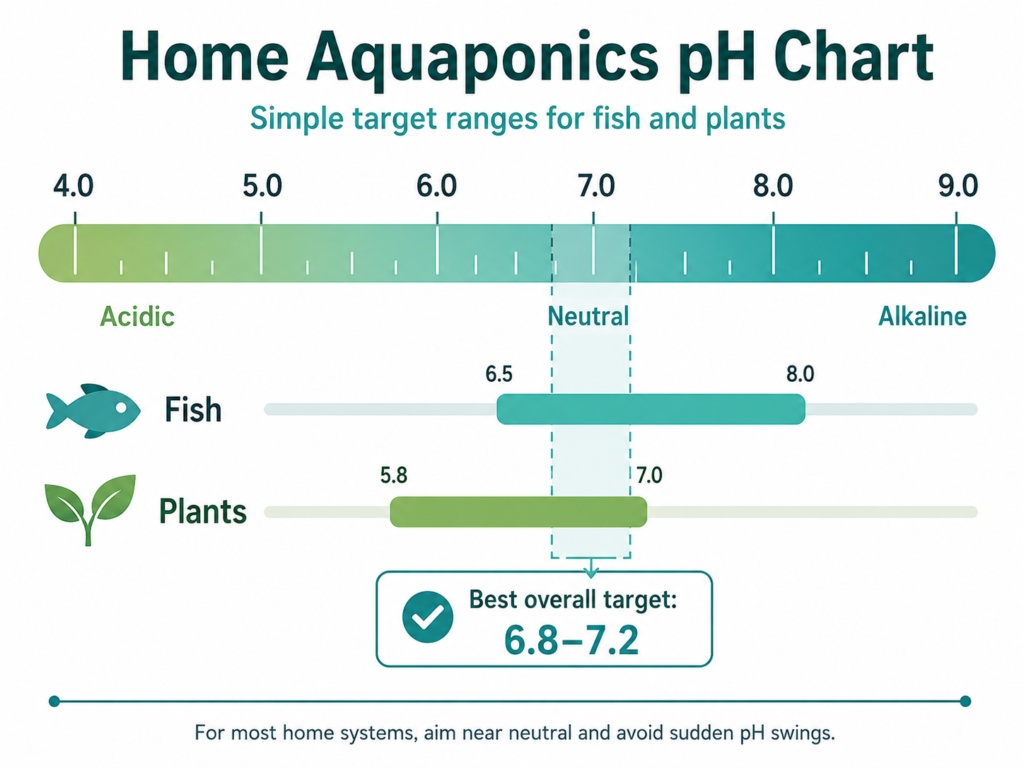
pH affects fish health, bacterial activity, and the availability of nutrients to plants. Aquaponics works in a compromise range because fish, plants, and nitrifying bacteria do not all prefer exactly the same conditions.
For many mixed backyard systems, a pH around the upper sixes to low sevens is workable. The exact target depends on fish species, source water, alkalinity, system age, and crop needs.
A slowly declining pH is common as nitrification consumes alkalinity. A sudden pH change is more concerning and may point to an additive, source-water change, dead material, a testing error, or depleted buffering capacity.
Do Not Correct pH Too Fast
Fish and bacteria usually tolerate gradual change better than a rapid chemical correction. If pH needs adjustment, confirm the reading, understand the cause, and make small changes. Dumping a large dose of pH-up or pH-down into the fish water can create a larger problem than the original reading.
Digital pH meters can be useful, but they require calibration and proper storage. A cheap meter with a neglected probe can give a very precise wrong answer. Keep liquid pH testing available to verify suspicious digital readings.
View digital pH meters and calibration supplies on Amazon.
Ammonia
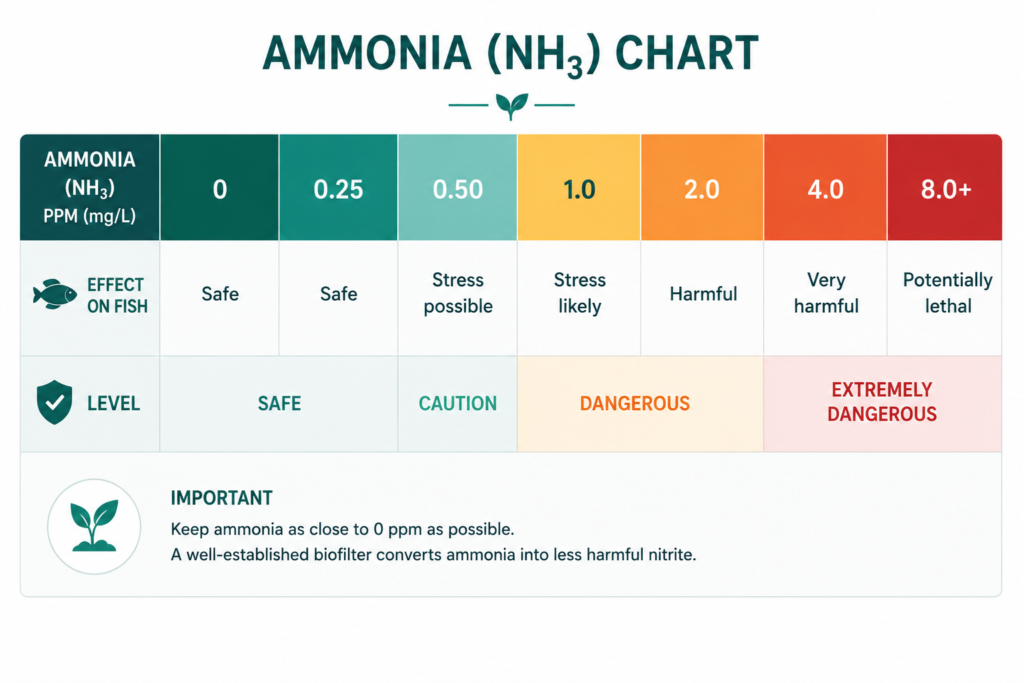
Ammonia enters the system through fish waste, uneaten feed, and dead or decomposing material. In a mature aquaponics system, bacteria should convert it quickly enough that the test remains near zero.
A confirmed ammonia reading usually means the system is still cycling, the fish or feeding load has exceeded the biological filter, water flow or aeration has failed, the pH or temperature has shifted, or something is decomposing in the system.
Ammonia becomes more dangerous as pH and temperature rise. That is why the number should never be interpreted alone.
What to Do When Ammonia Appears
- Confirm the result with a second test.
- Stop or sharply reduce feeding.
- Remove dead fish, uneaten feed, and decaying material.
- Verify that the water pump and aeration are running.
- Check water temperature and pH.
- Test nitrite.
- Consider a partial change with conditioned, temperature-compatible water if fish are at risk.
- Continue testing daily until ammonia returns near zero.
Do not keep feeding normally while the system is failing to process the waste already present.
Nitrite
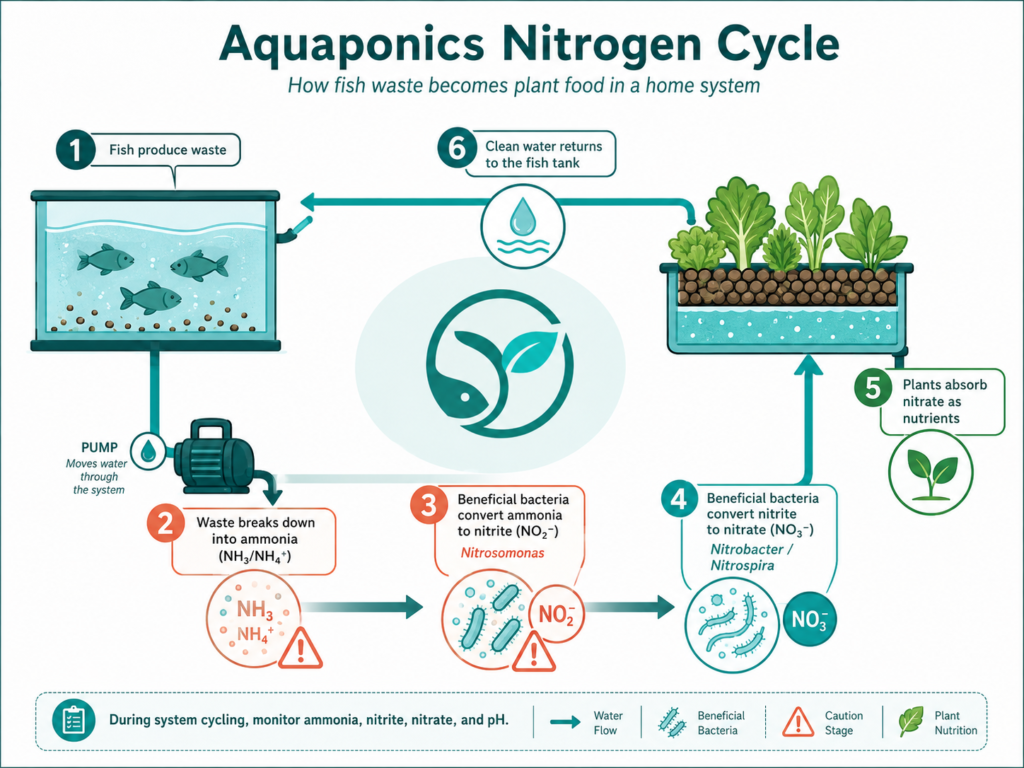
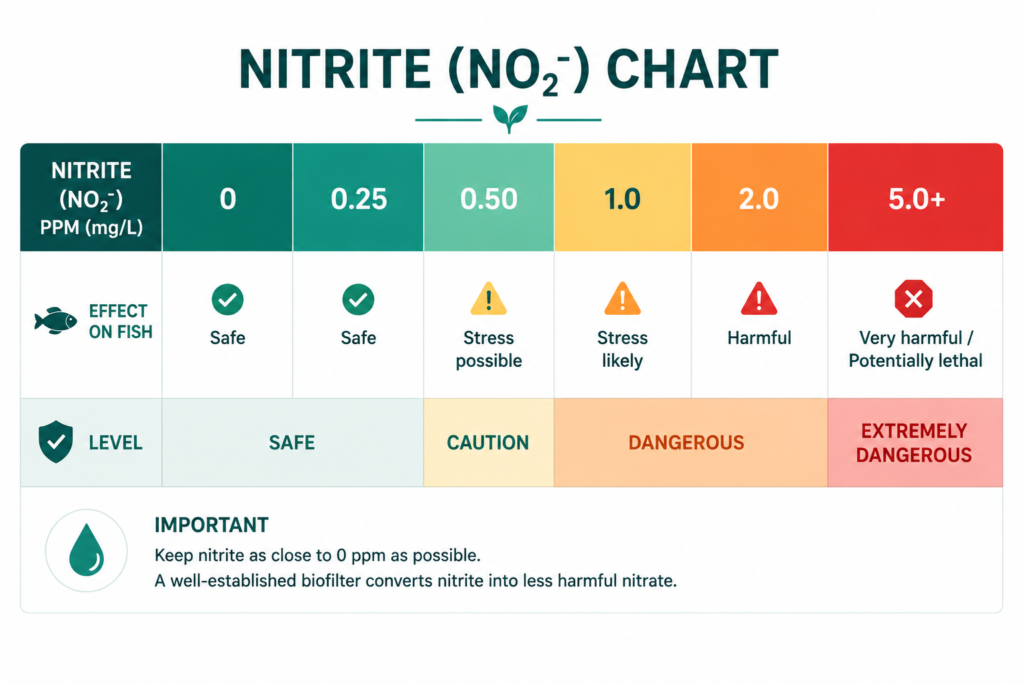
Nitrite appears when one group of bacteria begins converting ammonia. A second group of bacteria must then convert nitrite into nitrate.
During cycling, ammonia often rises first, followed by nitrite. Nitrate begins appearing as the biological filter matures. Nitrite therefore shows that the cycle is moving, but it is not finished.
Nitrite interferes with the fish’s ability to transport oxygen. A system can have plenty of bubbles and still have fish showing oxygen-like stress when nitrite is elevated.
What to Do When Nitrite Appears
- Reduce or stop feeding.
- Increase aeration.
- Confirm water flow through the biological filter and grow beds.
- Check ammonia, pH, and temperature.
- Remove accumulated solids and dead material.
- Use conditioned replacement water when a partial water change is necessary.
- Test daily until the reading returns near zero.
Nitrate
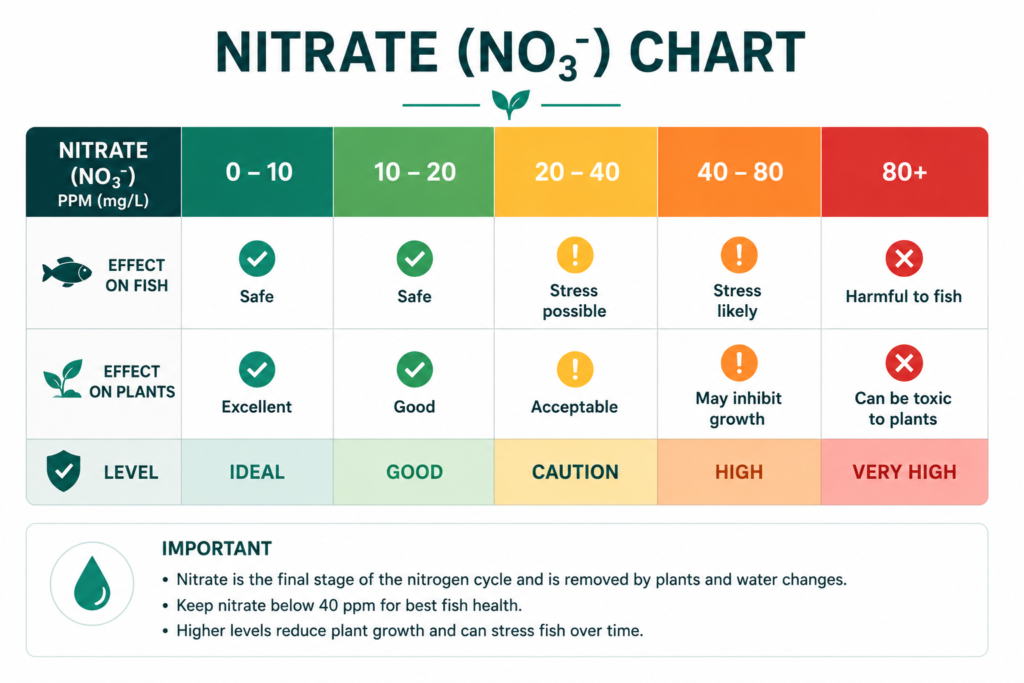
Nitrate is the end product most plants use. Fish waste becomes ammonia, bacteria convert ammonia to nitrite, other bacteria convert nitrite to nitrate, and plants remove nitrate and other nutrients from the water.
Nitrate is expected in an operating aquaponics system. A moderate reading shows that the nitrogen cycle is working and nutrients are available to plants.
A rising nitrate trend can mean the fish load or feeding rate exceeds plant uptake. It may also appear after a major harvest because the fish continue producing waste while fewer plants remain to use the nutrients.
Low or Missing Nitrate
Very low nitrate is not automatically bad. Plants may be using it as quickly as bacteria produce it. During startup, however, no nitrate combined with ammonia or nitrite usually means the nitrogen cycle has not fully matured.
Low nitrate combined with pale or slow-growing plants can also point to insufficient feeding, low fish biomass, poor bacterial activity, or another plant nutrient deficiency that nitrate testing alone will not reveal.
Water Temperature
Temperature affects fish metabolism, appetite, oxygen demand, bacterial activity, ammonia toxicity, and plant growth. It belongs in every water-testing routine even though it does not come in the master test-kit box.
The correct range depends on the fish species. Tilapia, catfish, bass, trout, and goldfish do not belong under one universal temperature recommendation. Use the species guides for goldfish and tilapia, catfish, or bass before setting a temperature plan.
Measure water temperature, not just greenhouse air temperature. A greenhouse can be warm in the afternoon while the water remains cold, or the air can cool rapidly overnight while the water loses heat more slowly.
View waterproof water thermometers on Amazon.
How Often Should You Test?
| System Condition | Testing Frequency | What to Test |
|---|---|---|
| New or cycling system | Daily | pH, ammonia, nitrite, nitrate, temperature |
| Stable mature system | Weekly | pH, ammonia, nitrite, nitrate, temperature |
| After adding fish | Daily for several days | Ammonia, nitrite, pH, temperature |
| After a fish death | Immediately, then daily | Ammonia, nitrite, pH, temperature |
| After pump or aeration failure | Immediately and after restoration | Ammonia, nitrite, temperature; dissolved oxygen if available |
| After a major plant harvest | Every few days | Nitrate, pH, ammonia, nitrite |
| During heat waves | Daily temperature checks | Temperature, ammonia, nitrite; dissolved oxygen if available |
| After a large water addition | Before and after | pH, temperature, chlorine or chloramine risk |
Do Not Chase Perfect Numbers
Testing is meant to reveal trends, not trigger a chemical correction every time a color looks slightly different. A stable system that is somewhat imperfect is usually safer than a system that gets chemically jerked around every time the owner gets nervous.
Watch the direction:
- Is ammonia rising over several tests?
- Is nitrite remaining detectable?
- Is nitrate climbing after plants were removed?
- Is pH falling faster than usual?
- Is temperature moving several degrees between morning and afternoon?
- Are the readings changing alongside fish behavior or equipment problems?
One strange result should be repeated before making a major decision. Test tubes get contaminated, reagent drops vary, meters lose calibration, and color charts look different under poor lighting.
Liquid Test Kits vs Test Strips vs Digital Meters
| Testing Method | Advantages | Limitations | Best Use |
|---|---|---|---|
| Liquid master kit | Good coverage, repeatable, affordable per test | Slower and requires color matching | Main testing method for most backyard systems |
| Test strips | Fast and convenient | May not include ammonia and can be harder to read accurately | Quick checks and backup testing |
| Digital pH meter | Fast numerical reading | Requires calibration, storage solution, and probe maintenance | Frequent pH testing with liquid verification |
| Dissolved-oxygen meter | Direct oxygen measurement | Higher cost and sensor maintenance | Heavily stocked, warm-water, or higher-risk systems |
| Conductivity meter | Shows changes in total dissolved ions | Does not identify individual nutrients or toxins | Advanced trend monitoring |
Test strips are better than no testing, but many common aquarium strips omit ammonia. Read the package carefully before assuming one strip covers the entire nitrogen cycle.
View aquarium water test strips on Amazon.
Tap Water Is Not Automatically Safe
Municipal water may be safe for people and still be dangerous to fish and nitrifying bacteria. The main concern is chlorine or chloramine.
Chlorine may dissipate with time and aeration. Chloramine is more persistent and should not be treated as though leaving a barrel overnight automatically solves the problem.
Check the local water supplier’s treatment information or use a conditioner that clearly states it neutralizes both chlorine and chloramine. Follow the product label for the actual amount of new water being treated.
I kept Seachem Prime Water Conditioner available for municipal water. It is not exciting equipment. It is the kind of boring bottle that can prevent a very expensive mistake.
Check current Seachem Prime sizes on Amazon.
My 55-Gallon Water-Conditioning Setup
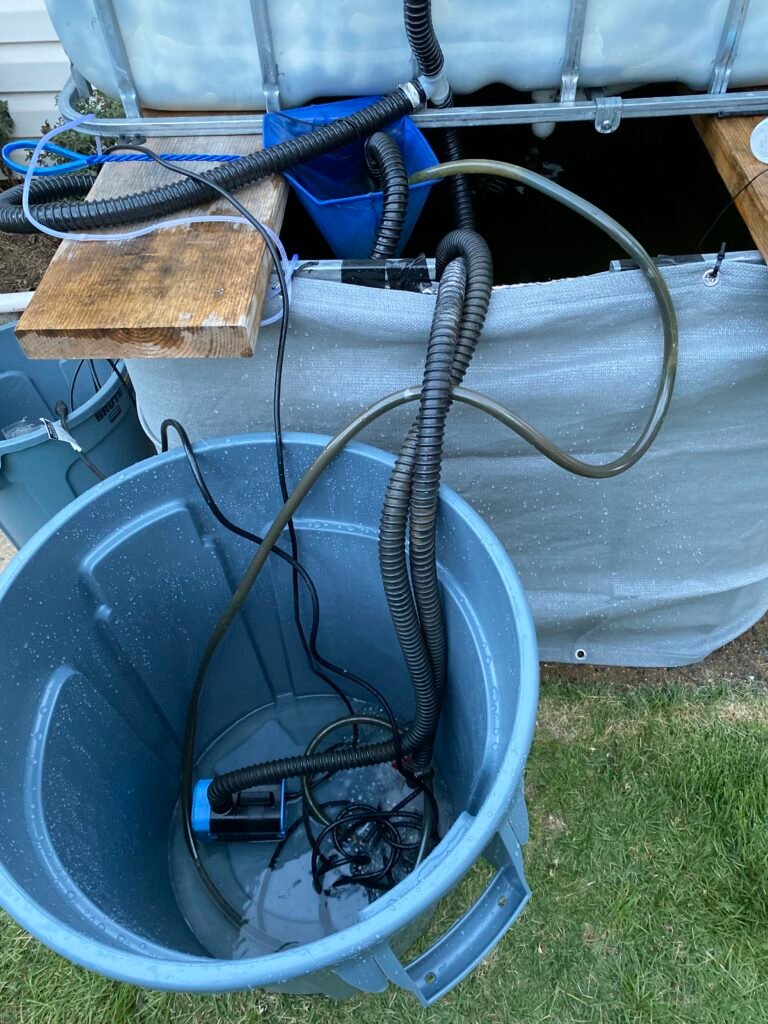
One of the most useful pieces of equipment in my system was a 55-gallon trash can used as a water-conditioning barrel. It was not pretty, but it allowed replacement water to be treated, checked, and temperature-adjusted before it entered the fish system.
My main water volume was roughly 150 to 200 gallons, so a 55-gallon barrel was useful for partial water changes and larger top-offs.
The routine was simple:
- Fill the barrel with source water.
- Add the correct water conditioner.
- Circulate or aerate the water.
- Check pH and temperature.
- Warm the replacement water in winter when necessary.
- Pump old system water into the garden or another appropriate location.
- Pump the conditioned water into the aquaponics system.
This kept untreated tap water out of the fish-holding water and made the process repeatable. Buckets work, but they get old before the first season does.
A small transfer pump also doubles as emergency equipment when the main circulation pump fails.
Neither type will usually drain a flat-bottomed barrel completely because inexpensive submersible pumps leave a shallow layer of water behind. For conditioning and transfer work, that is normally acceptable.
Temperature Still Matters During Water Changes
Water quality is not only chemistry. A large addition of replacement water can shock fish when the temperature differs sharply from the system water.
In winter, I warmed conditioned replacement water before transferring it. The goal was not laboratory precision. It was avoiding a sudden cold-water hit to a living fish system.
For cold-weather planning, see how to heat aquaponics water in winter.
Testing After a Fish Dies
One dead fish does not always mean the entire system is failing. It can become a system problem if the fish remains hidden and decomposes, or if the death was caused by water quality.
After a fish death:
- Remove the fish immediately.
- Test ammonia, nitrite, pH, and temperature.
- Watch the remaining fish for gasping, flashing, isolation, loss of appetite, or unusual swimming.
- Check whether the pump and air stones are operating normally.
- Look for uneaten food, dead roots, clogged plumbing, or contamination.
- Repeat testing over the next several days.
This is where water testing earns its keep. It separates an isolated loss from the beginning of a system-wide crash.
Algae Is a Water-Quality Signal
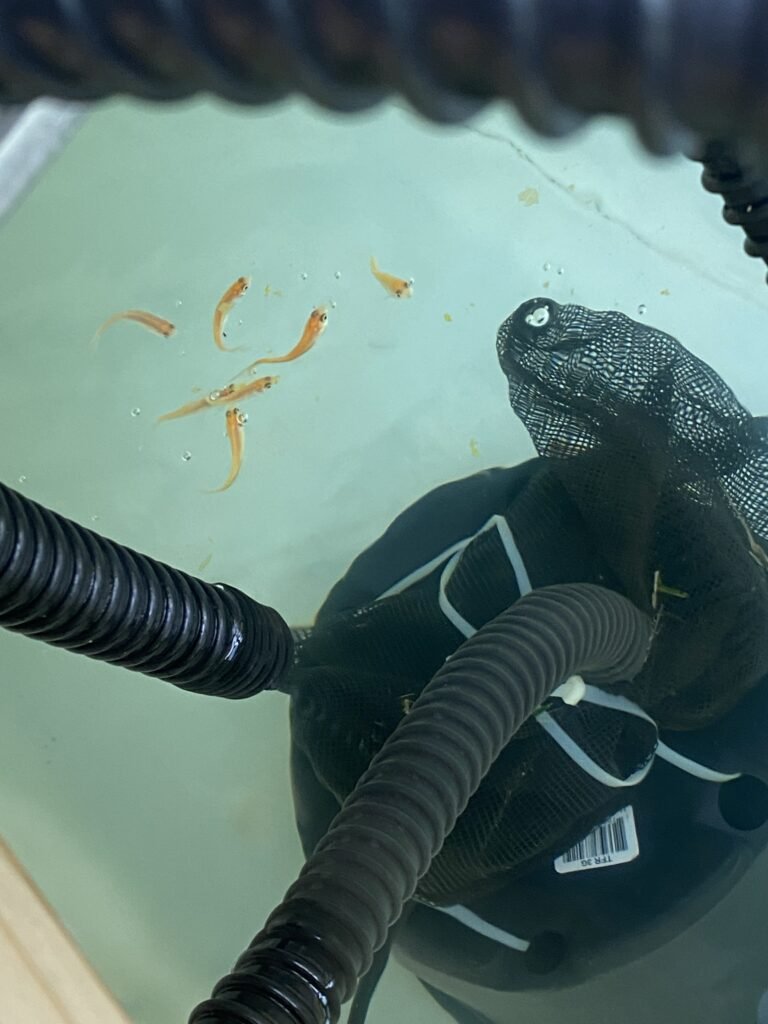
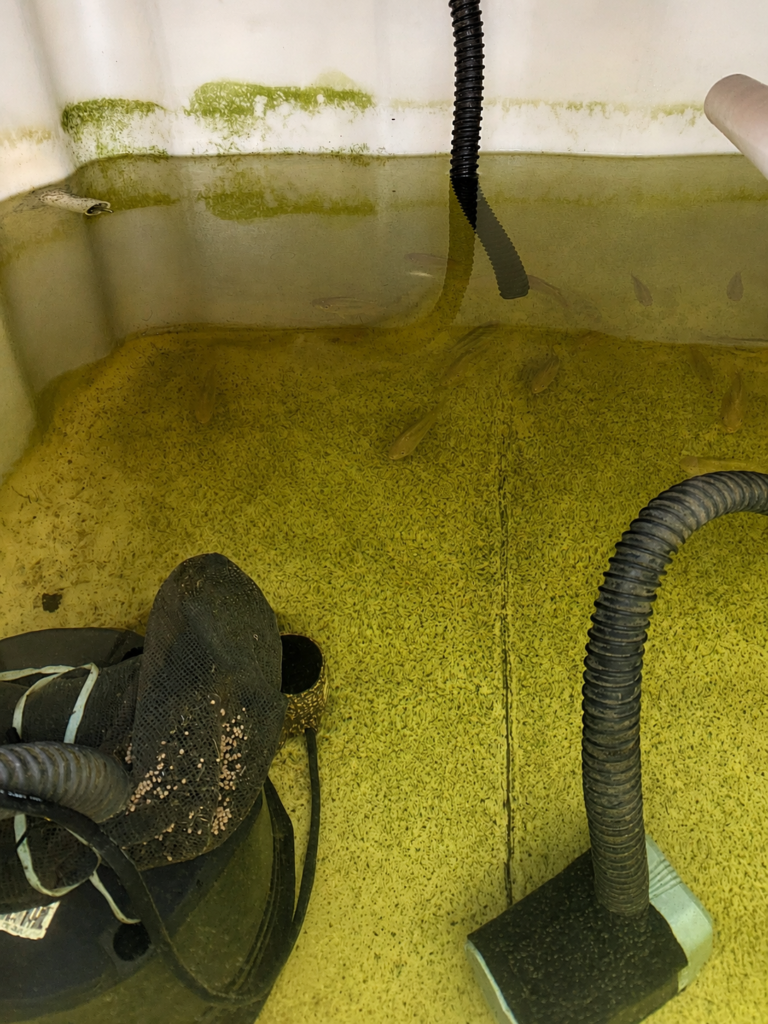
Some algae or green tint can be part of a mature outdoor or greenhouse system. Green water does not automatically mean the fish are in immediate danger, and crystal-clear water does not automatically mean everything is healthy.
Heavy algae growth often points to sunlight reaching the water, excess nutrients, weak plant uptake, or inadequate filtration. It may become more noticeable after a large harvest because fewer plants remain to use nitrate and other nutrients.
Algae also affects oxygen. It can produce oxygen during daylight and consume it after dark, which makes warm nights and early mornings higher-risk periods.
See how to prevent algae growth in aquaponics systems for the practical causes and corrections.
Water Clarity Is Not Water Quality
Clear water can contain dangerous ammonia or nitrite. Cloudy water may come from suspended solids, algae, a bacterial bloom, dusty grow media, or disturbed sediment.
Use appearance as a reason to investigate, not as the final diagnosis. Test the chemistry, inspect filtration, verify circulation, and check the fish.
A UV clarifier may help with free-floating algae and green water, but it does not replace water testing, shade, mechanical filtration, biological filtration, or adequate plant uptake. See using UV filters in aquaponics systems and how to keep aquaponics water clear.
Oxygen Problems Can Look Like Water-Chemistry Problems
Low oxygen can make fish sluggish, reduce feeding, weaken biological filtration, and increase stress. Warm water, heavy fish loads, algae, solids accumulation, pump failure, and power outages all increase the risk.
In my system, two air stones provided normal aeration, and a small solar-backed pond aerator provided some protection during short summer outages. It was not enough to replace the main setup, but small backup airflow was much better than none.
See aeration in aquaponics systems and backup power for aquaponics systems for equipment sizing and outage planning.
Solids Affect Water Quality Too
Fish waste does not disappear. Some is converted biologically, some is captured in grow beds, and some must be removed through settling, screens, brushes, or other mechanical filtration.
Accumulated solids increase oxygen demand, create odor, clog media, and make water chemistry harder to stabilize. Testing may reveal ammonia or nitrite stress, but the test kit will not remove the sludge causing it.
See aquaponics solids filtration basics for practical filter options.
Simple Weekly Testing Routine
- Test at roughly the same time of day.
- Rinse test tubes with system water before collecting samples.
- Measure pH, ammonia, nitrite, and nitrate.
- Check water temperature.
- Record the readings.
- Look at the fish before feeding.
- Inspect pump flow, aeration, filter condition, and grow-bed drainage.
- Compare the results with previous weeks rather than treating each result in isolation.
A notebook works. A spreadsheet works. A note on the wall works. The important part is keeping enough history to see whether the system is changing.
What I Would Buy First
- API Freshwater Master Test Kit
- Waterproof digital thermometer
- Seachem Prime Water Conditioner
- Small transfer pump
- A food-safe or clean 55-gallon conditioning container
That is not a glamorous shopping list. It is the kind of boring equipment that prevents avoidable fish losses and makes maintenance easier.
For pumps, testing equipment, aeration, heaters, filtration, and backup systems, see the Aquaponics Equipment Guide.
Frequently Asked Questions
What should I test in aquaponics water?
Test pH, ammonia, nitrite, nitrate, and water temperature. These readings cover the basic nitrogen cycle and the main environmental condition affecting fish and bacteria.
How often should I test aquaponics water?
Test daily while the system cycles or whenever there is a problem. A stable mature system can usually be tested weekly, with more frequent checks after adding fish, changing water, harvesting plants, or experiencing equipment failure.
What should ammonia and nitrite be?
Both should remain near zero in a mature system. Any confirmed rise means the biological filter is not processing waste as quickly as it is being produced.
Is nitrate bad in aquaponics?
Nitrate is expected and is an important plant nutrient. The concern is a persistent upward trend showing that fish waste production exceeds plant uptake and water replacement.
Are test strips accurate enough?
Test strips are useful for quick checks, but many do not include ammonia and can be harder to read precisely. A liquid master test kit is usually a better primary tool.
Can I add tap water directly to aquaponics?
Not safely unless you know it contains no harmful chlorine or chloramine and the temperature and pH are compatible. Condition municipal water before adding a substantial amount to a stocked system.
Why is my water clear if ammonia is high?
Ammonia is dissolved and does not necessarily make water cloudy. Water appearance cannot replace chemical testing.
Should I change water when ammonia rises?
A partial water change may be necessary when fish are at risk, but it should be combined with reducing feed, checking aeration and circulation, removing waste, and correcting the cause. Replacement water must be conditioned and reasonably close in temperature.
Final Takeaway
Aquaponics water testing is not about obsessing over perfect numbers. It is about seeing the system drift before the drift becomes dead fish, damaged plants, or a stalled biological filter.
Test more often when the system is new. Test after equipment failures, fish deaths, major harvests, water changes, heat waves, and anything else that changes the biological load. Record the results, watch the trends, and confirm strange readings before making aggressive corrections.
Aquaponics is a small living machine. Water testing is how you keep that machine from quietly eating itself.
Keep the work realistic: See what a real aquaponics week takes for daily checks, testing, seasonal work, and emergency time.