
Aquaponics Troubleshooting: What to Check First
When an aquaponics system starts acting wrong, the most interesting explanation is usually not the best place to start.
Fish are at the surface, so maybe they are sick. Plants are yellow, so maybe they need iron. The grow bed is slow, so maybe the pump is dying. The water is green, so maybe it needs a chemical.
Maybe.
But aquaponics is a connected loop. One boring mechanical problem can show up as symptoms in the fish, plants and water at the same time.
Start with the fundamentals.
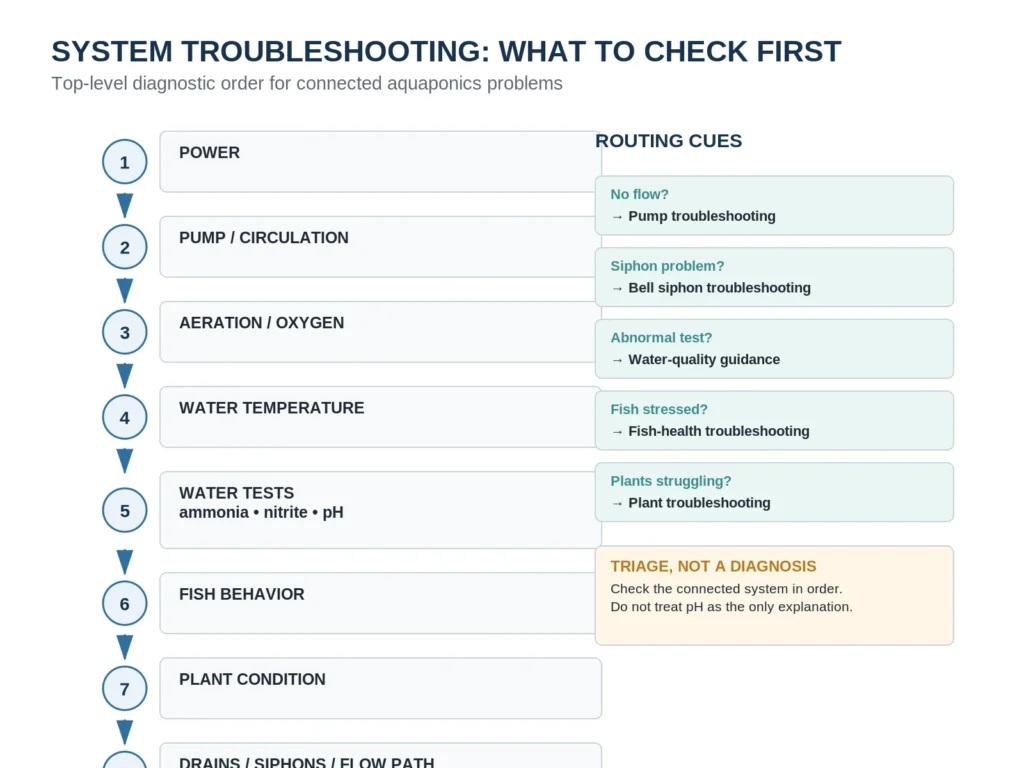
First: stop changing things long enough to observe
Before adding chemicals, replacing parts or treating fish, write down what is actually happening.
Record the water temperature, pH, ammonia, nitrite and nitrate if you track it. Check whether the pump and air pump are running. Look at normal flow points. Note whether fish are eating and whether anything changed recently.
The point is not paperwork for its own sake.
If you change five things at once and the system recovers, you have learned almost nothing about what caused the problem.
That lesson came up repeatedly in my IBC experiment. The bell siphon itself took about a day to tune. Once I had the pump flow and siphon working together, I left it alone. The system was much easier to understand when I changed one variable at a time.
1. Power
Start with the embarrassingly obvious.
Is the pump powered? Is the air pump powered? Did a GFCI trip? Did a timer or controller fail? Is a plug loose?
If circulation or aeration has stopped, restore oxygen and water movement as quickly and safely as possible.
Do not work on energized electrical equipment around water.
For outage planning, see Backup Power for Aquaponics Systems.
2. Aeration
Fish at the surface or breathing unusually fast can be consistent with low oxygen, although those signs are not specific enough to diagnose oxygen by themselves.
Check the mechanical system.
Is the air pump running? Are bubbles actually reaching the tank? Is an airline disconnected or kinked? Are air stones blocked? Is water agitation weaker than normal?
Warmer water also holds less dissolved oxygen, while fish, roots and nitrifying bacteria all need oxygen.
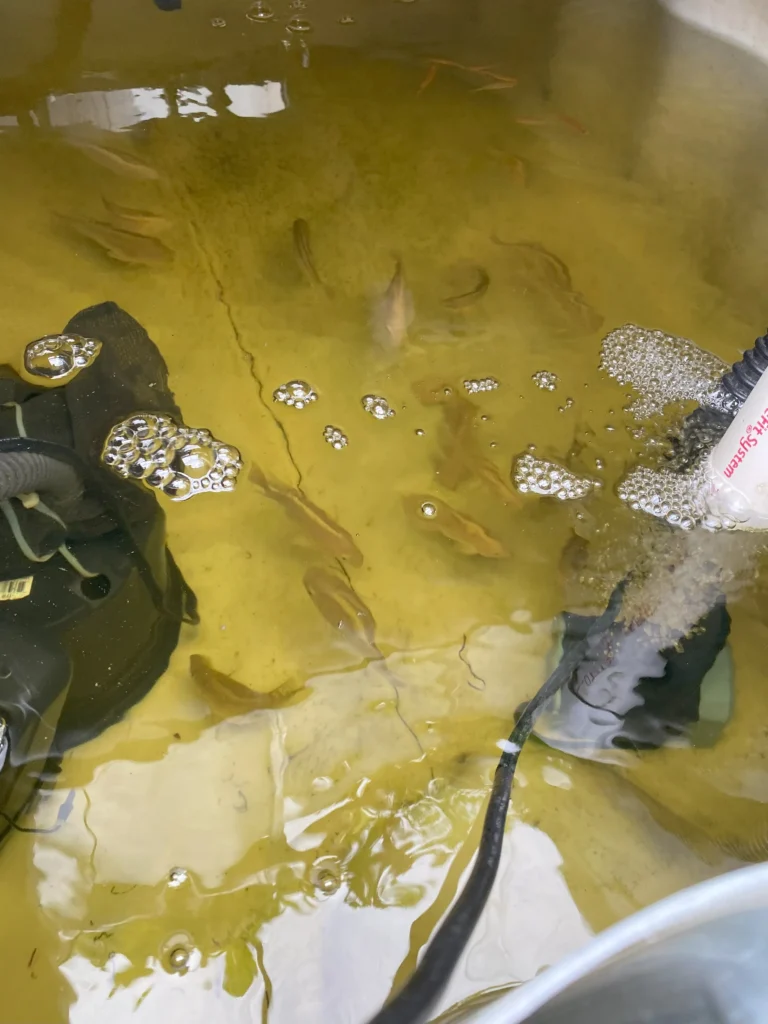
See Aeration in Aquaponics Systems for the equipment side.
3. Flow and circulation
A pump making noise is not proof that the system has normal flow.
Look at the water.
Check the pump intake, hoses, valves, drains and return points. Look for roots, debris, kinked hose, moved valves and unusual tank or sump levels.
My pump had a mesh bag around the intake. That helped keep fish away from it, but it also meant the screen itself could become a maintenance point. The pump clogged badly once; I took it apart, reassembled it and it worked again.
If flow is weak or absent, go to Aquaponics Pump Problems and Troubleshooting.
If the grow bed will not start or stop draining normally, go to Bell Siphon Troubleshooting.
4. Water temperature
Temperature can change fish appetite, oxygen availability, bacterial activity and the toxicity of ammonia.
Compare the current reading with both the fish species’ appropriate range and the system’s recent normal.
The AQP IBC system showed how quickly an environmental event can become a whole-system event. During a severe Northern Virginia cold snap, the greenhouse failed and the tank temperature briefly fell into the 40s despite heaters. A tarp and restored enclosure helped get the system back toward its previous operating range.
That was a weather emergency, not a universal temperature recommendation.
The useful lesson is to ask whether the environment changed before blaming the fish.
5. Ammonia and nitrite
If fish are stressed, test ammonia and nitrite early.
Ammonia enters the system from fish metabolism, waste, uneaten feed and decomposing organic material. Nitrifying bacteria convert ammonia to nitrite and then nitrate.
If the biological processing cannot keep up with the load, ammonia or nitrite can appear.
Potential triggers include heavier feeding, increased fish biomass, reduced oxygen, reduced flow through biofiltration, a dead fish, accumulated organics or damage to the bacterial population.
Use Aquaponics Water Testing Basics for the measurement foundation.
6. pH and trend
A pH reading matters.
A pH trend is more useful.
Compare the number with recent readings taken under similar conditions. Consider source water, recent top-offs or water changes and any adjustment you made.
In my own system I tried to test on a consistent schedule, usually in the morning. If something looked wrong, I tested more frequently until it stabilized.
Do not use that as a claim that every system needs my exact schedule. The point is consistency: trends are easier to interpret when you measure in a comparable way.
7. Fish behavior
Watch the group before grabbing a net.
Are all fish affected or just one? Are they eating? Are they gathering near an inflow? Is breathing unusually fast? Is one fish isolated? Are there visible injuries or lesions?
Several fish changing behavior at once increases the importance of checking system-wide causes such as oxygen, temperature and water quality.
Visible signs do not identify a pathogen by themselves.
Rapid mortality, severe disease signs or an unclear health problem can justify qualified fish-health help rather than internet diagnosis.
8. Plant condition
Yellow leaves do not automatically mean “add iron.”
Poor plant growth can reflect nutrient availability, pH, temperature, root oxygen, light, restricted flow, pests, transplant stress or an immature system.
Look at whether the problem affects one crop, one part of the bed or everything at once.
The existing What Plants Grow Well in Aquaponics page helps with crop context.
9. Solids, roots and dead organic material
Inspect the places nobody looks at until something smells wrong or stops moving:
pump screens, drain guards, filter bottoms, plumbing low points, root masses and corners where solids collect.
Organic material can restrict flow and consume oxygen while decomposing.
10. Ask the best troubleshooting question: what changed?
New fish?
More feed?
A plant harvest?
A filter cleaning?
A pump replacement?
A plumbing adjustment?
A hot afternoon, cold night or power interruption?
The most recent change is not always the cause, but it gives you a useful starting hypothesis.
My normal system was boring. Problems were not.
Once the IBC system was stable, a normal daily look was only a few minutes: feed the fish, make sure things were pumping, dripping and bubbling, and glance at the system.
Weekend plant trimming and periodic water work took more time.
Then there were the days when things went sideways.
A clogged pump intake. Green water. Bell-siphon tuning. A greenhouse torn apart during a blizzard.
That difference is why this page starts with triage. You want to identify whether you are looking at a routine drift or a real failure before you start “fixing” things.
When to stop routine troubleshooting
Escalate rather than improvising around:
- rapid unexplained fish mortality;
- severe visible disease;
- suspected chemical contamination;
- damaged electrical equipment;
- major structural failure or leak risk.
A troubleshooting guide is not permission to work around an electrical hazard or guess at a fish disease.
Bottom line
Check power, aeration, flow, temperature and water quality before reaching for complicated explanations.
Observe first. Change one variable at a time. Route the problem to the right subsystem.
That is not glamorous troubleshooting.
It is the kind that actually tells you something.
Sources
- Oklahoma State University — Principles of Small-Scale Aquaponics: https://extension.okstate.edu/fact-sheets/principles-of-small-scale-aquaponics
- Oklahoma State University — Nitrification and Maintenance in Media Bed Aquaponics: https://extension.okstate.edu/fact-sheets/nitrification-and-maintenance-in-media-bed-aquaponics
- FAO — Small-scale aquaponic food production: https://www.fao.org/family-farming/detail/en/c/1743023/