
Bell Siphon Troubleshooting: Start, Stop and Drain Fixes
A bell siphon is beautifully simple after it works.
Before that, it can make you question every piece of PVC you own.
The fastest way to troubleshoot one is to stop asking “Why doesn’t my siphon work?” and identify which part of the cycle is failing.
A flood-and-drain bell siphon has four useful stages:
- the bed fills;
- the siphon starts;
- the bed drains;
- air enters, the siphon breaks and filling begins again.
- inflow rate;
- the air path at the bottom of the bell;
- media or roots around the bell;
- any breather/snorkel feature if the design uses one;
- downstream plumbing that may be sustaining strong suction.
- roots;
- biofilm and settled solids;
- media around the guard;
- valve positions;
- pump intake;
- water level;
- moved plumbing;
- a shifted bell.
- FAO — Small-scale aquaponic food production: https://www.fao.org/family-farming/detail/en/c/1743023/
- Oklahoma State University — Aquaponics: https://extension.okstate.edu/fact-sheets/aquaponics
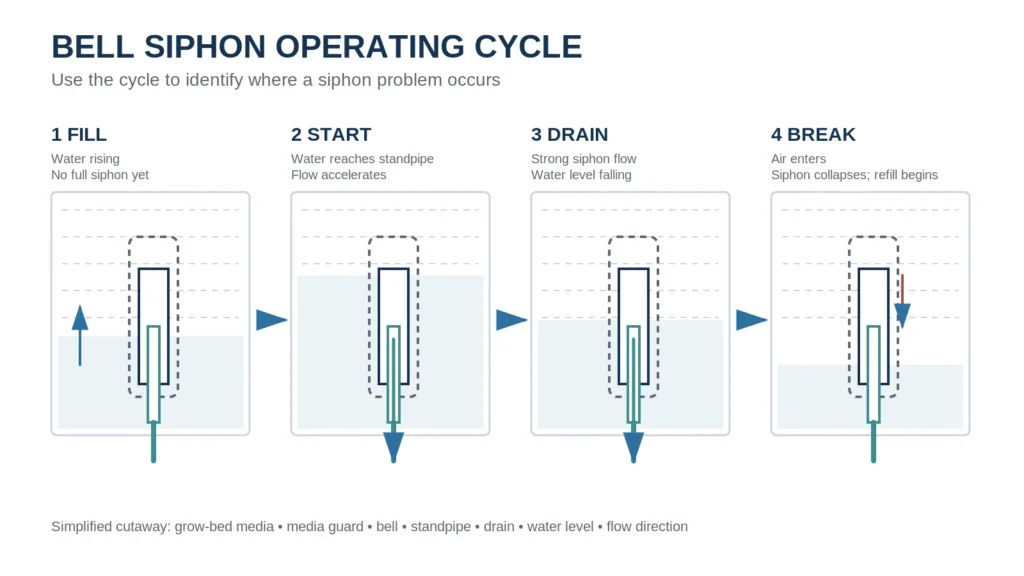
If you know which transition failed, you have a much smaller problem.
The bed fills, but the siphon will not start
If water reaches the standpipe and simply trickles away, the siphon is not establishing full flow.
Check whether enough water is actually entering the bed.
A pump can be running while a dirty intake, valve position, branch imbalance or plumbing restriction reduces the flow reaching the grow bed.
Then inspect the standpipe and drain for blockage and make sure the bell is positioned as intended.
Do not immediately cut the standpipe shorter or buy a larger pump.
Confirm the actual inflow first.
The siphon starts but will not stop
A siphon that establishes strongly but never breaks may be receiving enough inflow to keep sustaining the drain, or it may not be admitting air properly near the end of the cycle.
Check:
A small flow adjustment is a diagnostic test.
It is usually a better first move than cutting the siphon apart.
It drains too slowly
A slow drain is not automatically a bell problem.
The restriction may be downstream.
Inspect the standpipe, drain opening, elbows, horizontal runs, root intrusion, media guard and outlet.
A bell siphon cannot drain faster than the pipe after it allows.
If it starts hard and then drains poorly, follow the water past the bell.
It chatters or repeatedly starts and stops
Rapid partial starts often mean the system is operating near the boundary between enough flow to establish the siphon and enough flow to sustain it.
Possible causes include marginal inflow, a dirty pump intake, changing tank/sump level, a drain restriction or unexpected air entry.
Watch several full cycles.
If the problem changes as water level falls or the pump intake fouls, the siphon may be revealing a pump-flow problem.
Use Aquaponics Pump Problems and Troubleshooting for that side.
The grow bed does not drain low enough
A media bed can retain water below the effective drain level. That is not automatically a failure.
The question is whether the bed stops draining higher than it normally should.
Look for drain blockage, roots, media migration, a shifted bell or a change in the air path.
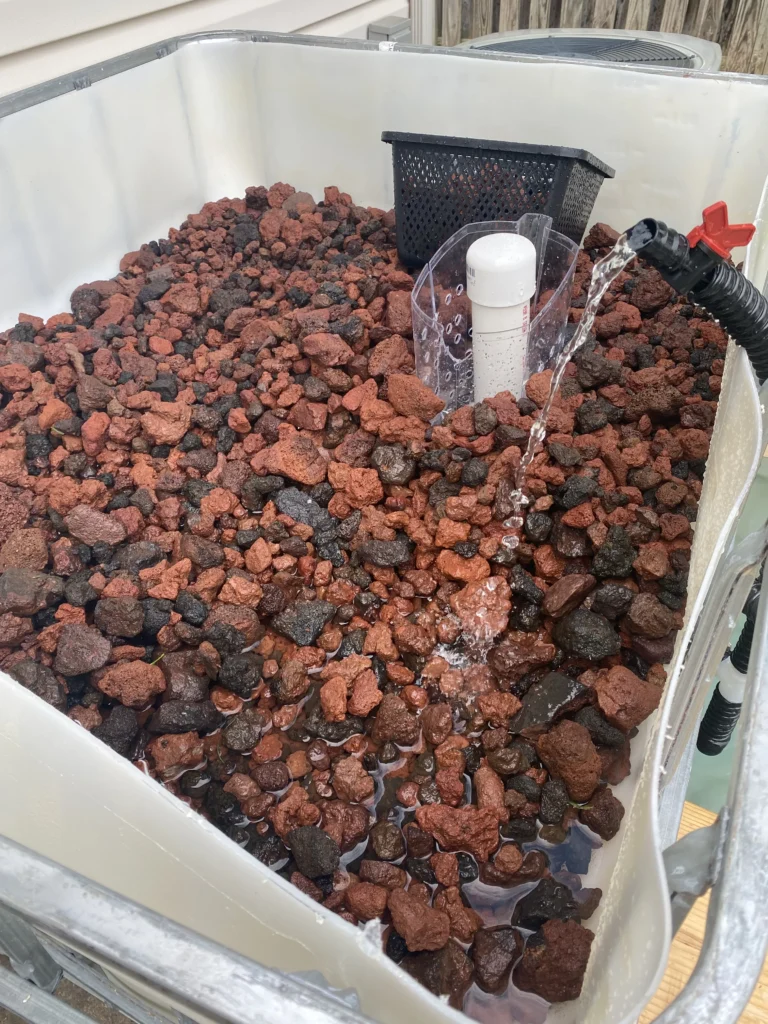
In my own grow bed, I could not see the exact remaining water depth through the tote wall, but after dismantling the system I found roughly the bottom inch was the wettest/sludgiest zone. That is an observation from one system, not a design rule.
It worked for months and suddenly became unreliable
When a previously stable siphon changes, maintenance deserves suspicion before redesign.
Check:
Once my siphon was finally tuned, I did not keep retuning it. I left it alone for the life of the system.
That is useful evidence: when stable geometry suddenly acts differently, ask what operating condition changed.
The part that took me a day
When I built the IBC system, I understood the bell-siphon principle before I built it.
Understanding the principle did not make the thing instantly cooperate.
I spent roughly a day trimming and tuning until the pump flow, water level and siphon behavior matched.
The first pump was too slow, filling the bed in roughly 35–40 minutes. The replacement could fill it in roughly 2–3 minutes wide open, which was too aggressive. With valves controlling the operating flow, I ended up around a 9–10 minute fill and roughly a one-minute drain.
Those numbers are not targets.
They are the numbers from one IBC system and one pump/siphon combination.
The lesson is that a bell siphon is part of a flow system. Pump rate, bed volume, standpipe, bell and downstream drain all have to cooperate.
Slow inflow and excessive inflow can fail differently
This was the useful tuning insight from my system.
When inflow was too low, water could pass over the standpipe without establishing the strong siphon I wanted.
At the other extreme, high inflow could keep the siphon sustained rather than allowing it to break cleanly.
The workable range was between those extremes.
Do not generalize my valve position or fill time. Generalize the diagnostic idea: inflow and drain behavior have to be balanced.
Change one thing at a time
Do not simultaneously change the pump valve, standpipe height, bell, breather and drain.
You will have no idea which change helped.
Make one adjustment. Watch several complete cycles. Write down what changed.
That approach is slower for ten minutes and much faster over an afternoon.
Do you need a bell siphon at all?
Bell siphons are associated with flood-and-drain media beds.
Constant-flood media beds, deep-water culture and NFT systems manage water differently.
If you are trying to force a bell siphon into a design that does not need one, the problem may be the design choice rather than the siphon.
For the basic mechanism, read How a Bell Siphon Works in Aquaponics Systems.
Bottom line
Identify the failed stage:
fill → start → drain → break
Then check flow, air entry, restrictions and anything that changed since the siphon last worked normally.
Do not redesign a previously stable siphon until you have ruled out maintenance and pump-flow changes.