
The best plants for aquaponics are crops that match the system’s fish load, available nutrients, water temperature, lighting, growing method, and maturity. Lettuce and many herbs are dependable choices for new systems. Peppers, tomatoes, cucumbers, strawberries, and other fruiting crops can also perform well, but they demand more light, root space, support, and nutrient management.
Plant selection is not only about what can survive with its roots in aquaponics water. A useful crop must grow productively without overwhelming the filtration, shading neighboring plants, clogging drains, or demanding more nutrients than the fish and bacteria can supply.
For most backyard systems, the safest starting strategy is to establish leafy greens and herbs first. Add fruiting plants gradually after ammonia and nitrite remain near zero, nitrate is available, and the system has proven that it can maintain stable water flow and plant growth.
Quick answer: Lettuce, basil, chives, parsley, mint, kale, Swiss chard, watercress, bok choy, peppers, tomatoes, cucumbers, strawberries, and several edible flowers can grow well in aquaponics. Leafy greens and herbs are easiest. Fruiting crops require a mature, well-lit, nutrient-rich system.
Important Food-Safety Warning About Root Vegetables
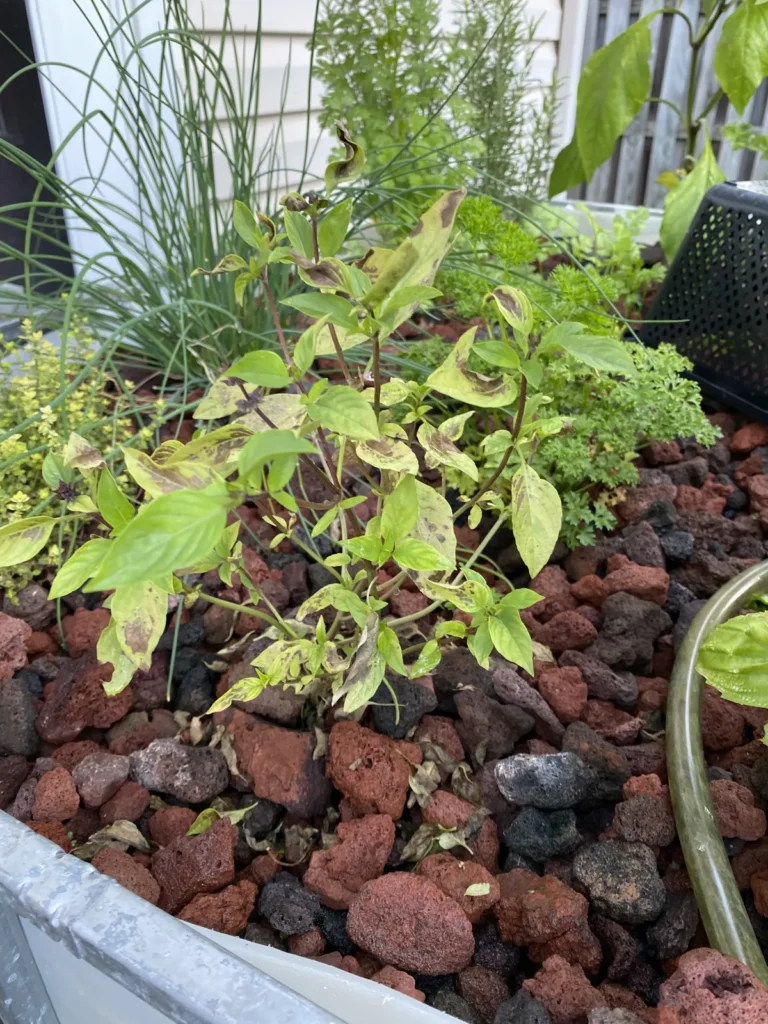
From my system: Field note: regular basil and hot peppers were the standouts in my system. Rosemary performed poorly in the hot, humid enclosure, Thai basil was mediocre, and chives were acceptable. The point is not that those results are universal; crop choice has to match heat, humidity, light, and system maturity.
Root vegetables require a different food-safety decision from tomatoes, peppers, cucumbers, herbs, berries, and other crops whose edible portions develop above the water and grow media.
In a coupled aquaponics system, plant roots remain in recirculating water derived from the fish-holding system. That water contains dissolved fish waste and may also carry suspended organic material and microorganisms introduced by fish, feed, animals, people, tools, source water, or dirty equipment.
A carrot, radish, beet, turnip, potato, or similar crop develops its edible portion inside the wet root zone. That creates more direct and continuous contact between the harvested food and the system water than occurs with an aboveground pepper or tomato.
That does not mean every aquaponic root vegetable is automatically contaminated or unsafe. Aquaponics water is not the same thing as untreated sewage. It does mean that raw-eaten root crops deserve additional caution because washing may not correct every possible contamination pathway.
Practical recommendation: For a normal backyard coupled system, prioritize aboveground vegetables, fruits, herbs, and flowers. Grow carrots, radishes, beets, potatoes, and similar edible roots in a separate soil, wicking, or decoupled growing bed unless you have a deliberate produce-safety plan and understand the added risk.
Aboveground produce still requires safe handling. Splashes, dirty hands, tools, insects, birds, rodents, pets, manure, contaminated supplements, and harvest containers can transfer microorganisms to leaves and fruit. Keep fish water off edible surfaces whenever practical and wash harvested produce under clean running water before use.
Leafy greens and herbs are not risk-free merely because they grow above the root zone. Lettuce, basil, parsley, and similar crops are commonly eaten raw, so sanitation, clean inputs, pest exclusion, and careful harvesting remain important.
Best Aquaponics Plants at a Glance
| Plant Group | Difficulty | Nutrient Demand | Best System Stage | Main Concern |
|---|---|---|---|---|
| Leafy greens | Easy | Low to moderate | New or mature | Heat, bolting, root oxygen |
| Culinary herbs | Easy to moderate | Low to moderate | New or mature | Spreading roots and flowering |
| Peppers | Moderate | Moderate to high | Mature | Light, pollination, potassium and calcium |
| Tomatoes | Moderate to advanced | High | Mature | Root mass, support, nutrient demand |
| Cucumbers | Moderate | High | Mature | Trellising, mildew, water use |
| Strawberries | Moderate | Moderate | Stable system | Crown moisture and pollination |
| Melons and squash | Advanced | High | Large mature system | Space, weight, pollination |
| Flowers | Easy to moderate | Varies | New or mature | Food-safe pest control |
| Root vegetables | Variable | Low to moderate | Specialized beds | Food contact, media shape, harvesting |
Why Leafy Greens Are the Best Starting Crops
Leafy greens are usually the easiest aquaponics plants because they grow quickly, use nitrogen efficiently, and do not need to produce flowers or fruit before harvest.
They are useful during system startup because their moderate nutrient demand matches the limited fish waste available while the fish and biological filter are still developing.
Good choices include:
- Leaf lettuce
- Romaine lettuce
- Butterhead lettuce
- Kale
- Swiss chard
- Bok choy
- Pak choi
- Mustard greens
- Arugula
- Watercress
- Collard greens
- Some spinach varieties
Leafy crops also provide fast feedback. Poor color, slow growth, long weak stems, burned leaf edges, or damaged roots can reveal problems with light, temperature, pH, water flow, or nutrient availability before a slower fruiting crop would show a useful result.
Lettuce
Lettuce is one of the most dependable aquaponics crops. It grows quickly, requires modest nutrients, and fits media beds, deep-water culture, floating rafts, and some nutrient-film systems.
It performs best in cool to moderate conditions. High heat can cause lettuce to bolt, become bitter, develop loose heads, or suffer tip burn.
Good airflow is important in dense plantings. Crowded leaves trap moisture and increase the risk of disease and decay.
Harvest individual outer leaves for an extended harvest or cut the entire head when it reaches useful size. Replant promptly so the system maintains steady nutrient uptake.
Kale, Swiss Chard, and Asian Greens
Kale and Swiss chard tolerate repeated harvesting and can remain productive longer than a single head of lettuce. They develop larger roots and can shade shorter crops, so spacing matters.
Bok choy, pak choi, and mustard greens grow quickly under suitable temperatures. They can bolt during heat or after sudden temperature changes.
Remove damaged outer leaves before they fall into the water or grow media. Dead plant material adds unnecessary solids and oxygen demand.
Spinach Can Be More Difficult Than It Looks
Spinach is often included on lists of easy aquaponics crops, but it prefers cooler conditions and can germinate poorly in warm environments. Mature plants may bolt quickly as temperatures rise.
Start spinach during cooler weather, use fresh seed, and avoid placing it beside large warm-season plants that block airflow.
Best Herbs for Aquaponics
Culinary herbs are productive, valuable, and well suited to frequent harvesting. Many can thrive with moderate nutrients and limited growing space.
| Herb | Difficulty | Preferred Conditions | Main Concern |
|---|---|---|---|
| Basil | Easy | Warm conditions and strong light | Cold damage and flowering |
| Mint | Easy | Moderate light and steady moisture | Aggressive roots |
| Parsley | Moderate | Cool to moderate conditions | Slow germination |
| Chives | Easy | Moderate light | Dense clumps |
| Oregano | Moderate | Strong light and airflow | Wet crowns |
| Thyme | Moderate | Bright light and aerated roots | Root and crown rot |
| Cilantro | Moderate | Cooler conditions | Bolting in heat |
| Dill | Moderate | Good light and root space | Height and early flowering |
Basil is the easiest general-purpose herb for warm aquaponics systems. Mint is equally willing to grow, but it requires containment because roots can spread through media and plumbing.
For detailed crop guidance, see growing herbs and peppers in aquaponics systems.
Peppers
Bell peppers, jalapeños, cayenne peppers, banana peppers, and compact hot-pepper varieties can produce well in a mature aquaponics system.
Peppers need more than nitrate. Strong production depends on adequate light, warmth, pollination, root oxygen, potassium, calcium, magnesium, iron, and stable water conditions.
Common pepper problems include:
- Flower drop during heat or cold
- Poor fruit set from inadequate pollination
- Long weak growth under insufficient light
- Yellow new leaves from iron availability problems
- Blossom-end rot associated with calcium transport problems
- Branches breaking under fruit weight
- Roots interfering with drains and siphons
Install stakes, cages, or overhead support before the plants become heavy. Leave enough room around each plant for airflow, pruning, harvesting, and inspection.
Tomatoes
Tomatoes can be highly productive in aquaponics, but they are not a good first crop for a small or immature system.
A mature tomato plant develops a large root system, consumes substantial water and nutrients, shades neighboring crops, and requires strong structural support.
Tomatoes need:
- Strong direct sunlight or properly sized grow lighting
- A mature nutrient-producing system
- Reliable potassium and calcium availability
- Stable root-zone oxygen
- Substantial trellis support
- Regular pruning
- Good airflow
- Pollination assistance in enclosed greenhouses
- Enough space that roots do not block drains
Indeterminate tomatoes continue growing and producing over a long season but can take over a greenhouse. Determinate or compact varieties are easier to manage where height and bed space are limited.
Cucumbers
Cucumbers grow quickly when they receive strong light, warmth, water, and nutrients. They can produce heavily from a relatively small bed footprint when trained vertically.
The plant itself may be easy to grow, but the vines need support and regular management. Dense foliage traps humidity and increases the risk of powdery mildew and other leaf problems.
Greenhouse cucumbers may require hand pollination unless a self-fertile or parthenocarpic variety is used.
Harvest fruit regularly. Oversized cucumbers draw energy from new production and can become heavy enough to damage unsupported vines.
Strawberries
Strawberries can grow in aquaponics towers, channels, media beds, and other systems that keep the plant crown above the normal water level.
They need good light, airflow, pollination, and careful moisture control. A crown that remains constantly wet may rot.
Keep developing fruit away from wet grow media and dirty surfaces. Remove damaged fruit promptly because decaying berries attract insects and mold.
Strawberries may require closer nutrient management than lettuce or basil, particularly for potassium, calcium, iron, and fruit development.
Beans and Peas
Beans and peas can grow in aquaponics, especially when seasonal temperatures suit the crop. Bush varieties require less support, while pole beans and climbing peas use vertical space efficiently.
They are not always the best use of a nutrient-rich grow bed because legumes can obtain nitrogen through relationships with root bacteria under suitable conditions. They still require other nutrients, light, root space, and support.
Peas prefer cooler conditions. Beans generally prefer warmer conditions. Select varieties according to the season rather than trying to grow both under the same greenhouse temperature year-round.
Squash, Zucchini, Pumpkins, and Melons
Large vining crops can grow in aquaponics, but they need a large mature system and substantial physical space.
These plants create several practical problems:
- Large leaves shade other crops.
- Vines spread into walkways and equipment.
- Heavy fruit requires support.
- Roots occupy substantial grow-bed volume.
- Nutrient demand can exceed a small fish load.
- Pollination may require manual assistance.
- Powdery mildew can spread through dense greenhouse foliage.
Compact zucchini or small-fruited melon varieties are easier to manage than large pumpkins and sprawling winter squash.
Support hanging melons with slings. The vine may hold a young fruit without complaint and then resign from the job shortly before harvest.
Eggplant
Eggplant has requirements similar to peppers. It prefers warmth, strong light, root space, and a mature system with reliable nutrient availability.
Plants become large and may require support. Fruit set can decline during temperature extremes or weak pollination.
Eggplant leaves are also attractive to aphids, mites, and other pests, so inspect the undersides regularly.
Celery and Water-Loving Crops
Celery, watercress, and several moisture-loving crops can perform well because aquaponics provides steady access to water.
Celery needs a long season and consistent nutrients. Watercress grows rapidly but may spread through channels, drains, and low-flow areas if it is not contained.
Do not assume a plant that likes moisture will tolerate stagnant, oxygen-poor water. Roots still require oxygen and dependable circulation.
Flowers in Aquaponics
Flowers can add color, attract pollinators, provide cut blooms, and support biological pest management around a greenhouse or outdoor system.
Possible choices include:
- Marigolds
- Nasturtiums
- Calendula
- Petunias
- Violas
- Pansies
- Zinnias
- Snapdragons
- Compact sunflowers
- Other small annual flowers
Edible flowers should be treated as food crops. Use correct plant identification and avoid pesticides or ornamentals treated with products not intended for edible production.
Flowers can attract beneficial insects, but they do not guarantee pest control. Inspect the entire plant area and keep diseased or heavily infested plants away from the shared water.
Plants That Need Extra Caution
| Plant | Main Concern | Better Approach |
|---|---|---|
| Mint | Aggressive roots block drains | Use a removable basket or isolated bed |
| Bamboo | Invasive roots and excessive size | Keep outside the aquaponics system |
| Large pumpkins | Space, weight, and nutrient demand | Use compact squash varieties |
| Sweet corn | Height, support, pollination, low value per bed area | Grow in soil unless space is abundant |
| Potatoes | Edible tubers in wet fish-water media | Use a separate soil or decoupled bed |
| Carrots and radishes | Food contact and misshapen roots in coarse media | Use a dedicated fine-media or soil bed |
| Woody shrubs | Permanent roots and difficult removal | Keep in separate containers |
| Toxic ornamentals | Food-safety and handling risks | Avoid in edible production beds |
Can Root Vegetables Physically Grow in Aquaponics?
Some root and tuber crops can physically grow in aquaponics, but the crop may not develop normally in coarse lava rock, gravel, or expanded clay.
Carrots and radishes may become forked, short, twisted, or damaged as they push through large irregular media. Potatoes need enough protected volume for tubers to expand without constant light exposure.
Harvesting also disturbs the grow bed. Pulling a mature root crop can move large amounts of media, damage neighboring roots, and release accumulated solids into the water.
A separate wicking bed, sand-based design, clean soil container, or decoupled hydroponic bed usually provides better physical conditions and a clearer food-safety boundary.
Match Crops to System Maturity
A new aquaponics system has limited fish biomass, limited feeding, and a developing bacterial population. It may not support several mature tomatoes, peppers, and cucumbers immediately.
| System Stage | Best Crop Types | What to Avoid Initially |
|---|---|---|
| Cycling or newly stocked | Small lettuce, basil, chives, light plantings | Heavy fruiting crops and dense planting |
| Stable young system | Leafy greens, herbs, kale, chard | Several large tomatoes at once |
| Mature moderate-load system | Mixed greens, herbs, peppers, strawberries | More fruiting plants than light and nutrients support |
| Large mature high-load system | Tomatoes, cucumbers, eggplant, melons, mixed crops | Uncontrolled planting that blocks maintenance access |
Plant demand should rise as fish and bacterial capacity rise. Starting with several heavy-feeding crops can produce pale plants even when the water chemistry is safe for fish.
Match Plants to Fish Load
The fish load and feeding rate determine how much nutrient enters the system. The plant area determines how quickly those nutrients are removed.
Too few plants may lead to:
- Rising nitrate
- Increased algae pressure
- Unused growing capacity
- More frequent water replacement
Too many demanding plants may lead to:
- Pale growth
- Slow production
- Nutrient deficiencies
- Weak flowering and fruit set
- Pressure to overfeed the fish
- Unnecessary supplementation
Do not overstock or overfeed fish solely to correct weak plant growth. Check light, pH, temperature, roots, iron, potassium, and other likely limitations first.
Water Quality for Aquaponics Plants
Plants depend on stable water chemistry as much as the fish and bacteria do.
Monitor:
- pH
- Ammonia
- Nitrite
- Nitrate
- Water temperature
- Root color and odor
- Fish feeding
- Plant growth and leaf color
Ammonia and nitrite should remain near zero in a mature system. A suitable pH must balance fish health, bacterial activity, and plant nutrient availability.
Use aquaponics water testing basics to establish a practical testing schedule.
Light Determines What the System Can Produce
Aquaponics water can contain plenty of nitrate while plants remain weak because they do not receive enough light.
Leafy greens tolerate less light than peppers, tomatoes, cucumbers, eggplant, and melons. Fruiting crops need enough energy to support flowers and fruit after producing roots, stems, and leaves.
Signs of inadequate light include:
- Long weak stems
- Large spaces between leaves
- Pale growth
- Plants leaning toward windows
- Slow flowering
- Flower drop
- Small fruit
- Low production
Greenhouse plastic, dirt, condensation, framing, shade cloth, nearby trees, and winter sun angle all reduce usable light.
Affiliate disclosure: This page contains affiliate links. As an Amazon Associate I earn from qualifying purchases.
View full-spectrum LED grow lights on Amazon.
Temperature Controls Crop Selection
Cool-season greens and warm-season fruiting plants should not be expected to perform equally under the same conditions.
| Cooler Conditions | Moderate Conditions | Warmer Conditions |
|---|---|---|
| Lettuce | Swiss chard | Basil |
| Spinach | Parsley | Peppers |
| Peas | Kale | Tomatoes |
| Cilantro | Chives | Cucumbers |
| Bok choy | Strawberries | Eggplant |
Water temperature, air temperature, and root-zone temperature can differ. Measure the water directly and monitor the plant canopy separately.
See how to heat aquaponics water in winter for insulation, heater sizing, and seasonal planning.
Choose the Right Growing Method
| Growing Method | Best Crops | Main Limitation |
|---|---|---|
| Media beds | Herbs, greens, peppers, tomatoes, eggplant | Weight, solids, roots blocking drains |
| Deep-water culture | Lettuce, basil, leafy greens | Needs good solids removal and aeration |
| Nutrient-film channels | Small herbs and greens | Narrow channels clog and dry quickly |
| Vertical towers | Herbs, strawberries, small greens | Uneven water distribution and cleaning |
| Wicking or decoupled beds | Root crops and larger soil-style plants | Additional plumbing and management |
The plant should fit the growing method. A mature tomato root system belongs in a large media bed or dedicated container, not a narrow channel intended for lettuce.
Grow Media Matters
Expanded clay, natural lava rock, and tested inert gravel can support many aquaponics plants.
The media should:
- Remain stable in water
- Allow reliable drainage
- Support roots and mature plants
- Provide bacterial surface area
- Remain free from dyes and coatings
- Be large enough to maintain flow
- Be accessible for planting and maintenance
Coarse media is well suited to peppers and other large rooted plants but produces poor shapes in carrots and similar crops.
Read aquaponics grow bed media basics before selecting or filling a bed.
Flood-and-Drain Beds
Flood-and-drain media beds work with many herbs and fruiting crops. The bed fills with nutrient-rich water and drains, drawing air back into the media.
The upper media surface should normally remain dry. Constant surface moisture encourages algae, insects, stem rot, and evaporation.
Bell siphons can produce automatic cycles but must remain accessible as plant roots grow. Mint, tomatoes, cucumbers, and peppers can wrap roots around media guards and standpipes.
See how a bell siphon works in aquaponics systems.
Nutrients Beyond Fish Waste
Fish feed supplies nitrogen and several other nutrients, but aquaponics systems may still become deficient in iron, potassium, calcium, magnesium, phosphorus, or other elements.
Fruiting plants expose these shortages more readily than lettuce and herbs.
Do not diagnose a deficiency from one leaf photograph alone. Similar symptoms can come from:
- High or low pH
- Cold roots
- Poor oxygen
- Weak light
- Root disease
- Excess salts
- Physical damage
- Several nutrient shortages at once
Use only supplements appropriate for fish systems and edible crop production. Anything added to the water becomes part of the environment shared by fish, bacteria, roots, and harvested food.
Food-Safe Inputs
Plant production begins with the materials entering the system.
Potential contamination sources include:
- Fish and transport water
- Fish feed
- Source water
- Seedlings and potting soil
- Dirty tools and harvest containers
- Pets, rodents, birds, insects, and wildlife
- Manure and compost
- Fish medications
- Pesticides and fungicides
- Water conditioners and nutrient supplements
- Paints, sealants, plumbing, and recycled containers
Food-production rule: Do not add a product to shared aquaponics water unless its intended use is compatible with the fish, biological filter, and edible crops in the system.
Safe Harvesting Practices
- Wash hands before harvesting.
- Use clean scissors or pruners.
- Keep harvest containers off greenhouse floors.
- Prevent fish water from splashing edible leaves and fruit.
- Discard produce contaminated by rodents, birds, or animal droppings.
- Remove damaged and decaying plant material.
- Wash produce with clean running water.
- Keep harvested produce away from fish-processing areas.
- Clean reusable harvest containers after use.
- Refrigerate perishable produce promptly.
Do not wash harvested vegetables in the aquaponics system. Use clean water suitable for produce washing.
Pest Control Around Fish and Edible Plants
Common garden pesticides can harm fish and aquatic organisms. Even products marketed as organic may be unsuitable over shared aquaponics water.
Start with:
- Inspecting new plants before introduction
- Removing infested leaves
- Using insect screening
- Improving airflow
- Reducing overcrowding
- Using sticky cards away from fish and beneficial insects
- Applying physical barriers
- Using biological controls where appropriate
- Treating plants outside the system when practical
Never spray directly over open fish water, sumps, filters, grow media, or raft beds unless the product is explicitly suitable for that use.
Root Size and Maintenance Access
A plant can grow well and still be a bad fit for the system because its roots make maintenance impossible.
Large or spreading roots can:
- Enter standpipes
- Block bell siphons
- Restrict water channels
- Wrap around pump screens
- Trap solids
- Reduce flow through media
- Make the plant difficult to remove
Leave a clear maintenance area around drains, media guards, valves, and plumbing. Do not plant mint or a large tomato directly against the one component that must remain removable.
Plant Spacing
| Plant | Practical Starting Spacing | Notes |
|---|---|---|
| Leaf lettuce | 6 to 10 inches | Spacing depends on harvest size |
| Basil | 8 to 12 inches | Harvest regularly to encourage branching |
| Kale | 12 to 18 inches | Mature leaves shade smaller crops |
| Swiss chard | 10 to 16 inches | Harvest outer leaves |
| Mint | Isolated basket | Roots spread aggressively |
| Strawberry | 8 to 12 inches | Keep crown and fruit dry |
| Pepper | 18 to 24 inches | Needs support and airflow |
| Tomato | 24 inches or more | Variety and pruning method matter |
| Cucumber | 12 to 24 inches | Train vertically |
| Eggplant | 18 to 24 inches | Support mature plants |
Stagger Planting and Harvesting
Removing every mature plant at once causes an immediate drop in nutrient uptake while the fish continue producing waste.
Stagger planting so the system contains:
- New seedlings
- Developing plants
- Mature plants
- Crops ready for harvest
This produces steadier harvests and more consistent nutrient use.
After a large harvest, replant promptly and monitor nitrate and algae. See how to prevent algae growth in aquaponics systems.
A Practical First-Year Crop Plan
Startup and Cycling
- A small amount of lettuce
- Basil
- Chives
- Parsley
Keep planting light while the bacterial population and fish load develop.
After the System Stabilizes
- Additional leafy greens
- Kale or Swiss chard
- Contained mint
- Strawberries
- One or two compact pepper plants
After a Full Season of Stable Operation
- Tomatoes
- Cucumbers
- Eggplant
- More peppers
- Compact melons or squash
This progression allows the system to prove its water quality, nutrient output, lighting, and root-space capacity before large fruiting crops occupy the beds.
Common Plant-Selection Mistakes
Plant selection is only one part of a successful first system. Review the common aquaponics beginner mistakes guide before adding more crops or fish.
Starting With Only Heavy Fruiting Crops
A young system may not provide enough nutrients for several tomatoes, peppers, and cucumbers. Establish herbs and greens first.
Ignoring Available Light
High nitrate cannot compensate for weak light. Fruiting crops need substantially more light than lettuce.
Planting Aggressive Roots Near Drains
Mint, tomatoes, cucumbers, and other vigorous plants can block siphons and plumbing.
Overcrowding the Bed
Small seedlings become mature plants. Crowding reduces light and airflow while increasing pest and disease pressure.
Treating Every Yellow Leaf as a Fertilizer Shortage
Yellowing can come from pH, temperature, light, roots, oxygen, disease, or nutrient availability. Diagnose before adding products.
Growing Raw Root Crops Without Considering Water Contact
Edible roots remain in direct contact with the recirculating root zone. Use a separate bed when the food-safety boundary is uncertain.
Using Unsafe Pest Treatments
A product safe for a soil garden may be harmful to fish or unsuitable around edible aquaponics crops.
Troubleshooting Plant Problems
| Plant Symptom | Possible Causes | What to Check |
|---|---|---|
| Pale new leaves | Iron availability or high pH | pH, root health, iron source |
| Long weak stems | Insufficient light | Light intensity, fixture distance, shading |
| Brown leaf edges | Potassium issue, heat, salt, root damage | Temperature, source water, nutrient balance |
| Flowers dropping | Heat, cold, poor pollination, stress | Air temperature, humidity, lighting |
| Wilting with wet roots | Low root oxygen or disease | Aeration, drainage, root color and odor |
| Slow growth across all plants | Cold water, weak light, low feeding, immature system | Temperature, nitrate, fish load, light |
| Only fruiting plants struggle | High nutrient demand | Potassium, calcium, iron, light, maturity |
| Roots block water flow | Overgrown plants or poor access | Drains, media guards, channels |
What I Would Plant in a Backyard Aquaponics System
For a new backyard system, I would begin with lettuce, basil, chives, parsley, kale, and Swiss chard. Those crops provide useful harvests without demanding the nutrient output, support, and lighting required by a bed full of fruiting plants.
Once the system remained stable, I would add compact hot peppers, one or two bell peppers, strawberries, and a trellised cucumber.
I would wait until the system had completed a stable growing season before committing substantial space to tomatoes, eggplant, squash, or melons.
I would grow carrots, beets, radishes, potatoes, and other edible root crops in a separate soil, wicking, or decoupled bed. They can still benefit from carefully managed nutrients without remaining buried in the continuously recirculating fish-water root zone.
Useful Equipment for Aquaponics Plants
- Full-spectrum LED grow lights
- Greenhouse trellis netting
- Plant support clips and ties
- Pruning and harvesting shears
- Freshwater liquid test kit
- Waterproof temperature probe
- Greenhouse monitoring traps
For pumps, lighting, filtration, aeration, testing equipment, heaters, and other system components, see the Aquaponics Equipment Guide.
Frequently Asked Questions
What are the easiest plants to grow in aquaponics?
Lettuce, basil, chives, mint, kale, Swiss chard, bok choy, and watercress are among the easiest choices. They grow quickly and have lower nutrient demands than large fruiting plants.
Can tomatoes grow in aquaponics?
Yes. Tomatoes can be productive in a mature system with strong light, substantial root space, trellis support, good pollination, and adequate potassium, calcium, and iron availability.
Can peppers grow in aquaponics?
Yes. Bell peppers and hot peppers grow well under warm, bright, stable conditions. They require more nutrients and time than lettuce and most herbs.
Can strawberries grow in aquaponics?
Yes. Keep the crown above the water level, provide airflow and pollination, and prevent fruit from resting on wet or dirty surfaces.
Can you grow carrots in aquaponics?
Carrots may grow in specialized fine-media beds, but coarse media can produce misshapen roots. Because the edible root remains in direct contact with the recirculating root zone, a separate soil, wicking, or decoupled bed is the more cautious choice.
Are aquaponic root vegetables safe to eat?
Safety depends on system management, water quality, contamination controls, crop handling, and intended preparation. Edible roots have greater direct contact with the recirculating fish-water root zone than aboveground fruit. Backyard growers should use additional caution and consider a separate growing method.
Are leafy greens safe in aquaponics?
Leafy greens are widely grown in aquaponics, but raw produce still requires careful sanitation. Prevent splashing, exclude animals, use clean tools, control system inputs, and wash harvested leaves with clean water.
Can fruit trees grow in aquaponics?
Small trees may survive in large specialized beds, but their permanent roots, structural weight, nutrient demand, and eventual size make them impractical for most backyard systems.
Why are my aquaponics plants yellow?
Possible causes include high pH, iron deficiency, weak lighting, cold water, damaged roots, low fish feeding, an immature system, or poor nutrient availability. Test the water and inspect roots before adding supplements.
Can normal fertilizer be added to aquaponics?
Do not add ordinary garden fertilizer to shared aquaponics water. Use only supplements suitable for fish, biological filtration, and edible crop production.
How many plants should an aquaponics system have?
The correct number depends on fish biomass, feeding rate, crop type, plant maturity, light, and system design. Add plants gradually and use nitrate trends and plant performance to judge balance.
Which aquaponics plants make the most sense financially?
Frequently harvested herbs, salad greens, specialty peppers, and strawberries often provide more value per square foot than large low-value crops. The best choice depends on local prices, growing conditions, and how consistently the system can produce a clean harvest.
Final Takeaway
The best plants for aquaponics are crops that fit the system rather than simply plants that can tolerate wet roots. Start with lettuce, basil, chives, parsley, kale, Swiss chard, and other manageable greens and herbs. Add peppers, strawberries, tomatoes, cucumbers, and eggplant after the system has enough light, root space, nutrients, and biological stability.
Treat food safety as part of crop selection. Aboveground vegetables, fruit, herbs, and flowers have less direct contact with the recirculating fish-water root zone, but they still require clean handling and protection from splashes and contamination. Root vegetables place the edible portion directly in that environment and deserve a more cautious growing method.
A successful grow bed should produce food without becoming an impenetrable wall of roots, vines, and plumbing regrets. Plant for the system you have, then expand after the fish, bacteria, water, and available light prove they can carry the load.