
Preventing algae in aquaponics starts with controlling light. Fish waste supplies nutrients, water provides moisture, and warm conditions encourage growth, but algae cannot dominate the system without enough usable light.
The most effective long-term strategy is to keep direct sunlight and grow-light spill away from the pond, stock tank, converted IBC container, sump, filters, pipes, and other exposed water. Feeding, filtration, plant uptake, circulation, and maintenance also matter, but light control usually produces the biggest improvement.
A small amount of algae is normal in outdoor and greenhouse aquaponics. The goal is not to create sterile water. The goal is to prevent algae from turning the water green, coating equipment, clogging plumbing, competing with crops, and consuming dangerous amounts of oxygen overnight.
Affiliate disclosure: This page contains affiliate links. As an Amazon Associate I earn from qualifying purchases.
Quick answer: Cover exposed water with opaque material, shade tanks from direct sun, prevent grow lights from shining into the water, feed fish conservatively, remove accumulated solids, maintain healthy plant growth, and use a UV clarifier only when free-floating green-water algae remains a problem.
Why Algae Grows in Aquaponics
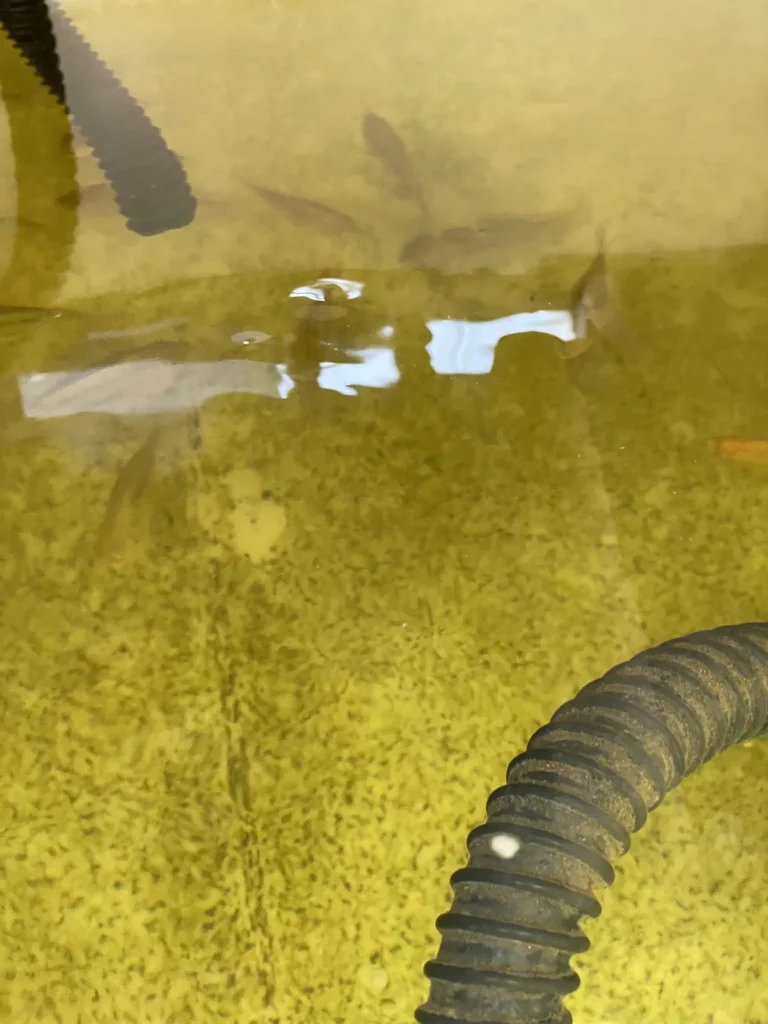
From my system: Field note: direct summer sun turned algae into my first major operating problem. Wrapping the sides of the IBC in flexible insulation did two jobs at once: it reduced temperature swings and blocked light from the translucent tote. Algae dropped substantially after that change.
Algae needs the same basic resources as aquaponics crops: light, water, carbon dioxide, and nutrients. An operating aquaponics system already supplies nearly everything algae needs.
Algae growth becomes more likely when:
- Direct sunlight reaches the fish-holding water
- Grow lights shine into an open tank or sump
- Transparent or translucent containers admit light
- Fish are overfed
- Solids accumulate in filters and grow beds
- Nitrate rises faster than plants use it
- A large plant harvest reduces nutrient uptake
- Water is warm
- Circulation is weak
- The system is new and biologically unstable
Algae is opportunistic. When useful crops are small, recently harvested, cold-stressed, poorly lit, or nutrient-limited, algae may use resources that the plants are not removing.
Why Excessive Algae Is a Problem
A thin green film on a sunlit surface is usually manageable. Heavy algae growth creates several operational risks.
- Free-floating algae turns the water green and hides fish.
- String algae can clog pump intakes, drains, pipes, and filter screens.
- Algae competes with crops for nitrate, iron, and other nutrients.
- Large algae populations consume oxygen after dark.
- Dead algae increases solids and bacterial oxygen demand.
- Algae can coat air stones, tank walls, and plumbing.
- Rapid daytime and nighttime pH changes may occur.
- Decaying algae can contribute to ammonia and foul odors.
The most serious risk is oxygen. Algae may produce oxygen during daylight, but it consumes oxygen continuously through respiration and stops photosynthesizing after dark. A system can look active and well oxygenated in the afternoon, then become dangerous before sunrise.
Different Types of Aquaponics Algae
| Type | Appearance | Common Location | Best Control |
|---|---|---|---|
| Free-floating algae | Green water | Fish tanks, ponds, sumps, filters | Block light and consider UV clarification |
| String or filamentous algae | Long green strands or mats | Tank walls, returns, shallow water, grow-bed edges | Manual removal, shade, nutrient control |
| Surface film algae | Thin green coating | Tank walls, pipes, media surfaces | Reduce light and scrub accessible surfaces |
| Brown film | Brown or dusty coating | New systems and low-light surfaces | Time, cleaning, stable water conditions |
| Blue-green growth | Dark green or blue-green slime | Stagnant, nutrient-rich areas | Improve circulation, remove buildup, investigate water quality |
Not every green or brown coating is the same organism, and not every treatment works on every type. UV clarification helps with organisms suspended in the water. It does little for algae attached to tank walls, grow media, or plumbing.
Block Light From the Fish Water
Light exclusion is the most effective algae-prevention measure because it removes the resource algae cannot obtain from fish waste or water chemistry.
Cover or shade:
- Ponds and stock tanks
- Converted IBC fish containers
- Sumps
- Swirl and radial flow filters
- Biofilters
- Clear tubing
- Transparent pipe sections
- Open water channels
- Unused plumbing openings
Use opaque materials rather than clear plastic. Clear covers may reduce debris while still allowing enough sunlight for algae growth.
A secure cover must leave space for feeding, inspection, plumbing, aeration, and gas exchange. It should not sag into the water, trap fish, obstruct air stones, or make emergency access difficult.
Simple rule: Direct light toward the plants, not the water. Crops need light. The fish tank does not.
Use Opaque Containers and Plumbing
White or translucent IBC containers can admit enough light for algae to grow inside. Clear tubing and transparent filter housings can develop algae that gradually restricts flow.
Options include:
- Installing an opaque exterior cover around an IBC container
- Using dark pond liner
- Building a removable insulated enclosure
- Painting only the outside of compatible containers with suitable material
- Replacing clear tubing with opaque tubing
- Wrapping exposed transparent plumbing
- Keeping filter barrels covered
Do not apply paint, sealant, adhesive, or coating to surfaces that contact system water unless the material is clearly suitable for aquatic and food-production use.
Manage Greenhouse Sunlight
A greenhouse protects the system from weather but can intensify sunlight and heat. An uncovered stock tank inside a greenhouse may receive enough light to grow algae rapidly even when the structure is not in full sun all day.
Reduce exposure by:
- Positioning fish containers beneath benches or opaque covers
- Using seasonal shade cloth
- Blocking low-angle morning or afternoon sun
- Covering sumps and filters
- Directing grow lights away from open water
- Cleaning greenhouse glazing only where crop light is needed
Do not shade the entire crop area more than necessary. The goal is to reduce light entering the water without starving herbs, peppers, greens, and other plants.
View greenhouse shade cloth on Amazon.
Control Grow-Light Spill
Indoor and greenhouse grow lights can cause algae when they shine directly into raft beds, sumps, fish tanks, or gaps around net pots.
Prevent light spill by:
- Lowering or repositioning fixtures
- Using reflectors and side shields
- Covering unused raft openings
- Closing gaps around net pots
- Covering exposed channels
- Using opaque lids on sumps and fish containers
Reflective material can redirect useful light toward plants, but keep loose sheets away from water, heaters, electrical equipment, and ventilation openings.
Do Not Overfeed the Fish
Overfeeding increases ammonia, suspended solids, dissolved nutrients, bacterial activity, and oxygen demand. All of those conditions can contribute to algae problems.
Feed only what the fish consume promptly. Reduce feeding when:
- Uneaten pellets remain visible
- Ammonia or nitrite is detected
- Fish appetite decreases
- Water temperature falls outside the feeding range
- A pump or air pump fails
- Filters are overloaded
- The water becomes heavily green or cloudy
- The system is recovering from a power outage
Fish can tolerate a short reduction in feeding. The system handles decomposing feed much less gracefully.
Keep Solids Under Control
Fish waste, uneaten feed, dead roots, and decaying algae release nutrients as they break down. They also consume oxygen and create areas where algae and unwanted microorganisms thrive.
Mechanical filtration should remove concentrated solids before they settle in grow beds, coat plant roots, or accumulate in the sump.
Useful filtration options include:
- Swirl filters
- Radial flow settlers
- Filter brushes
- Coarse filter pads
- Mesh screens
- Filter socks used after heavier solids removal
Drain collected sludge regularly. A filter full of decomposing waste may capture particles while continuing to release dissolved nutrients back into the water.
See aquaponics solids filtration basics for filter placement, sizing, and maintenance.
Maintain Enough Healthy Plants
Aquaponics crops remove nitrate and other dissolved nutrients. Strong plant growth reduces the resources available to algae.
Algae may increase after:
- A large harvest
- Removing mature plants
- Root disease
- Cold weather slowing plant growth
- Insufficient grow lighting
- A pest outbreak
- Plant nutrient lockout caused by unsuitable pH
Stagger planting and harvesting when practical so the system maintains active nutrient uptake. Replace harvested crops rather than leaving large growing areas empty for weeks.
See what plants grow well in aquaponics systems and growing herbs and peppers in aquaponics systems.
Maintain Proper Water Circulation
Stagnant areas collect solids and allow algae mats to establish. Proper circulation moves waste toward drains and filters while distributing oxygenated water.
Check for:
- Waste collecting in tank corners
- Weak water returns
- Clogged pump screens
- Uneven grow-bed flow
- Dead areas behind plumbing
- Slow filter turnover
- Blocked drains
- Long sections of warm, shallow water
Round tanks often benefit from a gentle circular flow that carries solids toward the center. Rectangular stock tanks and IBC containers may need carefully positioned returns because corners collect waste.
Do not create so much turbulence that waste is pulverized into fine suspended particles. The objective is controlled movement toward filtration.
Use how to size a pump for an aquaponics system to confirm flow at the actual head height.
Aeration Reduces Algae Risk
Aeration does not prevent light from reaching algae, but it protects fish and bacteria from the oxygen swings algae creates.
Strong aeration is especially important:
- During hot weather
- Before sunrise
- When algae is dying
- After covering green water
- After using a UV clarifier
- When fish are heavily stocked
- When solids have accumulated
- During pump or filter problems
Use independent aeration rather than depending entirely on splashing water returns. If the circulation pump fails, return-flow aeration stops with it.
See aeration in aquaponics systems for air-pump sizing and diffuser placement.
View pond air pumps for aquaponics on Amazon.
Test the Water Instead of Guessing
Algae is often a visible symptom of excess light and nutrients, but water testing shows whether a larger system problem is developing.
Test:
- pH
- Ammonia
- Nitrite
- Nitrate
- Water temperature
Ammonia and nitrite should remain near zero in a mature system. Rising nitrate may indicate that fish waste production exceeds plant uptake. Large algae populations can also cause daily pH changes as photosynthesis removes carbon dioxide during daylight.
Test at a consistent time when tracking trends. Comparing a morning pH reading with an afternoon reading can be misleading when algae is causing a daily swing.
See aquaponics water testing basics for a practical testing schedule.
View freshwater master test kits on Amazon.
Remove String Algae Manually
String algae attached to walls, drains, air stones, and plumbing will not be removed effectively by a UV clarifier. Manual removal is usually necessary.
- Turn off equipment when necessary for safe access.
- Pull or wind long strands around a brush or plastic tool.
- Remove loose algae before it reaches pump intakes.
- Clean drain guards and filter screens.
- Restore circulation and aeration immediately.
- Correct the light and nutrient conditions that allowed regrowth.
A clean toilet brush reserved only for the aquaponics system can work well on tank walls and pipe openings. Label it clearly unless you enjoy complicated household conversations.
Avoid sharp metal tools that could damage pond liners, plastic tanks, plumbing, or fish.
Clean Algae Without Destroying the Biofilter
Do not sterilize the entire system because algae appears. Beneficial nitrifying bacteria live on many of the same wet surfaces.
During cleaning:
- Remove excessive algae from accessible surfaces.
- Preserve established biological media.
- Avoid chlorinated tap water on biofilter components.
- Clean sections rather than every component at once.
- Maintain aeration and water circulation.
- Test ammonia and nitrite afterward.
A thin biofilm on submerged surfaces is normal. Scrubbing every surface back to new plastic is unnecessary and may reduce biological stability.
Use a UV Clarifier for Green Water
A UV clarifier can control free-floating algae by exposing water to ultraviolet light inside a closed chamber. Treated algae cells stop reproducing, clump together, and become easier for mechanical filtration to remove.
UV clarification works best when:
- The unit is sized for the water flow and volume
- The actual flow matches the manufacturer’s clarification rating
- Heavy solids are removed before the UV chamber
- The quartz sleeve is clean
- The bulb is replaced on schedule
- Light exposure to the fish water has already been reduced
UV does not remove attached string algae, lower nitrate, correct overfeeding, drain sludge, or replace mechanical and biological filtration.
See using UV filters in aquaponics systems for sizing, placement, and maintenance.
View pond UV clarifiers on Amazon.
Do Not Use Pool Algaecides
Swimming-pool chemicals, fountain treatments, and general pond algaecides may harm fish, nitrifying bacteria, plant roots, and edible crops.
Some algae treatments contain copper or other active ingredients that are inappropriate for aquaponics. Killing a large algae population rapidly can also create an oxygen emergency as the dead material decomposes.
Food-safety rule: Do not add an algae treatment unless the manufacturer clearly supports its use with the fish, beneficial bacteria, and edible crops in the same recirculating system.
Do Not Depend on Algae-Eating Fish
Adding algae-eating fish or snails may reduce some surface growth, but it does not correct direct sunlight, excess nutrients, poor filtration, or weak circulation.
Additional animals also add waste, oxygen demand, disease risk, and compatibility concerns. Species that eat algae in an aquarium may not be suitable for the temperature, water chemistry, fish population, or food-production goals of an aquaponics system.
Use system design and maintenance as the primary controls.
What to Do During a Heavy Algae Bloom
- Increase aeration immediately. Do not wait for fish to gasp.
- Test ammonia, nitrite, pH, nitrate, and temperature.
- Reduce or stop feeding temporarily.
- Block direct light from the water.
- Remove string algae and loose mats manually.
- Drain accumulated solids.
- Clean mechanical filters frequently.
- Inspect the pump and air stones.
- Use properly sized UV clarification for persistent green water.
- Monitor fish closely before sunrise.
Do not attempt to remove every visible trace in one aggressive cleaning. A rapid algae die-off can reduce oxygen and produce more waste than the filters can handle.
Why Algae Can Return After a Large Harvest
Mature plants remove nutrients every day. Harvesting a large portion of the crop suddenly reduces that demand while the fish continue eating and producing waste.
After a major harvest:
- Replant promptly
- Reduce feeding when plant area is temporarily low
- Monitor nitrate
- Keep fish water shaded
- Inspect for increasing green water
- Maintain solids removal
This is especially important during winter when replacement plants grow slowly and algae may still receive strong greenhouse light.
Algae on Grow Media
Algae growing on the surface of a media bed usually means the water level is too high or the surface receives frequent splashing.
The top layer of media should normally remain dry. In many flood-and-drain beds, the high-water level sits approximately one to two inches below the media surface.
Surface algae may attract fungus gnats, increase evaporation, and keep plant crowns too wet.
Correct it by:
- Lowering the standpipe or maximum flood level
- Correcting bell-siphon operation
- Reducing splashing
- Adding clean media to low areas
- Improving drainage
- Removing existing surface mats
See how a bell siphon works in aquaponics systems and aquaponics grow bed media basics.
Algae in Raft and Channel Systems
Raft beds and nutrient channels are especially vulnerable because shallow nutrient-rich water may receive strong light through unused planting holes and gaps around plants.
Prevention includes:
- Covering every unused planting hole
- Using opaque raft material
- Closing gaps around net pots
- Keeping channel lids installed
- Removing solids before water reaches roots
- Maintaining the designed flow rate
- Cleaning algae from exposed edges
Do not allow floating covers to block all gas exchange or trap excessive heat around plant crowns.
Seasonal Algae Prevention
| Season | Main Algae Risk | Best Prevention |
|---|---|---|
| Spring | Increasing sunlight before crops reach full size | Install covers early and establish plants quickly |
| Summer | Warm water, strong light, heavy feeding | Shade water, increase aeration, maintain filtration |
| Fall | Plant removal and changing sun angles | Replant promptly and block low-angle sunlight |
| Winter greenhouse | Slow plant uptake with direct sun on tanks | Reduce feeding and keep tanks covered |
Do not wait for the water to turn green before installing shade and covers. Prevention is easier than removing a mature bloom.
Routine Algae-Prevention Checklist
| Task | What to Check | Practical Frequency |
|---|---|---|
| Inspect tank covers | Light leaks, damage, safe access | Weekly |
| Observe water color | Green tint, suspended algae, surface film | Daily |
| Check fish feeding | Uneaten pellets and reduced appetite | Every feeding |
| Drain solids filters | Sludge accumulation and odor | As fish load requires |
| Inspect pump flow | Dead zones and weak returns | Weekly |
| Check aeration | Weak bubbles or clogged stones | Daily visual check |
| Remove attached algae | Strings around drains and equipment | As needed |
| Test water | pH, ammonia, nitrite, nitrate, temperature | Weekly when stable |
| Inspect plant density | Empty growing area and weak nutrient uptake | After harvests |
| Service UV equipment | Bulb age, sleeve condition, flow | Manufacturer schedule |
Common Algae-Control Mistakes
Algae control becomes easier when feeding, light, circulation, and testing are handled together. See common aquaponics beginner mistakes for the wider system view.
Treating Nutrients Without Blocking Light
Aquaponics water must contain nutrients for plants. Trying to eliminate every nutrient is not practical. Block light from the water first.
Using a Clear Tank Cover
Clear material may keep leaves out while allowing algae-producing light through. Use an opaque cover.
Depending on UV Alone
UV controls free-floating organisms passing through the chamber. It does not stop sunlight, remove sludge, or clean attached algae.
Killing Algae Too Quickly
A large die-off increases oxygen demand and solids. Improve aeration and filtration while the bloom declines.
Ignoring Morning Oxygen Risk
Oxygen is often lowest near sunrise after algae, fish, plants, and bacteria have consumed it throughout the night.
Cleaning Every Surface at Once
Aggressive cleaning can remove beneficial biofilm and destabilize nitrification. Clean problem areas while preserving biological media.
Using Pool or Fountain Chemicals
Products intended for non-food water systems may harm fish, roots, bacteria, and edible crops.
A Practical Algae-Control Plan
- Cover the fish tank, sump, and filters with opaque material.
- Block direct sunlight and grow-light spill.
- Test ammonia, nitrite, nitrate, pH, and temperature.
- Reduce fish feed when excess waste is present.
- Remove accumulated solids.
- Maintain active crops and replant after harvests.
- Verify pump circulation and eliminate dead zones.
- Maintain continuous aeration.
- Remove attached algae manually.
- Install or service a UV clarifier only for persistent green water.
- Monitor fish during algae die-off.
Useful Algae-Control Equipment
- Greenhouse shade cloth
- Opaque pond liner or covering material
- Pond UV clarifier
- Mechanical filter brushes
- Continuous-duty pond air pump
- Freshwater liquid test kit
For pumps, filtration, UV equipment, aeration, water testing, and other system components, see the Aquaponics Equipment Guide.
Frequently Asked Questions
What causes algae in aquaponics?
Algae grows when nutrient-rich aquaponics water receives enough light. Overfeeding, weak plant uptake, solids buildup, warm water, and poor circulation can make the problem worse.
What is the best way to prevent aquaponics algae?
Keep light away from the fish water. Cover tanks, sumps, filters, pipes, and unused planting openings with opaque material while maintaining safe access and gas exchange.
Is algae harmful to aquaponics fish?
A small amount is usually harmless. Heavy algae growth can create oxygen swings, clog equipment, hide fish, affect pH, and produce substantial waste when it dies.
Will reducing fish feed stop algae?
Reducing excessive feed lowers waste and nutrient production, but algae may continue if direct light reaches the water. Feeding control and light exclusion work together.
Will a UV filter prevent all algae?
No. UV clarification controls free-floating algae passing through the unit. It does not prevent string algae or surface films growing on tank walls, grow media, and plumbing.
Can I use algaecide in aquaponics?
Avoid algaecides unless the product is explicitly suitable for the fish, bacteria, and edible plants in the system. Pool and decorative pond treatments may be harmful.
Why does algae keep growing on my grow media?
The flood level may be too high, the surface may receive splashing, or strong light may reach wet media. Keep the upper media layer dry and correct the water level.
Does algae reduce nitrate?
Algae uses nitrate and other nutrients, but it is not a dependable nutrient-management strategy. It can release those nutrients again when it dies and may compete with useful crops.
Should I remove all algae from an aquaponics system?
No. A thin natural film is normal. Remove algae when it blocks equipment, turns water heavily green, covers plant areas, or creates oxygen and maintenance problems.
Why is algae worse after harvesting plants?
Harvesting reduces plant nutrient uptake while fish continue producing waste. Replant promptly, monitor nitrate, and reduce feeding temporarily when growing area is substantially reduced.
Final Takeaway
Preventing algae in aquaponics is mainly a matter of controlling light and keeping the system balanced. Cover the pond, stock tank, IBC container, sump, filters, and transparent plumbing. Keep grow lights focused on plants rather than water.
Feed fish conservatively, remove accumulated solids, maintain enough healthy crops, verify circulation, and keep aeration running continuously. Remove attached algae manually and reserve UV clarification for persistent green water.
A little algae is part of a living system. The trouble begins when the algae starts acting like it owns the place and your fish are merely paying rent.