
UV filters can help control green water and suspended microorganisms in aquaponics systems, but they are not a complete water-quality solution. They work best as a polishing tool after sunlight, feeding, solids, circulation, and biological filtration have already been addressed.
In most backyard systems, the main reason to install a UV unit is free-floating algae. Water passes through a sealed chamber containing an ultraviolet lamp. The UV exposure damages algae cells so they can no longer reproduce effectively, allowing the water to clear as the treated cells die or become trapped by mechanical filtration.
A UV filter will not remove fish waste, lower ammonia, correct overfeeding, clean algae from tank walls, or replace a biological filter. It treats only the organisms that pass through the chamber.
Affiliate disclosure: This page contains affiliate links. As an Amazon Associate I earn from qualifying purchases.
Quick answer: Use UV after mechanical filtration, match the unit to the actual water flow, keep the quartz sleeve clean, and replace the lamp on schedule. Block direct light from the fish water first. UV should support good system design, not compensate for an uncovered tank sitting in full sun.
What a UV Filter Does
From my system: Field note: I tried a submersible UV pump/clarifier during an algae bloom. It was rated for a larger water volume than my IBC tank, but I could not see a meaningful improvement. Blocking light and stabilizing the system mattered more in my setup.
A UV water filter exposes passing water to ultraviolet radiation inside a sealed chamber. Depending on the unit, manufacturer, exposure level, and flow rate, the system may be marketed as a clarifier or sterilizer.
In aquaponics, UV equipment is commonly used to reduce:
- Free-floating green-water algae
- Some suspended bacteria
- Some fungal spores
- Some protozoans and other microorganisms passing through the chamber
The UV lamp does not normally remove organisms from the water by itself. It damages them. Dead or disabled cells may remain suspended until they settle, decompose, or are captured by mechanical filtration.
UV Clarifier vs UV Sterilizer
The words clarifier and sterilizer are often used loosely in product listings, but the intended treatment level is different.
| UV Application | Main Goal | Typical Requirement | Aquaponics Use |
|---|---|---|---|
| Clarification | Control free-floating algae | Moderate UV exposure | Clearing green water |
| Higher-level sterilization | Reduce certain microorganisms | Slower flow or stronger UV exposure | Disease-management support in specialized systems |
A unit capable of clearing green water may not provide enough exposure to control harder-to-treat pathogens at the same flow rate. Follow the manufacturer’s flow rating for the specific treatment goal rather than assuming the maximum advertised flow provides full sterilization.
How UV Light Controls Green Water
Green water is caused by microscopic algae suspended throughout the water column. Because those algae cells travel with the circulating water, they eventually pass through an inline UV chamber.
Once exposed to a sufficient dose of UV light, the cells lose the ability to reproduce normally. As the existing population declines, the water becomes clearer.
UV works well on suspended algae because the water carries the organisms to the lamp. It is much less useful against algae attached to:
- Tank walls
- Stock-tank bottoms
- Grow media
- Raft surfaces
- Air stones
- Pipes and drains
- Plant roots
- Filter housings
Attached algae must be controlled with shading, water-level adjustments, manual cleaning, nutrient balance, and better system design.
What UV Filters Cannot Fix
A UV filter is useful, but its limitations need to be clear.
| Problem | Will UV Fix It? | What Actually Helps |
|---|---|---|
| Green water | Usually helps | UV, shading, nutrient balance |
| String algae | No | Manual removal and light control |
| Algae on tank walls | No | Shade and physical cleaning |
| Suspended fish waste | No | Settling and mechanical filtration |
| High ammonia | No | Biological filtration, reduced feeding, water testing |
| High nitrite | No | Biological filtration and aeration |
| High nitrate | No | Plant uptake, feeding balance, partial water replacement |
| Low dissolved oxygen | No | Aeration and circulation |
| Brown water from solids | No | Swirl or radial flow filtration |
| Tannins | No | Remove the source and manage dissolved organics |
UV equipment can make the water look better while an underlying ammonia, nitrite, oxygen, or filtration problem continues. Clear water is not proof that the system is healthy.
Block Sunlight Before Buying UV Equipment
Direct light is usually the main cause of green water in aquaponics. Before installing a UV unit, cover the fish-holding water and other exposed components.
Check:
- Open ponds and stock tanks
- Translucent IBC containers
- Uncovered sumps
- Clear tubing
- Transparent filter housings
- Open raft-bed planting holes
- Grow lights shining into the water
- Low-angle sunlight entering a greenhouse
Use opaque covers that still allow feeding, inspection, plumbing access, aeration, and gas exchange. Clear plastic may keep debris out while allowing enough light through to maintain algae growth.
See how to prevent algae growth in aquaponics systems for the underlying control methods.
Where to Install a UV Filter
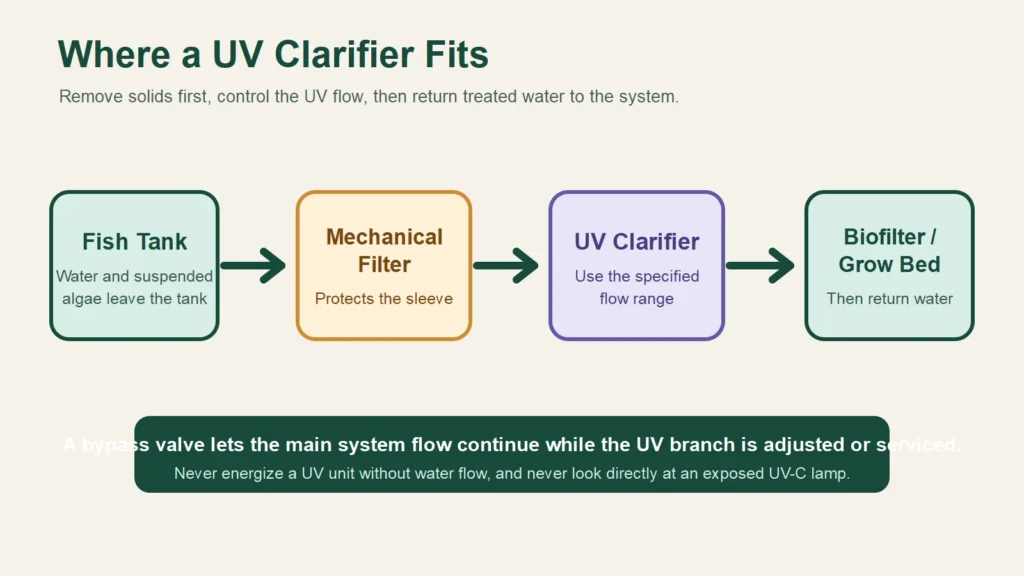
A UV filter should normally be installed after mechanical filtration. Cleaner water allows the ultraviolet light to reach suspended organisms more effectively.
A practical flow order is:
- Fish pond, stock tank, or converted IBC container
- Swirl filter or radial flow settler
- Mechanical filter brushes, screens, or pads
- UV filter
- Biological filter or plant-growing area
- Sump or return to the fish-holding water
The exact layout depends on whether the system is pump-fed or gravity-fed. The important point is to prevent heavy solids from coating the UV sleeve and blocking light.
See aquaponics solids filtration basics for filter placement and waste removal.
Why Mechanical Filtration Comes First
UV light must pass through the water and quartz sleeve before reaching algae or microorganisms. Dirt, biofilm, mineral deposits, and suspended waste reduce that exposure.
Without adequate pretreatment:
- The quartz sleeve becomes dirty faster.
- Suspended solids shade microorganisms from UV exposure.
- The chamber requires more frequent cleaning.
- Flow may become restricted.
- Clarification takes longer.
- The lamp may appear operational while treatment effectiveness declines.
A settling filter followed by coarse mechanical filtration usually removes enough waste to improve UV performance significantly.
Flow Rate Controls UV Exposure
Water must remain inside the UV chamber long enough to receive the intended exposure. If flow is too fast, algae and microorganisms pass the lamp too quickly.
Manufacturers commonly provide different maximum flow rates for:
- Green-water clarification
- General microorganism reduction
- Higher-level sterilization
Use the rating that matches the actual goal. Do not use the largest flow number on the package merely because the pump can move that much water.
Practical rule: Slower flow generally increases UV exposure. Too little flow may reduce total system turnover, while too much flow reduces treatment effectiveness. Match the bypass or dedicated pump to the manufacturer’s chart.
Use a Bypass for Better Flow Control
The main circulation pump may move more water than the UV chamber should handle. A bypass allows only part of the system flow to pass through the UV unit.
A basic bypass includes:
- A tee after mechanical filtration
- One branch through the UV unit
- One unrestricted or controlled bypass branch
- Valves for balancing flow
- Unions for removing the UV unit
This arrangement maintains overall water circulation while slowing flow through the UV chamber enough to achieve the intended exposure.
Do not restrict flow on the pump intake. Control flow on the discharge side or through a bypass.
How to Size a UV Unit
UV sizing depends on more than total gallons. The important variables include:
- Total operating water volume
- Actual flow through the UV chamber
- Clarification or sterilization goal
- Water clarity before UV treatment
- Fish load
- Amount of sunlight
- Severity of the algae bloom
- Plumbing diameter
- Manufacturer exposure rating
A small UV unit may eventually improve a large system if water circulates through it repeatedly, but treatment may be slow. An undersized chamber paired with excessive flow may accomplish very little.
Choose a unit based on the manufacturer’s recommended pond or aquarium volume and the rated flow for green-water clarification. Add some capacity when the aquaponics system receives strong sunlight or experiences recurring blooms.
UV Wattage Is Not the Only Number That Matters
A higher-wattage lamp may provide greater treatment capacity, but chamber design, lamp length, water path, sleeve condition, and flow rate all affect performance.
Compare units using:
- Recommended water volume
- Clarification flow rate
- Sterilization flow rate when provided
- Lamp wattage
- Inlet and outlet size
- Maximum pressure rating
- Replacement-lamp availability
- Quartz-sleeve availability
- Expected lamp life
- Ease of cleaning
A unit with inexpensive replacement bulbs and a removable sleeve may be a better long-term purchase than a sealed model that becomes disposable when one component fails.
Measure the Actual Flow
Pump ratings do not equal actual installed flow. Vertical lift, pipe length, valves, elbows, filters, and the UV chamber itself reduce output.
Measure the UV branch with a container and stopwatch:
- Direct the UV outlet into a container of known volume.
- Measure how many seconds it takes to fill.
- Calculate gallons per hour.
Gallons collected ÷ seconds × 3,600 = gallons per hour
If a five-gallon container fills in 60 seconds, the branch is moving approximately 300 gallons per hour.
Compare that measured flow with the UV manufacturer’s clarification rating. See how to size a pump for an aquaponics system for head loss and pump-curve guidance.
How Long Does UV Take to Clear Green Water?
A correctly sized and maintained UV clarifier may begin improving green water within several days. Severe blooms, undersized equipment, dirty sleeves, excessive flow, and continued sunlight can extend the process considerably.
Recovery time depends on:
- Algae density
- UV wattage
- Actual flow rate
- Water clarity entering the chamber
- Mechanical filter capacity
- Direct light exposure
- Plant nutrient uptake
- Water temperature
- Lamp age
- Quartz-sleeve cleanliness
As algae dies, mechanical filters may collect more material. Clean them frequently and maintain strong aeration during the clearing process.
Increase Aeration During an Algae Die-Off
Dead algae becomes organic waste. Bacteria consume oxygen while decomposing it, which can reduce dissolved oxygen and increase ammonia.
When starting UV on heavily green water:
- Increase aeration.
- Reduce feeding.
- Test ammonia and nitrite daily.
- Drain settling filters.
- Clean mechanical media.
- Watch fish closely before sunrise.
- Remove settled dead algae where practical.
See aeration in aquaponics systems for air-pump sizing and diffuser placement.
UV and Beneficial Bacteria
Most established nitrifying bacteria live on wet surfaces such as grow media, biofilter media, pipes, tank walls, and filter components. They are not primarily free-floating in the water.
A UV unit therefore does not normally destroy the entire biological filter. It can reduce some suspended microorganisms passing through the chamber, especially during system startup or after bacteria have been disturbed.
Do not use UV as a replacement for biological filtration. Maintain adequate biofilter surface area, water flow, aeration, and stable pH.
Should UV Run Continuously?
During an active green-water bloom, continuous operation usually provides the fastest clarification. Once the water clears, some growers continue running the unit while others use it seasonally or only when algae begins returning.
Continuous operation may be useful when:
- The system receives unavoidable sunlight.
- Green water returns quickly when UV stops.
- Fish observation is important.
- The unit is integrated into the main circulation loop.
- Recurring suspended algae is a known problem.
Seasonal operation may be enough when winter sunlight and water temperature reduce algae growth.
Do not cycle the lamp on and off repeatedly throughout the day unless the manufacturer supports that operating method. Frequent switching may reduce lamp life.
UV Filter Installation
- Choose an accessible location. Leave room to remove the lamp and quartz sleeve.
- Install mechanical filtration first. Keep heavy solids away from the chamber.
- Follow the approved mounting position. Some units can be mounted horizontally or vertically, while others have restrictions.
- Use unions. Make the unit removable without cutting pipe.
- Add isolation valves. Allow maintenance without draining the system.
- Install a bypass when necessary. Control UV flow independently from total circulation.
- Keep electrical components dry. Use drip loops and protected outlets.
- Confirm the chamber remains full of water. Avoid trapping air around the lamp sleeve.
- Measure actual flow. Verify that it matches the treatment goal.
- Check for leaks before energizing the lamp.
Follow the manufacturer’s instructions for maximum pressure, pipe diameter, mounting orientation, and startup procedure.
Electrical and UV Safety
UV equipment combines water, electricity, and radiation that can damage eyes and skin.
- Never look directly at an operating UV lamp.
- Never operate the lamp outside the sealed housing.
- Disconnect power before opening the unit.
- Use ground-fault circuit-interrupter protection.
- Keep plugs, ballasts, and controllers dry.
- Use drip loops in electrical cords.
- Inspect cords and seals for damage.
- Do not operate a damaged quartz sleeve.
- Allow the chamber to cool before maintenance.
- Follow local electrical requirements for outdoor and greenhouse installations.
Important: The lamp can appear dim or invisible in daylight and still emit harmful ultraviolet radiation. Never test it by looking at the exposed bulb.
Cleaning the Quartz Sleeve
The lamp is usually separated from the water by a quartz sleeve. Mineral scale, algae, biofilm, and fine solids collect on that sleeve and reduce UV transmission.
Cleaning frequency depends on source water, pH, hardness, solids filtration, and system conditions.
- Disconnect electrical power.
- Close isolation valves.
- Drain or relieve pressure according to the manufacturer’s instructions.
- Remove the lamp carefully without touching the glass unnecessarily.
- Remove the quartz sleeve.
- Clean deposits using the approved method.
- Inspect the sleeve for cracks and clouding.
- Inspect and lubricate seals only with manufacturer-approved material.
- Reassemble the unit.
- Restore water flow and check for leaks before reconnecting power.
Quartz sleeves are fragile. Keep a replacement available when the system depends on continuous UV operation.
Replace the Lamp on Schedule
A UV lamp may continue glowing after its effective ultraviolet output has declined. Visible light does not prove that the lamp is still treating water properly.
Replace the lamp according to the manufacturer’s operating-hour or calendar recommendation. Many units require annual replacement when used continuously, but the correct interval varies.
Record the installation date on the unit or maintenance log. Otherwise, every lamp eventually becomes “the one we changed sometime last year, probably.”
UV Maintenance Schedule
| Maintenance Task | What to Check | Practical Timing |
|---|---|---|
| Inspect water clarity | Green tint returning or worsening | Daily observation |
| Verify flow | Reduced output or blocked plumbing | Weekly |
| Inspect for leaks | Unions, seals, chamber, fittings | Weekly |
| Clean mechanical prefilter | Restricted flow and solids accumulation | As required |
| Clean quartz sleeve | Scale, slime, algae, clouding | Every few months or as needed |
| Inspect electrical components | Moisture, heat, damaged cord | Monthly |
| Replace UV lamp | Operating hours or manufacturer schedule | Usually annually when continuous |
| Inspect seals | Cracking, flattening, leaks | During sleeve maintenance |
UV Filters and Plant Nutrients
A UV filter does not directly remove nitrate, potassium, iron, calcium, or other dissolved plant nutrients. It therefore does not replace plant uptake or nutrient management.
Clearing an algae bloom may make more dissolved nutrients available to crops because the algae is no longer using them. Plant growth and nitrate should be monitored after the water clears.
Large amounts of dead algae may temporarily increase the organic load. Mechanical filtration and aeration should remain strong during the transition.
UV Filters and Fish Disease
UV can reduce certain free-floating organisms that pass through the chamber, but it should not be treated as a guaranteed disease cure.
Effectiveness depends on:
- The specific organism
- UV dose
- Actual flow rate
- Water clarity
- Pathogen life stage
- How much water reaches the chamber
- Whether the organism lives primarily on the fish or surfaces
Good quarantine, stable water quality, adequate oxygen, conservative stocking, and appropriate fish handling remain more important than relying on UV after disease enters the system.
Fish medications and treatments may affect edible plants and beneficial bacteria. A separate quarantine or hospital tank is often safer than treating the entire aquaponics loop.
UV and New-System Cycling
During initial cycling, beneficial bacteria are colonizing media, pipes, filters, and other surfaces. Most mature nitrifying bacteria become attached, but newly introduced microorganisms may spend some time suspended in the water.
Unless green water or a specific problem requires UV, many growers leave the unit off during early cycling and allow the biological filter to establish first.
Continue testing ammonia, nitrite, nitrate, and pH whether the UV unit is running or not. Use aquaponics water testing basics for the cycling sequence and testing schedule.
Common UV Filter Mistakes
Before treating UV as the answer to every green-water problem, review the broader common aquaponics beginner mistakes that create unstable systems.
Installing UV Before Mechanical Filtration
Solids and biofilm block ultraviolet light and dirty the quartz sleeve. Remove heavy waste first.
Running Water Too Fast
Excessive flow reduces exposure time. Use the manufacturer’s rating for clarification or sterilization, not only the chamber’s maximum flow.
Ignoring Direct Sunlight
UV may clear the water while the uncovered tank continues producing algae. Block the light source.
Expecting UV to Remove Attached Algae
Algae on walls, pipes, media, and drains never passes through the chamber. It must be shaded or removed manually.
Forgetting the Quartz Sleeve
A clean lamp inside a dirty sleeve may provide little effective treatment.
Waiting for the Bulb to Burn Out
Effective UV output declines before visible light disappears. Replace the lamp on schedule.
Running UV Without Water Flow
Some units can overheat without water moving through the chamber. Follow the manufacturer’s startup and shutdown sequence.
Assuming Clear Water Means Safe Water
UV can improve appearance while ammonia, nitrite, low oxygen, or temperature problems remain.
Troubleshooting a UV Filter
| Problem | Likely Cause | Correction |
|---|---|---|
| Water remains green | Unit undersized, flow too fast, lamp old, sleeve dirty | Verify sizing, measure flow, clean sleeve, replace lamp |
| Green water returns quickly | Direct sunlight or weak plant uptake | Cover water and correct nutrient balance |
| Flow drops through UV | Blocked prefilter, dirty chamber, undersized plumbing | Clean filtration and inspect plumbing |
| Unit leaks | Damaged seal, cracked sleeve, loose union | Disconnect power, isolate water, inspect components |
| Lamp does not illuminate | Failed bulb, ballast, outlet, or safety switch | Disconnect power and follow manufacturer testing steps |
| Water clears but fish are stressed | Algae die-off reducing oxygen or ammonia rising | Increase aeration, reduce feeding, test water |
| Attached algae remains | Organisms never pass through UV | Shade and clean surfaces manually |
When a UV Filter Is Worth Buying
A UV filter is a reasonable purchase when:
- Green water persists after tanks are shaded.
- The system receives unavoidable sunlight.
- Fish visibility is important.
- The system already has adequate mechanical filtration.
- Flow can be controlled through the chamber.
- The owner is willing to clean the sleeve and replace lamps.
- Recurring algae blooms create maintenance or oxygen problems.
UV is less useful when the main problem is brown water, sludge, attached algae, overfeeding, weak aeration, or an immature biological filter.
What I Would Do First
For green water, I would first cover the fish tank, sump, and filters with opaque material. I would reduce excess feeding, drain settled solids, confirm strong aeration, and test ammonia, nitrite, nitrate, pH, and temperature.
If the water remained green after those corrections, I would install a serviceable UV clarifier after mechanical filtration. I would use a bypass valve to match the manufacturer’s clarification flow rate and place unions on both sides so the unit could be removed without cutting pipe.
I would also record the lamp-installation date and keep a replacement sleeve seal available. UV equipment is low-maintenance only when maintenance has somewhere convenient to happen.
Useful UV and Filtration Equipment
- Pond UV clarifiers
- Replacement UV lamps
- Mechanical filter brushes
- PVC unions and flow-control valves
- Continuous-duty pond air pumps
- Freshwater liquid test kits
For pumps, filtration, aeration, test kits, UV equipment, heaters, and backup systems, see the Aquaponics Equipment Guide.
Frequently Asked Questions
Do UV filters work in aquaponics?
Yes. UV filters can control free-floating algae and reduce some suspended microorganisms when the unit is correctly sized, maintained, and operated at the proper flow rate.
Will a UV filter clear green aquaponics water?
A properly sized UV clarifier can clear green water caused by suspended algae. Direct light should also be blocked to prevent the bloom from returning.
Will UV kill algae on tank walls?
No. Attached algae does not pass through the chamber. It requires shading, water-level correction, and manual cleaning.
Where should a UV filter be installed?
Install it after settling and mechanical filtration so solids do not block ultraviolet light or coat the quartz sleeve.
Can UV harm beneficial bacteria?
UV can affect suspended bacteria passing through the chamber, but most established nitrifying bacteria live on filter media, grow media, pipes, and other surfaces.
Should UV run all the time?
Continuous operation is common during an algae bloom. After the water clears, the unit may be operated continuously, seasonally, or as needed depending on sunlight and recurrence.
How fast should water flow through a UV filter?
Use the manufacturer’s flow rating for the intended treatment. Green-water clarification usually permits faster flow than higher-level microorganism control.
How often should the UV bulb be replaced?
Replace it according to the manufacturer’s operating-hour or calendar recommendation. A bulb may continue glowing after its effective ultraviolet output has declined.
Why is my UV filter not clearing the water?
Common causes include excessive flow, an undersized unit, a dirty quartz sleeve, an old lamp, poor mechanical filtration, or continued direct sunlight.
Does UV remove ammonia or nitrate?
No. Ammonia and nitrite require biological filtration. Nitrate is removed mainly through plant uptake and water management.
Can UV replace an aquaponics filter?
No. UV does not remove heavy solids or provide the biological surface area needed for nitrification. It should be used with mechanical and biological filtration.
Final Takeaway
UV filters can be useful in aquaponics when green water remains a problem after exposed water has been shaded and feeding, solids, circulation, and plant uptake are under control.
Install the UV unit after mechanical filtration, control the flow through the chamber, clean the quartz sleeve, replace the lamp on schedule, and maintain strong aeration while an algae bloom dies off.
Use UV as a finishing tool, not a substitute for good system design. A correctly installed clarifier can keep the water clear. It cannot stop the sun from shining into an uncovered stock tank or convince overfed fish to produce less waste.