
Sizing an aquaponics pump starts with the amount of water that must circulate through the system and ends with the amount of flow the pump can actually deliver after lifting water through pipes, valves, filters, and grow beds.
The number printed on the pump box is the maximum flow under ideal conditions, usually with little or no vertical lift. Your aquaponics system will receive less flow once head height and plumbing resistance are added.
A practical starting point is to circulate approximately the full fish-holding water volume once per hour. That target should then be adjusted for fish load, filtration, grow-bed design, system layout, and the actual flow shown on the pump curve.
Affiliate disclosure: This page contains affiliate links. As an Amazon Associate I earn from qualifying purchases.
Quick answer: Calculate the water volume, choose the required turnover rate, measure total head height, check the manufacturer’s pump curve, and select a pump that still delivers the required flow at that head. Add some reserve capacity, then control excess flow with a valve or bypass.
Why Pump Sizing Matters
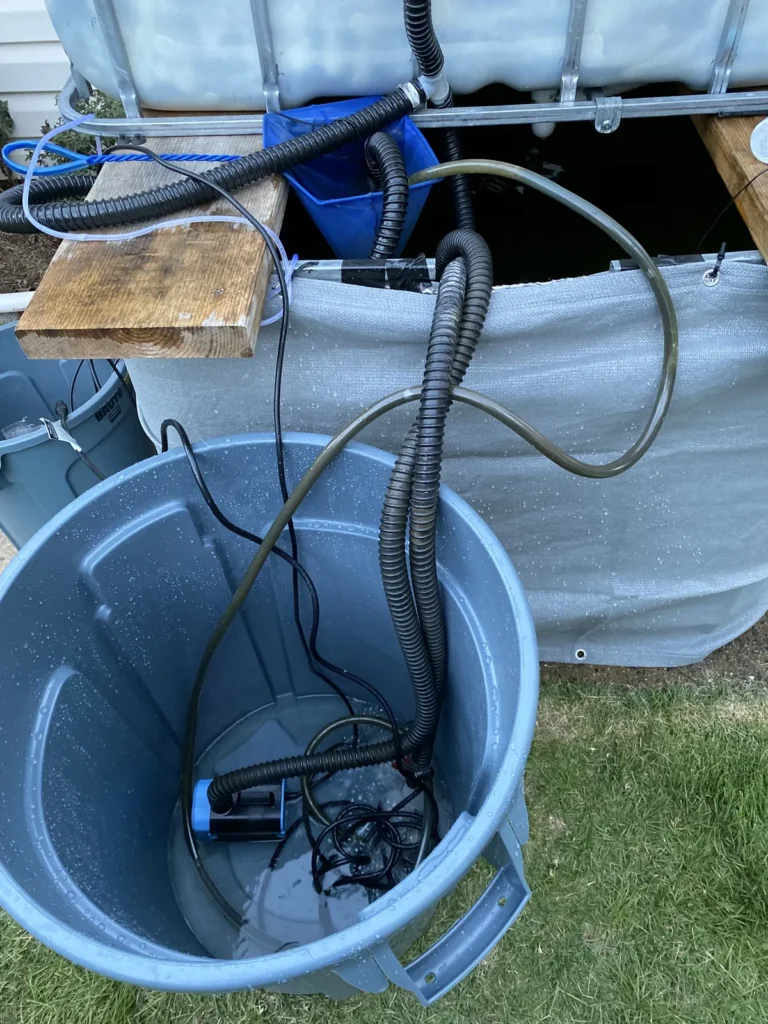
From my system: Field note: my first pump took roughly 35–40 minutes to fill the bed. The replacement could do it in only 2–3 minutes. A valve let me throttle the larger pump until the flood-and-drain cycle settled around 9–10 minutes of fill and about one minute of drain.
The water pump connects nearly every part of an aquaponics system. It moves fish waste toward filtration, carries dissolved nutrients to plants, supplies biological filters with oxygenated water, and returns treated water to the pond, stock tank, converted IBC container, or fish tank.
An undersized pump can cause:
- Weak water circulation
- Waste settling in dead zones
- Poor solids transport
- Uneven grow-bed flow
- Reduced biological filtration
- Low water movement around plant roots
- Unreliable bell siphon operation
- Lower oxygen distribution
An oversized pump can also create problems:
- Filters may overflow or pass solids too quickly
- Grow beds may fill faster than they can drain
- Bell siphons may fail to break
- Fish may experience excessive current
- Plumbing noise may increase
- Energy use may be unnecessarily high
- Valves may need to remain heavily restricted
The goal is not maximum flow. The goal is enough reliable flow at the actual operating conditions.
Start With Total System Water Volume
Begin by estimating the amount of water actively circulating through the system. Include the fish-holding water, sump, filters, and water contained in grow beds when they are flooded.
Do not automatically use the advertised capacity of an IBC container or stock tank. The real operating volume is usually lower because the container is not filled completely, plumbing occupies space, and grow media displaces water.
Rectangular Tank Volume
Length in inches × width in inches × water depth in inches ÷ 231 = gallons
For example, a rectangular stock tank measuring 60 inches long, 36 inches wide, and 24 inches deep contains approximately:
- 60 × 36 × 24 = 51,840 cubic inches
- 51,840 ÷ 231 = approximately 224 gallons
Round Tank Volume
Diameter in feet × diameter in feet × water depth in feet × 5.875 = approximate gallons
Irregular ponds and partially filled containers may need to be estimated from manufacturer dimensions, measured fill amounts, or water-meter readings.
Choose a Target Turnover Rate
Turnover rate describes how often the system’s water volume passes through the circulation loop.
A common aquaponics starting point is approximately one full fish-tank volume per hour. A 300-gallon fish-holding system would therefore begin with a target of roughly 300 gallons per hour at the actual operating head.
This is a baseline, not a universal law. Required flow changes with:
- Fish species and biomass
- Daily feeding rate
- Water temperature
- Solids production
- Filtration design
- Grow-bed area
- Raft or channel requirements
- Available aeration
- Pipe layout
- Whether multiple tanks share one pump
| System Condition | Practical Starting Turnover | Notes |
|---|---|---|
| Lightly stocked media-bed system | About once per hour | Media beds provide biological filtration and some solids capture |
| Moderately stocked backyard system | About once per hour or slightly more | Verify filter and drain capacity |
| Heavily stocked fish system | May require higher flow or separate filtration loops | Base design on feed and waste load, not gallons alone |
| Large pond with low fish density | May use slower turnover | Strong aeration and supplemental circulation may still be needed |
| Raft or channel system | Depends on channel and root-zone flow requirements | Solids removal should occur before sensitive plant areas |
If one pump supplies several grow beds, filters, and returns, calculate the combined flow requirement rather than sizing only for the fish tank.
Understand Head Height
Head height is the resistance the pump must overcome. Vertical lift is the largest part, but pipe length, elbows, valves, filters, and fittings also reduce flow. See the Aquaponics Plumbing Guide for pipe, valve, fitting, and overflow planning.
Static head is the vertical distance from the water level at the pump intake to the highest point where the water is discharged.
Measure from the operating water level, not from the floor beneath the pump. A submersible pump sitting at the bottom of a four-foot-deep sump does not automatically have four feet of additional head if the sump water level is near the top.
Example Head Measurement
Assume a pump sits inside a sump whose normal water surface is 18 inches above the floor. The water is discharged into a grow bed 60 inches above the floor.
- Grow-bed discharge height: 60 inches
- Sump operating water level: 18 inches
- Vertical head: 42 inches
- 42 inches ÷ 12 = 3.5 feet of static head
The pump must deliver the required flow at 3.5 feet of static head plus the resistance created by the plumbing.
Pipe Friction Adds Dynamic Head
Water loses pressure as it moves through pipe. Narrow pipe, long runs, elbows, tees, check valves, partially closed valves, filters, and spray bars all increase resistance.
Common sources of additional head include:
- Long horizontal pipe runs
- Small pipe diameter
- Multiple 90-degree elbows
- Tees and manifolds
- Check valves
- UV clarifiers
- Pressurized filters
- Venturi fittings
- Spray bars
- Partially closed flow-control valves
- Dirty pump screens and filters
For small backyard systems, exact hydraulic calculations are not always necessary. Measure the vertical head, simplify the plumbing, use adequately sized pipe, and select a pump with a reasonable reserve on the pump curve.
For larger systems, long pipe runs, or high fish loads, calculate total dynamic head more carefully or use a pump-sizing calculator from the manufacturer.
Read the Pump Curve
A pump curve shows how much water a pump delivers at different head heights. Flow decreases as head increases.
A pump advertised at 1,000 gallons per hour may deliver:
| Head Height | Example Flow |
|---|---|
| 0 feet | 1,000 GPH |
| 3 feet | 800 GPH |
| 6 feet | 550 GPH |
| 9 feet | 250 GPH |
| Maximum head | Little or no usable flow |
Those figures are only an example. Every pump has a different curve.
Find the expected total head on the chart, then read across to the corresponding flow. That value matters more than the maximum flow printed in large letters on the product listing.
Do not select a pump by maximum head: Maximum head is the height where flow approaches zero. A pump capable of lifting water ten feet may deliver very little useful flow at nine feet.
Pump Sizing Example
Assume an aquaponics system contains:
- 300 gallons of operating water
- A target turnover of once per hour
- Four feet of vertical lift
- Moderate pipe and fitting resistance
- Two grow-bed branches
The minimum target is approximately 300 gallons per hour at the actual head.
Because plumbing resistance and normal pump wear reduce performance, a pump delivering approximately 400 to 500 gallons per hour at four to five feet of head would provide a more practical margin.
A pump rated for 500 gallons per hour at zero head may not meet that requirement. A pump rated for 800 or 1,000 gallons per hour at zero head might deliver the correct amount after head loss.
The pump curve decides which one is suitable.
Why Slightly Oversizing the Pump Helps
A modest reserve allows for:
- Biofilm forming inside pipes
- Partial filter restriction
- Pump wear
- Additional grow beds
- Seasonal root growth
- Small errors in volume or head estimates
- Flow division between several outlets
Oversizing does not mean buying the largest pump available. A pump delivering several times the required flow wastes energy and may require severe throttling.
A reasonable reserve is enough to maintain the target flow as the system ages without overwhelming the drains and filters.
Control Excess Flow With a Bypass
A valve can reduce flow to the grow beds, but a bypass is often more useful. A bypass returns excess water directly to the fish tank or sump instead of forcing the pump to work against a heavily closed valve.
A basic bypass arrangement includes:
- A tee after the pump
- One branch feeding the grow beds and filters
- One branch returning to the fish-holding water or sump
- A valve on one or both branches
The bypass can provide additional surface movement or circulation while allowing precise control of grow-bed flow.
Do not restrict the pump intake to reduce flow. Control flow on the discharge side unless the manufacturer specifically states otherwise.
Size the Plumbing for the Pump
A strong pump connected to narrow plumbing may deliver less water than a smaller pump using properly sized pipe.
Larger-diameter pipe reduces friction and usually improves flow efficiency. It also reduces the chance that roots, solids, or biofilm will create a complete blockage.
Plumbing should be selected based on:
- Pump outlet size
- Target flow
- Pipe length
- Number of fittings
- Solids content
- Gravity-drain capacity
- Future expansion
Avoid immediately reducing a large pump outlet into a much smaller pipe. That creates resistance near the pump and wastes available capacity.
Match Pump Flow to Filter Capacity
More flow does not always produce better filtration. Swirl filters and radial flow settlers need slower water movement so heavier waste can settle.
If water moves through a settling filter too quickly:
- Solids remain suspended
- Waste passes into grow beds
- Filter performance drops
- Fine mechanical media clogs faster
- The filter may overflow
Filter flow should fall within the filter’s operating range. A high-flow main loop may need a larger filter, multiple filters, or a separate side-stream filtration loop.
See aquaponics solids filtration basics for filter placement and flow considerations.
Pump Flow and Bell Siphons
Bell siphons need a specific range of incoming flow. If the flow is too low, the siphon may never start. If the flow is too high, the bed may not drain faster than it fills and the siphon may fail to stop.
When one pump supplies several bell-siphon beds, use individual valves on each branch. This allows each bed to be tuned without changing the others.
The total pump must supply all beds at the operating head while leaving enough capacity for filtration and returns.
See how a bell siphon works in aquaponics systems for flow tuning and troubleshooting.
Submersible vs External Pumps
| Feature | Submersible Pump | External Pump |
|---|---|---|
| Installation | Sits inside sump or tank | Installed outside the water |
| Priming | Usually self-primed by submersion | May require flooded suction or priming |
| Cooling | Water cools the motor | Air-cooled motor |
| Heat transfer | Adds some motor heat to water | Less motor heat enters water |
| Maintenance | Must be removed from water | Often easier to access |
| Noise | Usually quieter | May be more noticeable |
| Best fit | Small and medium backyard systems | Larger ponds and higher-flow systems |
Submersible pond and hydroponic pumps are common in backyard aquaponics because they are simple to install and usually tolerate continuous operation.
External pumps may provide better efficiency and service access at higher flow rates, but they require correct inlet plumbing and protection from running dry.
View submersible pond pumps for aquaponics on Amazon.
Energy Efficiency Matters
Aquaponics pumps often run continuously. A small difference in wattage becomes meaningful over a full year.
Annual energy use can be estimated with:
Pump watts × 24 hours × 365 days ÷ 1,000 = kilowatt-hours per year
A 60-watt pump uses approximately:
- 60 × 24 × 365 = 525,600 watt-hours
- 525,600 ÷ 1,000 = approximately 526 kilowatt-hours per year
Compare pumps using both flow at the required head and electrical consumption. A cheaper pump that uses significantly more electricity may cost more over its service life.
View plug-in electricity usage meters on Amazon.
Continuous-Duty Rating
Select a pump designed for continuous operation. Aquaponics circulation is life-support equipment, not an occasional fountain feature.
Check for:
- Continuous-duty operation
- Suitable freshwater use
- Manufacturer pump curve
- Replaceable impeller or rotor
- Solids-handling capability
- Thermal protection
- Appropriate cord length
- Outdoor or submerged rating
- Available replacement parts
- Warranty support
A pump that performs well but cannot be cleaned, rebuilt, or replaced quickly creates unnecessary system risk.
Solids-Handling Pumps
Pumps vary in how well they handle fish waste and debris. Some small magnetic-drive pumps clog easily when exposed to roots, feed, or string algae.
A solids-handling pump may pass larger particles, but that is not always desirable. Passing waste through the impeller can break it into smaller particles that are harder to settle.
Where practical, remove heavy solids before the pump or use a pump intake arrangement that does not sit directly in settled sludge.
Use an intake screen large enough to prevent fish, roots, and large debris from entering without clogging every day.
Measure the Real Flow After Installation
The final test is measuring the water the installed system actually moves.
Use a container and stopwatch:
- Direct one outlet into a container of known volume.
- Measure how many seconds it takes to fill.
- Convert the result to gallons per hour.
Gallons collected ÷ seconds × 3,600 = gallons per hour
If a five-gallon bucket fills in 45 seconds:
- 5 ÷ 45 = 0.111 gallons per second
- 0.111 × 3,600 = approximately 400 gallons per hour
Measure each branch when the pump feeds several beds or filters. The total pump flow may be adequate while one branch receives almost nothing.
Install Unions and Valves
Pumps eventually need cleaning or replacement. Plumbing should allow removal without draining the entire system or cutting pipe.
Useful fittings include:
- A union near the pump outlet
- An isolation valve
- A removable intake screen
- A bypass valve
- Individual branch valves
- Flexible couplings where vibration is a concern
Do not permanently trap the pump beneath a grow bed or behind a full IBC container. The pump will eventually ask to be cleaned on the coldest and least convenient day available.
Protect the Pump From Running Dry
Many submersible pumps depend on surrounding water for cooling. Running dry can damage seals, bearings, impellers, or the motor.
Dry-running risk increases when:
- The sump is undersized
- Several grow beds fill at the same time
- Water evaporates
- A pipe leaks
- A drain blocks
- A valve is left closed
- A bell siphon behaves unpredictably
Use a sufficiently large sump, maintain a safe operating water level, and consider a low-water shutoff or float switch.
View low-water float switches and pump controls on Amazon.
Plan for Pump Failure
The main circulation pump will eventually stop because of a power outage, clogged intake, worn impeller, failed controller, damaged cord, or ordinary mechanical wear.
A practical backup plan includes:
- Continuous independent aeration
- A spare pump with compatible fittings
- Unions for fast replacement
- A battery or generator plan
- A power-failure alarm
- Written valve and restart instructions
The spare pump does not need to be identical, but it should deliver enough emergency flow at the system’s head height.
See backup power for aquaponics systems for outage planning and runtime calculations.
Pump Maintenance
| Maintenance Task | What to Check | Practical Timing |
|---|---|---|
| Observe outlet flow | Weak return, uneven branches, reduced splash | Daily visual check |
| Clean intake screen | Roots, algae, feed, leaves, debris | Weekly or as needed |
| Inspect impeller | Biofilm, grit, damage, swelling | Every few months |
| Check fittings | Leaks, loose unions, cracked tubing | Monthly |
| Measure real flow | Decline from original output | Several times per year |
| Inspect electrical cord | Cuts, heat damage, damaged plug | Monthly |
| Test spare pump | Startup, fittings, actual flow | Several times per year |
Gradual flow loss is easy to miss because the pump still makes noise and water still moves. Comparing measured flow over time reveals restriction and wear before the system becomes unstable.
Common Pump-Sizing Mistakes
Pump errors rarely travel alone. The common aquaponics beginner mistakes guide connects circulation problems with aeration, stocking, testing, and maintenance.
Using the Box Rating as Actual Flow
The maximum rating usually represents flow at zero head. Use the pump curve at the real operating height.
Measuring Head From the Pump Body
Measure from the operating water surface at the pump intake to the discharge height, then account for plumbing resistance.
Ignoring Pipe Diameter
Narrow plumbing can consume much of the pump’s available pressure and reduce flow substantially.
Sizing Only for the Fish Tank
Filters, grow beds, raft channels, bypasses, and multiple tanks may all require part of the total flow.
Buying a Pump With No Reserve
A pump operating at the absolute minimum may become inadequate as filters clog, pipes develop biofilm, and fish grow.
Buying Far Too Much Pump
Excess flow increases energy use and may overwhelm filters and drains. Modest oversizing is useful. Extreme oversizing is not.
Ignoring Continuous Energy Cost
A pump running 24 hours per day should be selected for efficiency as well as purchase price.
Installing the Pump Where It Cannot Be Reached
Pumps need cleaning and replacement. Provide unions, valves, access space, and a safe way to remove the unit.
Pump Selection Checklist
- Calculate actual operating water volume.
- Select a target turnover rate.
- Measure vertical head from water surface to discharge.
- Account for pipe length, fittings, valves, and filters.
- Check the manufacturer’s pump curve.
- Confirm flow at the actual head.
- Add modest reserve capacity.
- Verify continuous-duty operation.
- Compare wattage and annual energy use.
- Confirm solids-handling ability.
- Match pipe diameter to the target flow.
- Install valves, unions, and a bypass.
- Measure actual installed flow.
- Keep a tested spare pump.
What I Would Buy
For a small or medium backyard system, I would choose a continuous-duty submersible pond pump that delivers the required flow at the actual head height, not at zero head.
I would also install:
- A removable intake screen
- A union near the pump
- An isolation valve
- A bypass return
- Individual valves for each grow-bed branch
- A spare pump or emergency replacement
View energy-efficient submersible pond pumps on Amazon.
View pump unions, valves, and plumbing fittings on Amazon.
For a broader overview of pumps, aeration, filtration, heaters, test kits, and backup systems, see the Aquaponics Equipment Guide.
Frequently Asked Questions
How many times per hour should aquaponics water circulate?
Approximately one full fish-tank volume per hour is a common starting point. Heavily stocked systems, specialized plant systems, and large ponds may require a different rate.
What size pump do I need for a 300-gallon aquaponics system?
Begin with a target of approximately 300 gallons per hour at the actual operating head. Select the pump by checking which model delivers that flow after vertical lift and plumbing losses are included.
Should an aquaponics pump run continuously?
Most aquaponics circulation pumps run continuously. Timer-controlled systems exist, but stopping the main pump also stops water movement through filtration and grow areas.
Is it better to oversize an aquaponics pump?
Slight oversizing provides useful reserve for head loss, dirty filters, and future additions. Excessive oversizing wastes energy and may overwhelm drains and filters.
Can I reduce pump flow with a valve?
Yes. Restrict flow on the discharge side, or use a bypass that returns excess water to the tank or sump. Do not restrict the pump intake.
What is pump head height?
Head height is the resistance the pump must overcome. It includes vertical lift and additional resistance from pipe, elbows, valves, filters, and fittings.
How do I measure actual pump flow?
Collect water from the outlet in a container of known volume and time how long it takes to fill. Convert the result to gallons per hour.
Can one pump run several aquaponics grow beds?
Yes. Size the pump for the combined flow at the actual head and install a manifold with individual valves for each grow bed.
Are submersible pumps safe for fish?
Use a pump intended for ponds, aquariums, hydroponics, or similar freshwater applications. Avoid pumps with exposed oils, unsuitable metals, damaged cords, or unclear material specifications.
Why has my pump flow decreased?
Common causes include a clogged intake, dirty impeller, restricted filter, root intrusion, biofilm inside pipes, partially closed valves, air locks, or normal pump wear.
Final Takeaway
To size an aquaponics pump correctly, calculate the real water volume, establish the required turnover rate, measure the vertical lift, account for plumbing resistance, and use the manufacturer’s pump curve to confirm actual flow.
Choose a continuous-duty pump with modest reserve capacity, efficient energy use, serviceable parts, and enough pressure to supply every filter and grow bed. Install valves, unions, and a bypass so the system can be balanced and maintained.
Finally, measure the installed flow. A pump label tells you what the pump did under test conditions. A bucket and stopwatch tell you what it is doing in your aquaponics system.