
Heating aquaponics water in winter is mostly a heat-loss problem. A heater can add warmth, but exposed stock tanks, converted IBC containers, ponds, pipes, grow beds, and greenhouse surfaces can lose heat faster than a small heater replaces it.
The most reliable approach combines insulation, reduced nighttime heat loss, a properly sized water heater, direct temperature monitoring, and a backup plan for power failures. The goal is not to make the water tropical during a blizzard. The goal is to keep the system inside a safe and stable range for the fish, plants, and nitrifying bacteria.
For a small protected system, one submersible heater may be enough. Larger stock tanks, IBC systems, ponds, and greenhouse systems often need multiple heaters, a titanium heating element with an external controller, or a different winter operating strategy.
Affiliate disclosure: This page contains affiliate links. As an Amazon Associate I earn from qualifying purchases.
Practical rule: Insulate first, cover exposed water, measure the actual water temperature, and then size the heater for the remaining heat loss. Heating an uninsulated outdoor container is an expensive argument with winter.
Why Winter Water Temperature Matters
From my system: Field note: insulation, a small greenhouse, and a ring-style stock-tank heater controlled by a thermostat kept my IBC system around 65°F through most of a Northern Virginia winter. During one severe cold snap and greenhouse failure, the water briefly dropped into the 40s before I covered the tank and recovered.
Fish are cold-blooded. Their metabolism, appetite, digestion, immune response, and growth rate change with water temperature. As water cools, many warm-water fish eat less and become less active. If the temperature falls too far or changes too quickly, fish may become stressed or die.
Temperature also affects the rest of the aquaponics system:
- Nitrifying bacteria process ammonia more slowly in cold water.
- Fish produce less waste when they eat less.
- Warm-season plants slow down.
- Root growth and nutrient uptake change.
- Heaters increase electrical demand.
- Cold pipes and grow beds remove heat from circulating water.
- Sudden temperature changes can stress fish even when the final temperature is technically survivable.
A winter system may remain alive while producing very little. That can be acceptable. Keeping fish healthy through winter does not always require maintaining summer growth rates.
Choose the Winter Temperature Based on the Fish
There is no universal aquaponics temperature target. The correct range depends on the fish species.
| Fish Type | General Winter Behavior | Heating Demand |
|---|---|---|
| Tilapia | Warm-water fish that slow sharply in cold water | High in cold climates |
| Catfish | More cold-tolerant than tilapia, but feeding and growth decline | Moderate |
| Bass | Species-dependent, generally more seasonal than tilapia | Moderate |
| Goldfish | Tolerate cool water and reduced winter feeding | Low to moderate |
| Koi | Tolerate cool water when temperature changes gradually | Low to moderate |
| Trout | Cold-water fish that may need cooling rather than winter heating | Low |
Do not heat a system to a generic number copied from an aquarium guide. Match the temperature plan to the species, expected winter conditions, fish size, feeding goals, and plant selection.
For species-specific planning, see using goldfish in aquaponics systems and using tilapia, catfish, or bass in aquaponics systems.
Measure Water Temperature, Not Just Air Temperature
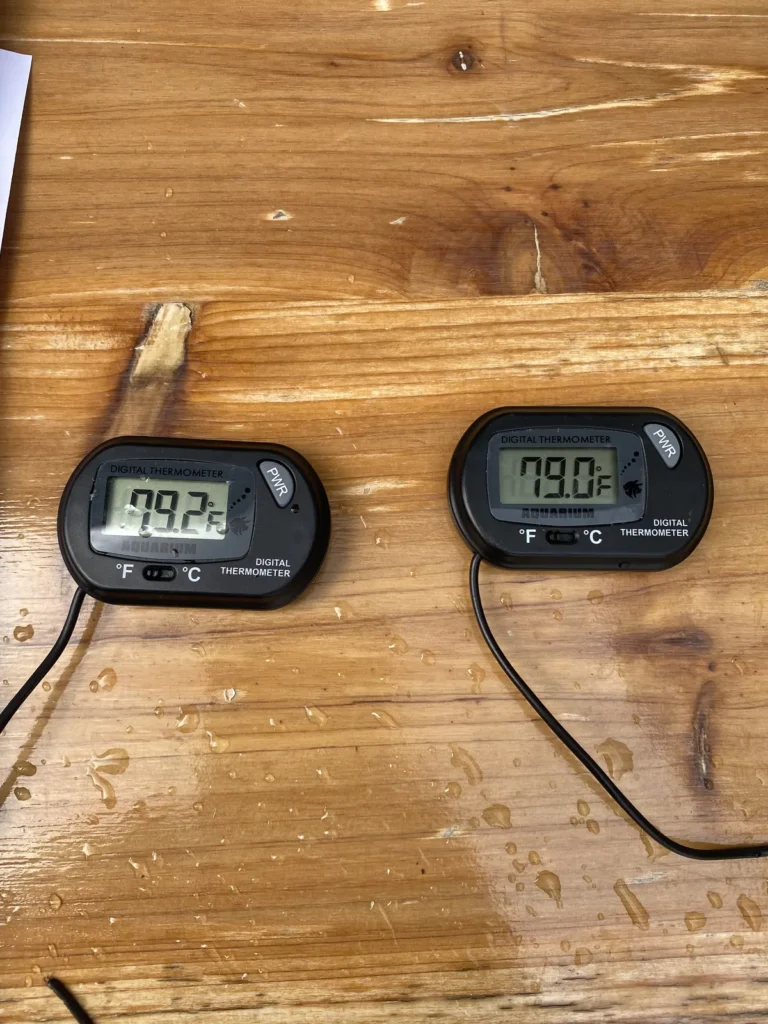
Greenhouse air can warm quickly in sunlight while the water remains cold. After sunset, the air may fall rapidly while the water cools more slowly. Neither reading replaces the other.
Use a waterproof probe thermometer in the fish-holding water or sump. Place the probe away from the heater so it measures the system rather than the warm pocket around the heating element.
For larger systems, use more than one thermometer. A long pond, wide stock tank, separate sump, or several connected IBC containers can develop meaningful temperature differences.
View waterproof water thermometers on Amazon.
Stop Heat Loss Before Adding More Heaters
Water loses heat through the container walls, exposed surface, plumbing, grow beds, evaporation, air movement, and contact with cold ground or structures.
The cheapest watt is the one the heater never has to produce.
Insulate the Fish-Holding Container
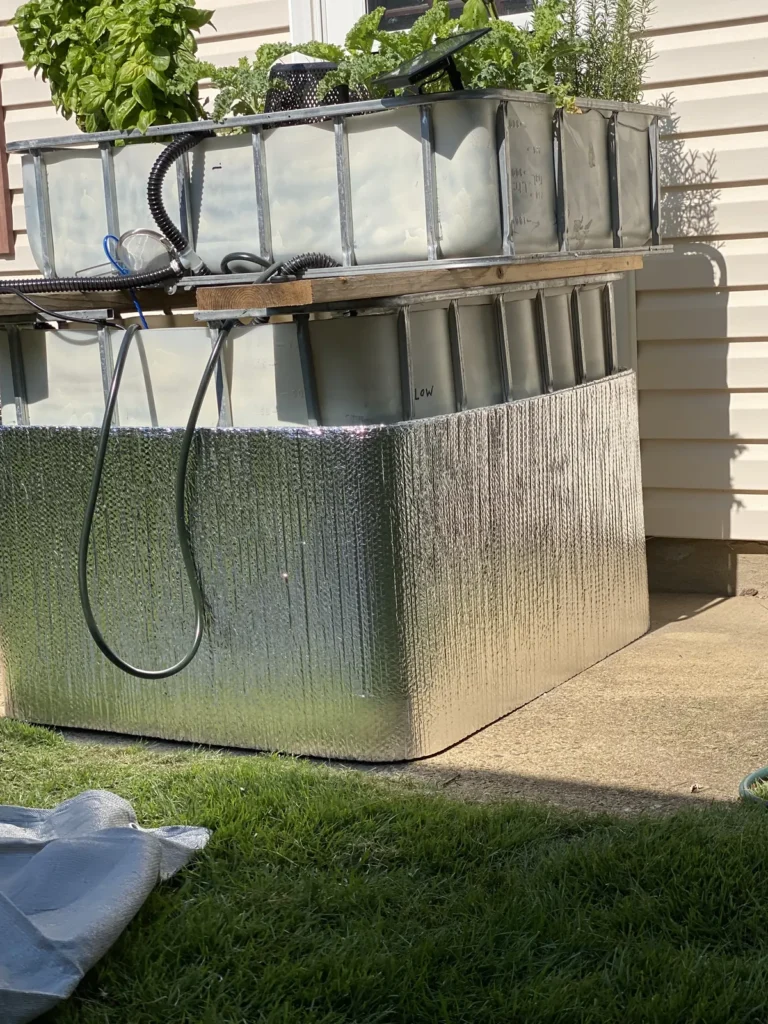
Rigid foam board is useful around stock tanks and converted IBC containers. Cut panels to fit the sides and protect them from water, sunlight, fish, rodents, and physical damage.
Possible materials include:
- Rigid foam insulation board
- Foam panels enclosed in plywood or weather-resistant sheathing
- Insulated removable jackets
- Reflective bubble insulation used as a secondary layer
- Straw bales or insulated walls around outdoor containers
Reflective insulation works best when it faces an air gap. Wrapping a cold tank in one thin shiny layer may help slightly, but it does not replace real insulation.
Insulate the Bottom
A stock tank or IBC container sitting on cold concrete, soil, or a metal frame can lose heat through the base. Install suitable rigid insulation beneath the container before filling it when the structure allows.
Never place soft or compressible material under a full container unless it can support the complete load evenly. Water is heavy, and a twisted IBC frame is a poor winter feature.
Insulate Pipes
Exposed plumbing acts like a radiator. Insulate long pipe runs, especially those outside the greenhouse or near exterior walls.
Keep pipe insulation dry and inspect it for gaps. Valves, unions, and pump housings may remain exposed for access, but they still contribute to heat loss.
Protect the Grow Beds
Cold grow media absorbs heat from circulating water. Large flood-and-drain beds can become significant heat exchangers during winter.
Insulate the bed walls and underside where practical. Reduce drafts beneath elevated beds and repair gaps in greenhouse walls near plumbing and media beds. The Aquaponics Greenhouse Guide covers enclosure layout, ventilation, heating, and insulation together.
Use a Tank Cover Carefully
Evaporation removes substantial heat. A partial cover can reduce evaporation and nighttime heat loss.
Possible covers include:
- Rigid insulated lids
- Floating foam panels designed for water use
- Greenhouse twin-wall polycarbonate panels
- Framed covers with removable access sections
- Insulated hinged lids over stock tanks or IBC containers
Do not seal the water completely. The system still needs gas exchange, aeration, feeding access, inspection space, and a path for plumbing.
Safety note: A cover must not fall into the water, trap fish, block aeration, overheat electrical equipment, or prevent immediate access during an emergency.
Submersible Aquarium Heaters
Submersible aquarium heaters are the simplest choice for small aquaponics systems. They sit directly in the water and use a built-in thermostat to maintain a selected temperature.
They work best in:
- Small indoor systems
- Insulated sumps
- Protected greenhouse systems
- Low-volume quarantine or nursery containers
- Systems needing only a modest temperature increase
The common mistake is sizing the heater from aquarium gallon ratings without considering outdoor heat loss. A heater rated for a 200-gallon indoor aquarium may be badly undersized for a 200-gallon stock tank in an unheated greenhouse.
Glass heaters can break if exposed to air while hot, struck by equipment, or handled carelessly. Place them where fish, pumps, and maintenance tools cannot damage them.
View submersible aquarium heaters on Amazon.
Titanium Heaters With External Controllers
Titanium heaters are often a better fit for larger aquaponics systems. The heating element is durable, and an external temperature controller switches the heater on and off based on a separate probe.
This arrangement offers several advantages:
- No fragile glass tube
- Replaceable controller or heater components
- Remote temperature adjustment
- Separate probe placement
- Support for higher wattage
- Better suitability for sumps and larger water volumes
The controller must be rated for the heater’s electrical load. A 1,000-watt heater should not be connected to a controller designed for a much smaller appliance.
View titanium heaters and external temperature controllers on Amazon.
Use More Than One Heater in Larger Systems
Two smaller heaters can provide better distribution and some redundancy compared with one large heater.
For example, two 500-watt heaters placed in different high-flow areas may be preferable to one 1,000-watt heater. If one fails, the remaining heater may slow the temperature decline until the problem is noticed.
Multiple heaters should still be controlled carefully. Built-in thermostats may not agree, and placing every heater beside the same temperature probe can produce uneven heating.
Do not treat redundancy as extra capacity. If the system requires both heaters to maintain temperature, losing one still creates a problem.
How Much Heater Wattage Do You Need?
Heater demand depends on water volume, desired temperature increase, insulation, exposed surface area, air temperature, wind, plumbing, grow beds, and whether the system is inside a greenhouse.
Indoor aquarium rules of thumb are only a starting point. Outdoor and greenhouse systems may require substantially more wattage.
| System Condition | Heating Difficulty | Practical Expectation |
|---|---|---|
| Small indoor insulated system | Low | Standard aquarium heater may be sufficient |
| Insulated greenhouse stock tank | Moderate | Multiple heaters or titanium system may be required |
| Uninsulated IBC in a greenhouse | High | Insulation should be added before increasing heater size |
| Outdoor exposed stock tank | Very high | Electric aquarium heating may be costly or inadequate |
| Large pond | Very high | Species choice, partial heating, or alternative systems may be more practical |
Use a plug-in electricity meter to measure the heater’s actual energy use. If it runs continuously and the water still cools, the system is losing more heat than the heater can replace.
View plug-in electricity usage meters on Amazon.
Place Heaters in Moving Water
A heater should warm circulating water rather than create one hot pocket.
Good locations include:
- An aerated sump
- A high-flow section of the fish-holding container
- Near the pump intake without blocking it
- Inside a protected heater chamber with continuous flow
- Downstream from solids removal where debris is less likely to coat the element
Avoid placing heaters where they can sit partly exposed when the water level drops. Many heaters can overheat or fail if operated dry.
Use guards around heaters when fish, nets, roots, or maintenance tools could strike the element.
Use a Separate Temperature Controller
An external controller adds a second level of temperature management. The heater’s built-in thermostat can be set slightly above the desired temperature while the external controller handles normal switching.
This setup can reduce the risk of a heater thermostat sticking on, although it does not eliminate all failure modes.
Look for:
- Appropriate wattage and amperage rating
- Waterproof or protected temperature probe
- Heating mode
- Adjustable temperature differential
- High- and low-temperature alarms
- Readable display
- Memory after power loss
View aquarium and greenhouse temperature controllers on Amazon.
Greenhouse Heat Retention
A greenhouse reduces wind exposure and captures solar heat, but it does not automatically remain warm overnight. Thin plastic or single-wall panels lose heat quickly after sunset.
Improve winter performance by:
- Repairing gaps and damaged panels
- Adding an interior plastic layer where appropriate
- Using twin-wall polycarbonate
- Installing insulated north-wall sections
- Using thermal curtains at night
- Sealing drafts near the tank and plumbing
- Adding water barrels or other thermal mass
- Insulating the perimeter and foundation where practical
Thermal mass slows temperature changes. It does not create heat. Barrels warmed during the day can release some heat overnight, but several cloudy days will expose the limits quickly.
Should You Heat the Water or the Greenhouse?
Heating water directly is usually more efficient when fish survival is the main goal. Heating the entire greenhouse may make sense when protecting crops, plumbing, filters, and work areas at the same time.
| Approach | Main Advantage | Main Drawback |
|---|---|---|
| Heat the water | Targets the fish and biological system directly | Grow beds and pipes may still freeze |
| Heat the greenhouse | Protects plants, plumbing, and equipment | Higher energy demand |
| Heat both moderately | Reduces extreme conditions across the system | More equipment and operating cost |
| Reduce winter operation | Lowest energy demand | Less plant and fish production |
In very cold climates, keeping a warm-water fish species active all winter may cost more than changing species, reducing the fish load, or operating seasonally.
Reduce Winter Circulation Heat Loss
Circulation is necessary, but every exposed component can remove heat from the water.
During winter:
- Keep essential water circulation running.
- Insulate exposed pipes.
- Bypass unused grow beds where the design allows.
- Reduce unnecessary waterfalls and spray bars that increase evaporation.
- Keep return lines below covers when practical.
- Protect filters from freezing.
- Do not reduce circulation enough to create stagnant water or ammonia problems.
Water movement and aeration remain essential. The goal is to reduce unnecessary heat loss, not turn the system into a warm stagnant bucket.
Aeration During Winter
Cold water holds more dissolved oxygen than warm water, but fish and bacteria still need reliable aeration. Heaters, covers, reduced waterfalls, and enclosed greenhouses can change gas exchange.
Keep the air pump dry and protected from condensation. Cold air pumped into warm water can contribute some heat loss, but shutting off aeration creates a larger biological risk.
See aeration in aquaponics systems for air-pump sizing and diffuser placement.
Adjust Feeding as Water Cools
Fish metabolism and appetite decline as water cools. Continuing a warm-weather feeding schedule can leave uneaten feed and create ammonia problems while bacterial activity is also slowing.
Reduce feeding based on fish behavior, species, temperature, and water-test results. Do not feed simply because the calendar says it is feeding time.
Test ammonia and nitrite more frequently during seasonal transitions. Use aquaponics water testing basics to monitor the system.
Cold-Weather Water Changes
Adding very cold replacement water can stress fish and force heaters to run continuously.
Prepare replacement water in a separate container when practical:
- Fill a clean conditioning barrel.
- Treat chlorine or chloramine.
- Circulate or aerate the water.
- Check pH.
- Warm the water toward the system temperature.
- Add it gradually.
A stock-tank heater or guarded submersible heater can warm replacement water, but it must be appropriate for the container and used according to the manufacturer’s instructions.
Plan for Power Outages
Winter outages create two problems at once: oxygen and temperature.
Battery systems can run air pumps and small circulation pumps for many hours, but electric heaters consume battery capacity quickly. A generator is usually more practical for extended heater operation.
A layered winter backup plan includes:
- Automatic battery aeration
- A UPS or portable power station for monitoring and limited circulation
- An inverter generator for heaters and larger pumps
- Stored fuel
- Insulated tank covers
- Temperature alarms
- A written shutdown and restart procedure
See backup power for aquaponics systems for runtime calculations and generator planning.
Electrical Safety Around Heated Water
Water heaters combine electricity and water. Treat installation as life-support equipment, not a casual extension-cord project.
- Use ground-fault circuit-interrupter protection.
- Use grounded equipment.
- Keep plugs and controllers dry.
- Create drip loops in power cords.
- Use weather-rated enclosures where required.
- Do not exceed outlet, circuit, controller, or extension-cord ratings.
- Inspect cords for damage.
- Unplug heaters before removing them from water.
- Allow hot heaters to cool before exposure to air.
- Keep combustible material away from space heaters.
Electrical load warning: Two 1,000-watt heaters use 2,000 watts before pumps, aeration, lights, or greenhouse heat are counted. Verify the circuit capacity before plugging in additional heaters.
Temperature Alarms and Remote Monitoring
A temperature alarm provides warning before the fish are visibly stressed. Models may use a local audible alarm, Wi-Fi, or cellular service.
Monitor:
- Low water temperature
- High water temperature
- Greenhouse air temperature
- Power failure
- Water level
- Heater runtime
A Wi-Fi alarm needs the router and internet equipment to remain powered. Put critical monitoring equipment on a small UPS when remote notifications are part of the winter plan.
View water-temperature alarms on Amazon.
Signs the Heating System Is Undersized
- The heater runs continuously.
- Water temperature falls every night.
- The system never reaches the controller setting.
- Temperature varies widely between containers.
- Fish stop eating during normal winter weather.
- Ice forms on pipes or grow beds while the tank remains barely warm.
- Electricity use is high without stable temperature.
- One heater maintains a warm pocket but not the full system.
Before adding more wattage, inspect insulation, covers, drafts, exposed plumbing, flow patterns, heater placement, and temperature-probe location.
Common Winter Heating Mistakes
Many winter failures begin as ordinary design and maintenance errors. The broader aquaponics beginner mistakes guide provides a system-wide checklist.
Heating an Uninsulated Container
A larger heater may mask heat loss without solving it. Insulate the tank, bottom, pipes, and exposed surfaces first.
Using One Small Glass Heater in a Large Stock Tank
An aquarium heater may be unable to maintain temperature in a large greenhouse system. Use realistic wattage, multiple heaters, or a titanium system.
Measuring Air Temperature Instead of Water
Greenhouse air and system water do not change at the same rate. Use a submerged probe.
Placing the Probe Beside the Heater
The controller may shut off while the rest of the system remains cold. Place the probe in representative moving water.
Ignoring Heater Failure
Heaters fail on, fail off, crack, corrode, or lose calibration. Use an independent thermometer and temperature alarm.
Trying to Run Large Heaters From a Small Battery
Resistance heaters consume battery capacity rapidly. Reserve battery power for aeration and circulation, and use a generator for prolonged heating when necessary.
Overfeeding Cold Fish
Cold fish may stop eating while uneaten food continues decomposing. Reduce feeding as temperature and appetite decline.
A Practical Winter Setup
For a protected backyard system using a stock tank or converted IBC container, a practical winter arrangement may include:
- Rigid foam insulation around the sides and bottom
- A removable insulated cover over part of the water surface
- Insulated plumbing
- Two guarded heaters in separate high-flow locations
- An external temperature controller
- An independent thermometer
- A low-temperature alarm
- Continuous aeration
- Reduced winter feeding
- Automatic battery aeration
- A generator for extended outages
The exact equipment depends on the climate and fish. A setup that works in Georgia may be badly undersized in Michigan.
When Seasonal Operation Makes More Sense
Heating a large outdoor system through a severe winter can cost more than the fish and produce very little plant growth.
Seasonal alternatives include:
- Using cold-tolerant fish
- Reducing the winter fish load
- Moving valuable fish indoors
- Operating only an insulated core system
- Bypassing unused grow beds
- Growing cold-tolerant plants
- Shutting down production while protecting plumbing and equipment
The most efficient winter heater is sometimes a better species choice.
What I Would Buy First
- Waterproof probe thermometer
- Rigid foam insulation and a safe removable tank cover
- Titanium heater with an external controller
- Independent temperature alarm
- Backup generator for extended outages
Buy the thermometer before the heater. Insulate before increasing wattage. Add backup power before winter weather proves why it was necessary.
For pumps, heaters, aeration, testing equipment, filtration, and other system components, see the Aquaponics Equipment Guide.
Frequently Asked Questions
What is the best way to heat aquaponics water in winter?
Insulate the fish-holding container and plumbing, reduce evaporation with a safe partial cover, then use a properly sized submersible or titanium heater controlled by a reliable thermostat.
Can I use an aquarium heater in an aquaponics stock tank?
Yes, but aquarium heaters are often rated for indoor conditions. An outdoor or greenhouse stock tank may require more wattage, several heaters, and better insulation.
Are titanium heaters better than glass heaters?
Titanium heaters are more resistant to breakage and are commonly paired with external controllers. Glass heaters are less expensive but more vulnerable to physical and thermal damage.
Should I heat the fish tank or the sump?
Either location can work if water circulates continuously. A sump often protects the heater from fish and equipment, while heating the fish-holding water may reduce delay. Place heaters in representative moving water.
How many watts does an aquaponics heater need?
There is no reliable wattage based only on gallons. Required power depends on insulation, container shape, exposed surface, plumbing, air temperature, desired water temperature, and greenhouse protection.
Can a greenhouse keep aquaponics water warm without a heater?
A greenhouse can slow heat loss and add solar warmth during the day, but it may still become cold overnight. Performance depends on insulation, glazing, sunlight, thermal mass, and climate.
Should I cover the fish tank in winter?
A safe partial cover can reduce evaporation and heat loss. Leave room for gas exchange, aeration, feeding, plumbing, and inspection.
Can I turn off the water pump at night to save heat?
Usually not. Stopping circulation can reduce filtration and oxygen distribution. Reduce unnecessary waterfalls and insulate plumbing instead of shutting down essential water movement.
Can a battery run an aquaponics heater?
It can, but runtime is usually short because resistance heaters use substantial power. Batteries are more effective for aeration and reduced circulation. A generator is generally more practical for prolonged winter heating.
What happens if aquaponics water gets too cold?
Fish metabolism and feeding decline, bacterial activity slows, plant growth changes, and warm-water fish may become stressed or die. The exact risk depends on species and how rapidly the temperature falls.
Final Takeaway
The best way to heat aquaponics water in winter is to reduce heat loss before adding more electrical power. Insulate the stock tank, IBC container, pond walls, plumbing, and grow beds. Cover exposed water safely. Measure the actual water temperature and place heaters in moving water.
Use equipment sized for the real winter environment, not an indoor aquarium rating. Monitor the system with an independent thermometer, reduce feeding as fish slow down, and maintain aeration and circulation.
Finally, plan for power failure. Winter is not the season to discover that the heaters, pumps, and backup equipment all depend on the same outlet and the same optimistic extension cord.