
Keeping aquaponics water clear starts with identifying what is making it cloudy. Green water usually points to free-floating algae. Brown or gray water usually comes from suspended solids, uneaten feed, disturbed grow media, or decomposing organic material. Milky water may indicate a bacterial bloom, especially in a new or recently disturbed system.
Clear water is useful because it makes fish easier to observe, reduces maintenance, and often reflects better control of light, feeding, solids, and water movement. It does not prove that the water is chemically safe. Ammonia, nitrite, chlorine, pH problems, and low dissolved oxygen can all exist in water that looks perfectly clean.
The correct approach is to test the water, identify the type of cloudiness, correct the cause, and give the system time to stabilize. Dumping clarifiers or random treatments into shared fish-and-plant water can create a larger problem than the cloudy appearance.
Quick answer: Block sunlight from the fish-holding water, reduce overfeeding, remove accumulated solids, improve mechanical filtration, maintain reliable circulation and aeration, and confirm that ammonia and nitrite remain near zero.
Clear Water Is Not the Same as Healthy Water
From my system: Field note: the tank could look fine and still need chemistry attention. At other times the water went visibly green as the fish load rose and I chased ammonia, nitrite, and nitrate. Opaque insulation around the IBC reduced sunlight and made a noticeable difference to algae.
Water clarity is only one part of aquaponics water quality. Clear water may still contain dangerous levels of dissolved ammonia or nitrite. Cloudy water may come from harmless dust after adding new grow media or a temporary bacterial bloom during system startup.
Before treating a clarity problem, check:
- pH
- Ammonia
- Nitrite
- Nitrate
- Water temperature
- Fish behavior
- Pump flow
- Aeration
- Recent feeding
- Recent system changes
Use the aquaponics water testing basics guide to separate a cosmetic water-clarity issue from a developing fish-health emergency.
Identify the Type of Cloudy Water First
| Water Appearance | Most Likely Cause | First Things to Check |
|---|---|---|
| Bright green water | Free-floating algae | Sunlight, nitrate, uncovered water, plant uptake |
| Brown or gray cloudiness | Suspended fish waste, feed, soil, media dust, or sediment | Feeding, solids filtration, pump placement, new media |
| Milky white water | Bacterial bloom or suspended fine particles | System age, dead material, ammonia, recent cleaning |
| Tea-colored but transparent water | Dissolved organic material or tannins | Wood, plant debris, composting roots, source water |
| Surface foam | Dissolved organic compounds, protein, feed, or heavy waste | Overfeeding, dead fish, solids buildup, water movement |
| Oily surface film | Feed oils, biofilm, weak surface movement, or contamination | Fish feed, aeration, nearby chemicals, decaying material |
Several conditions can occur together. A heavily fed sunlit stock tank may have green algae, suspended fish waste, and surface foam at the same time. Fixing only one cause may improve the water without making it completely clear.
Green Water Is Usually Free-Floating Algae
Green aquaponics water is usually caused by microscopic algae suspended throughout the water column. Algae needs light, nutrients, and suitable temperature. Aquaponics systems already contain water and nutrients, so direct light exposure often becomes the deciding factor.
Green water becomes more likely when:
- The pond, stock tank, IBC container, or sump receives direct sunlight
- Transparent or translucent plumbing allows light inside
- Nitrate and other nutrients are abundant
- Plant uptake is weak
- A large crop was recently harvested
- Water temperature is warm
- Circulation is poor
- The system is new and not yet balanced
A small amount of algae is normal in outdoor and greenhouse systems. The goal is not sterile water. The goal is preventing algae from dominating the water column, consuming oxygen overnight, coating surfaces, and hiding the fish.
Block Light From the Water
Reducing light exposure is the most dependable long-term correction for green water. Algae cannot maintain a heavy suspended population without enough light.
Cover or shade:
- Fish ponds and stock tanks
- Converted IBC containers
- Sumps
- Settling filters
- Clear tubing
- Transparent filter housings
- Open distribution channels
- Unused openings around plumbing
Use an opaque, secure cover that leaves room for feeding, inspection, plumbing, aeration, and gas exchange. The cover should not fall into the water, trap fish, block air stones, or prevent emergency access.
Shade cloth can reduce direct sun on outdoor or greenhouse systems. It works best when the fish-holding water itself is also covered. Shading the entire greenhouse while leaving an open stock tank in a bright location may not reduce algae enough.
Practical rule: Plants need light. Fish water does not. Direct useful light toward the crops and keep it away from the water wherever possible.
Do Not Eliminate Algae Too Quickly
A major algae population contains living biomass. When a large amount dies at once, bacteria begin decomposing it and consuming oxygen. Ammonia may rise, filters may clog, and fish may become stressed.
After covering a heavily green system:
- Increase aeration.
- Reduce feeding.
- Test ammonia and nitrite daily.
- Clean mechanical filters as dead algae collects.
- Remove settled organic material.
- Watch fish closely near sunrise.
- Allow the water to clear gradually.
Do not assume that dead algae has vanished. It has simply changed from a light problem into a solids and oxygen problem.
Brown or Gray Water Usually Means Suspended Solids
Fish waste, uneaten feed, dead roots, algae fragments, and fine media particles can remain suspended in circulating water. Strong pump turbulence may keep solids moving instead of allowing them to settle or enter a filter.
Common signs of a solids problem include:
- Brown or gray water
- Visible particles moving through the water
- Waste collecting in corners
- Dark sludge in the sump
- Dirty grow-bed surfaces
- Roots coated with fine material
- Filters clogging quickly
- Foul odor
- Slow drainage
- Persistent surface foam
Improving solids removal usually requires better capture before waste reaches pumps, grow beds, raft roots, or narrow plumbing.
Use Settling Filtration for Heavy Solids
Swirl filters and radial flow settlers slow the water so heavier fish waste can drop to the bottom. The collected sludge is then removed through a drain valve.
A swirl filter is simple and inexpensive. Water enters a round container in a circular pattern, allowing heavier particles to settle.
A radial flow settler directs incoming water downward before allowing it to rise toward the outlet. This controlled change in direction often separates solids more efficiently than a basic swirl pattern.
| Filter Type | Best Use | Main Limitation |
|---|---|---|
| Swirl filter | Simple backyard systems and low-cost builds | May allow more fine solids to pass |
| Radial flow settler | Stock tanks, IBC systems, and heavier fish loads | Requires more careful internal plumbing |
| Filter brushes | Capturing medium particles after settling | Need regular rinsing |
| Coarse sponge or pads | Polishing water after heavy solids removal | Clog quickly if used first |
| Filter socks | Temporary fine-particle removal | Require frequent cleaning or replacement |
See aquaponics solids filtration basics for filter placement, sizing, sludge removal, and maintenance.
Fine Filtration Comes After Heavy Solids Removal
Sponges, mesh, filter pads, brushes, and filter socks can improve clarity by trapping smaller particles. They work best after a settling filter has already removed larger waste.
Putting fine material first creates a maintenance problem. The media clogs quickly, restricts flow, and begins decomposing captured waste.
A practical filtration sequence is:
- Remove large settleable solids.
- Capture medium suspended particles.
- Use fine polishing media only when needed.
- Provide biological filtration after excessive solids have been removed.
- Send cleaner water toward sensitive plant roots and channels.
Mechanical filter media should be easy to remove and rinse. Any filter that requires partial demolition for cleaning will eventually become a decorative barrel full of sludge.
Affiliate disclosure: This page contains affiliate links. As an Amazon Associate I earn from qualifying purchases.
View pond filter brushes and mechanical filter media on Amazon.
Overfeeding Is a Major Cause of Cloudy Water
Every pellet added to the system becomes fish growth, fish waste, dissolved nutrients, or uneaten organic material. Overfeeding increases solids, ammonia production, bacterial activity, and oxygen demand.
Feed only what the fish consume promptly. The exact time depends on fish species and feed type, but uneaten food should not remain floating or collect on the bottom.
Reduce or stop feeding when:
- Ammonia or nitrite is detected
- Fish are not eating normally
- Water temperature is outside the normal feeding range
- A pump or air pump has failed
- A fish has died
- Water is heavily cloudy or foamy
- Filters are overloaded
- The system is recovering from an outage
Fish tolerate missed meals better than they tolerate decomposing feed in low-oxygen water.
Check the Fish Feed Itself
Low-quality or damaged feed can break apart quickly and release fine particles and oils into the water. Pellets should remain intact long enough for the fish to consume them.
Store feed in a sealed container away from moisture, heat, insects, and rodents. Discard feed that smells rancid, contains mold, or has absorbed water.
Some surface oil after feeding is normal, especially with high-fat feed. A persistent film may indicate excessive feeding, poor surface movement, or feed that is breaking down before consumption.
Improve Water Circulation Without Creating a Blender
Water movement helps transport solids toward drains and filters. Poor circulation allows waste to settle in corners and low areas.
Too much turbulence can create the opposite problem by breaking waste into smaller particles and keeping it suspended. Pumps placed directly in settled sludge may pull waste apart before filtration can remove it.
Good circulation should:
- Move waste toward a bottom drain or collection area
- Prevent stagnant corners
- Distribute oxygenated water
- Avoid stressing fish with excessive current
- Allow settling filters to receive intact solids
- Maintain reliable grow-bed and filter flow
Round stock tanks often work well with a gentle circular current. Rectangular IBC containers may need careful inlet placement because corners collect waste.
Use how to size a pump for an aquaponics system before increasing pump capacity. More pump is not automatically more filtration.
Aeration Supports Clearer and More Stable Water
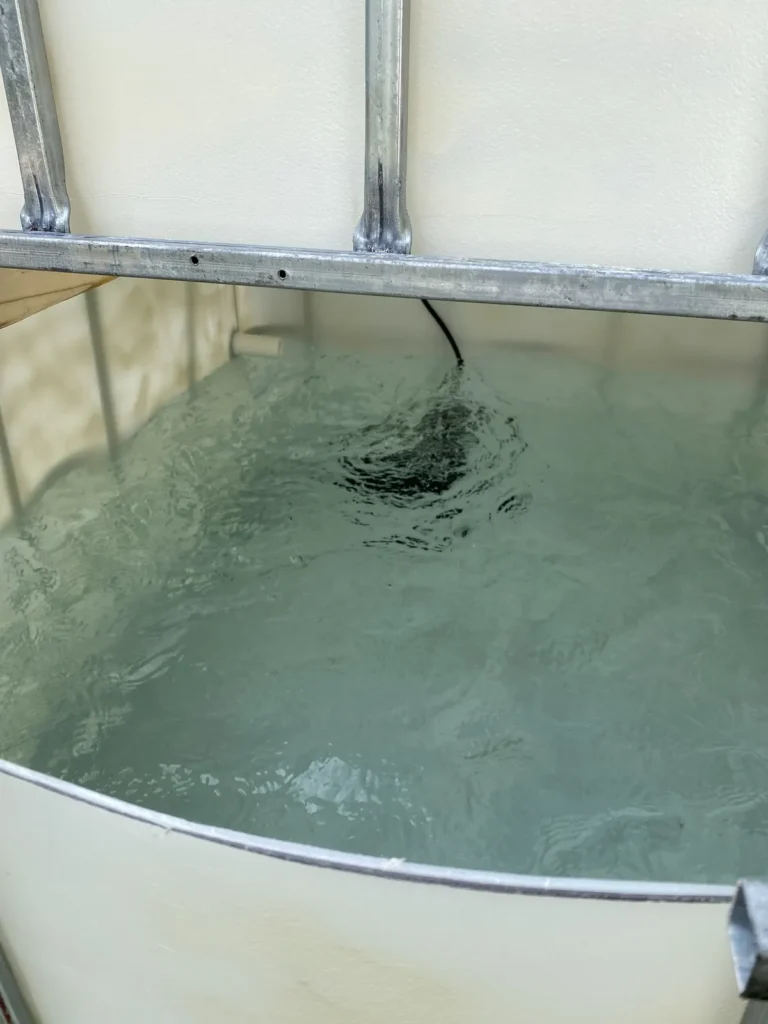
Aeration does not physically remove suspended particles, but it supports fish, nitrifying bacteria, and aerobic decomposition. It also improves surface movement and reduces stagnant areas.
Low oxygen allows organic waste to break down poorly and can create foul-smelling anaerobic areas in filters, media beds, and tank bottoms.
Aeration becomes especially important when:
- Algae is dying
- Water is warm
- Fish are heavily stocked
- Solids have accumulated
- Mechanical filters are dirty
- Water circulation is reduced
- The system has recently been treated or changed
See aeration in aquaponics systems for air-pump sizing, diffuser placement, maintenance, and backup aeration.
View pond air pumps for aquaponics on Amazon.
Biological Filtration Helps Stabilize the System
Biological filtration does not directly strain particles from the water. It provides oxygenated surface area for bacteria that convert ammonia into nitrite and then nitrate.
A mature biological filter helps prevent dissolved waste from becoming toxic, but it does not replace mechanical filtration. A barrel full of bio-media may process ammonia while allowing visible fish waste to circulate through the system.
Biological filtration can struggle when:
- The system is new
- Ammonia production rises suddenly
- Water temperature drops
- pH moves outside the useful bacterial range
- Aeration fails
- Chlorine or chloramine enters the system
- Filter media becomes packed with solids
- The biofilter dries out
Cloudy water combined with ammonia or nitrite is a system problem, not merely an appearance issue.
Milky Water and Bacterial Blooms
Milky or whitish water may be caused by a bacterial bloom. This commonly occurs in new systems or after a large amount of organic material enters the water.
Possible triggers include:
- System startup
- Overfeeding
- A dead fish
- Dead plant roots
- A large algae die-off
- Cleaning too much biological media at once
- A sudden increase in fish load
- Disturbing settled sludge
- Adding unwashed grow media
Test ammonia and nitrite immediately. Increase aeration, remove obvious organic waste, reduce feeding, and avoid unnecessary chemical treatments. Many startup blooms clear as the biological system stabilizes.
New Grow Media Can Cloud the Water
Lava rock, gravel, and expanded clay may contain dust and fine particles. If the media is not washed thoroughly, those particles can circulate through the system for days.
Before adding grow media:
- Rinse manageable batches outside the system.
- Agitate the media to release trapped dust.
- Continue rinsing until runoff becomes reasonably clear.
- Fill and flush the grow bed before connecting it to fish water when practical.
- Clean mechanical filters frequently during the first days of operation.
See aquaponics grow bed media basics for media selection, washing, depth, weight, and maintenance.
Surface Foam and Organic Buildup
Foam that remains on the surface can indicate dissolved organic compounds from fish feed, waste, dead organisms, algae, or plant material.
A few temporary bubbles near an air stone or water return are normal. Persistent thick foam deserves investigation.
Check for:
- Overfeeding
- Dead fish
- Decaying roots
- Dirty mechanical filters
- Heavy algae die-off
- Restricted water exchange
- Excess protein or oil from feed
- Contamination from soap or cleaners
If soap, detergent, pesticide, fuel, paint, or another unknown chemical may have entered the system, treat the situation as contamination rather than ordinary cloudy water.
Tea-Colored Water and Tannins
Water may appear brown while remaining transparent. This can come from tannins released by wood, leaves, roots, or other plant material.
Tannins are different from suspended solids. A settling filter will not remove dissolved color efficiently.
Remove the source when possible, perform limited water replacement with properly conditioned water, and monitor pH. Some natural materials can lower pH as they decompose.
A slight tea color is not automatically dangerous, but unknown wood, treated lumber, bark, or decomposing debris should not remain in shared aquaponics water.
Can Plants Help Clear the Water?
Healthy plants remove nitrate and other dissolved nutrients that would otherwise support algae. Strong plant growth therefore helps reduce the conditions that encourage green water.
Plant uptake is not a substitute for blocking direct light or removing fish solids. Plants mainly use dissolved nutrients. They do not remove large waste particles from the water.
Algae problems may appear after:
- A major harvest
- Removing several mature plants
- Plant disease or root failure
- Seasonal slowing of plant growth
- Weak greenhouse lighting
- Cold water reducing nutrient uptake
Balance fish feeding and stocking with the amount of active plant growth. See what plants grow well in aquaponics systems for crop selection.
Should You Use a UV Clarifier?
A UV clarifier exposes passing water to ultraviolet light. It can reduce free-floating algae and some suspended microorganisms, making it useful for persistent green water.
UV works best when:
- The water passes close enough to the lamp
- The flow rate matches the unit
- The quartz sleeve remains clean
- The bulb is replaced on schedule
- Heavy solids are removed before the UV unit
- Light exposure to the fish water has already been reduced
UV does not remove settled waste, correct overfeeding, lower nitrate, improve poor circulation, or replace biological filtration. It treats water passing through the chamber, not the underlying system design.
See using UV filters in aquaponics systems for sizing, flow, installation, maintenance, and limitations.
View pond UV clarifiers on Amazon.
Avoid Algaecides and Random Water Clarifiers
Products sold for swimming pools, decorative ponds, fountains, and general gardening may not be safe for fish, nitrifying bacteria, plant roots, or edible crops.
Algaecides can kill algae quickly and create a sudden oxygen demand as the dead material decomposes. Some products contain copper or other compounds that can harm fish and aquatic organisms.
Water clarifiers may bind particles together, but that does not guarantee suitability for a recirculating food-production system.
Food-production rule: Do not add a chemical to aquaponics water unless the label and manufacturer clearly support use with the fish, bacteria, and edible plants in the system.
Do Not Clean the Entire System at Once
Aquaponics systems depend on bacteria living on wet surfaces. Aggressively cleaning every pipe, grow bed, filter, and piece of bio-media at the same time can remove or damage a large portion of the biological filter.
Clean mechanical filters as needed, but avoid sterilizing mature biological media. Rinse bio-media only when flow is restricted, and use system water rather than chlorinated tap water when practical.
Stagger major maintenance so the remaining system continues processing ammonia and nitrite.
How Long Does Cloudy Water Take to Clear?
The recovery time depends on the cause and the severity of the problem.
| Cause | Typical Response | What Controls Recovery Time |
|---|---|---|
| Media dust | Several hours to several days | Particle size, filtration, flushing |
| Overfeeding and suspended waste | Several days to weeks | Feeding reduction, solids removal, filter capacity |
| Green-water algae | Several days to several weeks | Light exclusion, UV, nutrient balance, cleanup of dead algae |
| Bacterial bloom | Several days to several weeks | System maturity, organic load, ammonia, aeration |
| Tannins | Weeks or longer | Removal of source, water replacement, dissolved organic load |
Do not expect instant results after installing a filter or covering the tank. Suspended material must pass through the filter, algae must stop reproducing, dead material must be removed, and the biological system must stabilize.
A Step-by-Step Water-Clarity Plan
- Test the water. Check pH, ammonia, nitrite, nitrate, and temperature.
- Observe the fish. Look for gasping, sluggish behavior, crowding around returns, or reduced feeding.
- Identify the color and type of cloudiness. Green, brown, milky, foamy, or tea-colored water points toward different causes.
- Stop overfeeding. Reduce feed immediately when waste is visible or water chemistry is unstable.
- Remove dead material. Check for dead fish, roots, leaves, and uneaten feed.
- Block sunlight. Cover fish water, sumps, filters, and transparent plumbing.
- Drain settled solids. Clean swirl filters, radial flow settlers, and sump bottoms.
- Improve mechanical filtration. Use coarse removal before fine filter pads or socks.
- Verify pump flow. Confirm water reaches filters and grow beds without stagnant areas.
- Increase aeration. Especially during algae die-off, warm weather, or bacterial blooms.
- Clean filters gradually. Avoid destroying biological filtration.
- Monitor daily until stable. Track clarity, ammonia, nitrite, feeding, and fish behavior.
Troubleshooting by Symptom
| Symptom | Likely Cause | Immediate Action |
|---|---|---|
| Green water with normal ammonia | Sunlight and nutrient-fed algae | Block light, increase aeration, consider UV |
| Brown water after feeding | Feed dust or suspended waste | Reduce feed and improve solids removal |
| Milky water in a new system | Bacterial bloom | Test daily, aerate, avoid overfeeding |
| Cloudy water after adding media | Dust and fines | Flush beds and clean mechanical filters |
| Foam with foul odor | Heavy organic waste or decomposition | Stop feeding, remove waste, increase aeration |
| Clear water with fish gasping | Low oxygen, nitrite, or another invisible problem | Increase aeration and test immediately |
| Water clears but ammonia rises | Algae die-off or damaged biofilter | Reduce feeding, aerate, monitor daily |
| Water remains cloudy despite filtration | Filter too small, flow too fast, or particles too fine | Reduce flow through settler or add staged filtration |
Common Water-Clarity Mistakes
Cloudy water is often a symptom of a wider management problem. The beginner mistakes guide helps trace those connected causes.
Treating Green Water Without Blocking Sunlight
Algae will return when the main light source remains unchanged. Shade and opaque covers solve the cause rather than repeatedly treating the symptom.
Adding Fine Filter Pads Before a Settling Filter
Fine media clogs quickly when large fish waste reaches it first. Remove heavy solids before polishing the water.
Increasing Pump Flow Without Checking the Filter
High flow can push solids through a settling filter before they drop out. Filter performance depends on slowing water down.
Cleaning Biological Media With Chlorinated Water
Chlorine and chloramine can damage the bacteria responsible for processing ammonia and nitrite.
Continuing to Feed During a Water-Quality Problem
Additional feed increases waste while the system is already struggling. Reduce feeding until chemistry and filtration recover.
Assuming UV Fixes the Entire System
UV may clear suspended algae. It does not remove fish waste, lower nitrate, fix overstocking, restore oxygen, or clean a clogged grow bed.
Chasing Swimming-Pool Clarity
A mature aquaponics system is a living environment. Slight color, biofilm, and natural organic material are normal. The target is stable, observable water, not sterile-looking water at the expense of system biology.
Routine Maintenance for Clearer Water
| Task | What to Check | Practical Frequency |
|---|---|---|
| Observe fish and water | Color, particles, foam, fish behavior | Daily |
| Remove uneaten feed | Pellets collecting on the surface or bottom | After feeding |
| Drain settling filters | Sludge depth and outlet clarity | As fish load requires |
| Clean brushes or pads | Restricted flow and trapped waste | Weekly or as needed |
| Inspect tank covers | Light leaks, safety, ventilation | Monthly |
| Check pump flow | Reduced circulation or clogged intake | Weekly |
| Inspect air stones | Weak or uneven bubbles | Weekly |
| Remove dead roots and leaves | Organic buildup in beds and filters | During harvest and pruning |
| Test water chemistry | pH, ammonia, nitrite, nitrate, temperature | Weekly when stable |
| Inspect UV equipment | Flow, sleeve cleanliness, lamp age | According to manufacturer schedule |
What I Would Correct First
For green water, I would cover the fish-holding water and increase aeration before buying additional equipment. If the water remained green after light control, I would inspect plant uptake and consider a properly sized UV clarifier.
For brown or gray water, I would reduce feeding, drain accumulated sludge, and improve settling filtration before adding fine filter pads.
For milky water, I would test ammonia and nitrite, remove decomposing material, increase aeration, and allow the biological system time to stabilize.
The equipment comes after the diagnosis. A bigger filter does not fix direct sunlight, and a UV clarifier does not fix three handfuls of feed entering a system that needed one.
Useful Equipment for Water Clarity
- Freshwater liquid test kit
- Filter brushes and coarse mechanical media
- Pond UV clarifier
- Continuous-duty pond air pump
- Opaque covering and shade material
- Small transfer pump for maintenance and water changes
For a broader overview of filtration, pumps, aeration, UV clarifiers, test kits, plumbing, and backup equipment, see the Aquaponics Equipment Guide.
Frequently Asked Questions
Why is my aquaponics water green?
Green water is usually caused by free-floating algae receiving enough light and nutrients. Cover or shade the fish-holding water, improve plant uptake, maintain filtration, and consider UV only when light control is not enough.
Why is my aquaponics water cloudy and brown?
Brown cloudiness usually comes from suspended fish waste, uneaten feed, disturbed sludge, or dusty grow media. Reduce feeding and improve settling and mechanical filtration.
Is cloudy aquaponics water dangerous?
It can be. The appearance alone does not determine risk. Test ammonia, nitrite, pH, and temperature, and check fish behavior, aeration, and filtration.
How long does green aquaponics water take to clear?
It may take several days to several weeks after sunlight is blocked. Recovery depends on algae density, temperature, filtration, aeration, plant uptake, and whether a UV clarifier is used.
Will a UV filter clear green aquaponics water?
A properly sized UV clarifier can reduce free-floating algae. It will not correct overfeeding, high nutrients, direct sunlight, solids accumulation, or inadequate biological filtration.
Can I use an algaecide in aquaponics?
Avoid algaecides unless the product is clearly approved for the fish, bacteria, and edible crops in the system. Many pond and pool treatments are inappropriate for aquaponics.
Can overfeeding make aquaponics water cloudy?
Yes. Uneaten feed and increased fish waste create suspended solids, bacterial growth, ammonia, oxygen demand, foam, and filter overload.
Do grow beds filter aquaponics water?
Media beds capture some solids and provide biological filtration, but excessive waste can clog the media and create low-oxygen areas. Heavier fish loads benefit from mechanical filtration before the beds.
Should aquaponics water be crystal clear?
Not necessarily. Slight natural color and biofilm are normal in a mature living system. The water should allow fish observation and remain free from excessive suspended waste, heavy algae, foul odor, and unstable chemistry.
Why is the water cloudy after cleaning the system?
Cleaning can disturb settled waste or damage biological filtration. Check ammonia and nitrite, increase aeration, remove suspended solids, and avoid cleaning every biological component at once.
Final Takeaway
Keeping aquaponics water clear requires treating the cause rather than the color. Block sunlight to control green-water algae. Reduce feeding and remove settled fish waste to correct brown cloudiness. Improve mechanical filtration before adding fine polishing media. Support the biological system with reliable circulation, aeration, and stable water chemistry.
Test before treating. Clear water can still be dangerous, and cloudy water can sometimes be temporary. Watch the fish, follow ammonia and nitrite, inspect the filters, and give the system time to respond after corrections.
The goal is not swimming-pool water. The goal is stable water that supports fish, bacteria, and plants without turning every filter cleaning into an archaeological dig.