
Aquaponics combines fish keeping, biological filtration, and soilless plant growing in one recirculating system. That sounds like three hobbies stacked in a trench coat, and some days it behaves exactly that way. The good news is that beginners do not need to master everything at once; they need to make the first decisions in the right order.
This page is the front door. It explains what to choose, what to postpone, and which detailed guide to read next. Start small enough to observe, large enough that water conditions do not swing wildly, and simple enough that every pipe has an understandable job.
Affiliate disclosure: This guide contains Amazon affiliate links. If you buy through one of them, Aquaponics411 may earn a commission at no additional cost to you. As an Amazon Associate, Aquaponics411 earns from qualifying purchases.
First Decision: What Do You Want the System to Do?
From my system: Beginner reality check: aquaponics was not technically beyond me, but it was more work than the cheap-and-easy articles suggested. A normal day could be five minutes; a weekend could be an hour or two; a failure could take over the day. Build something you can operate, not just something you can assemble.
A learning system, a salad-producing backyard unit, and a fish-production project are different designs. Write down the primary goal, available footprint, climate, electrical access, water source, and the person who will check it during vacations. Honest constraints create better systems than ambitious gallon counts.
Choose a Growing Method
Media Bed
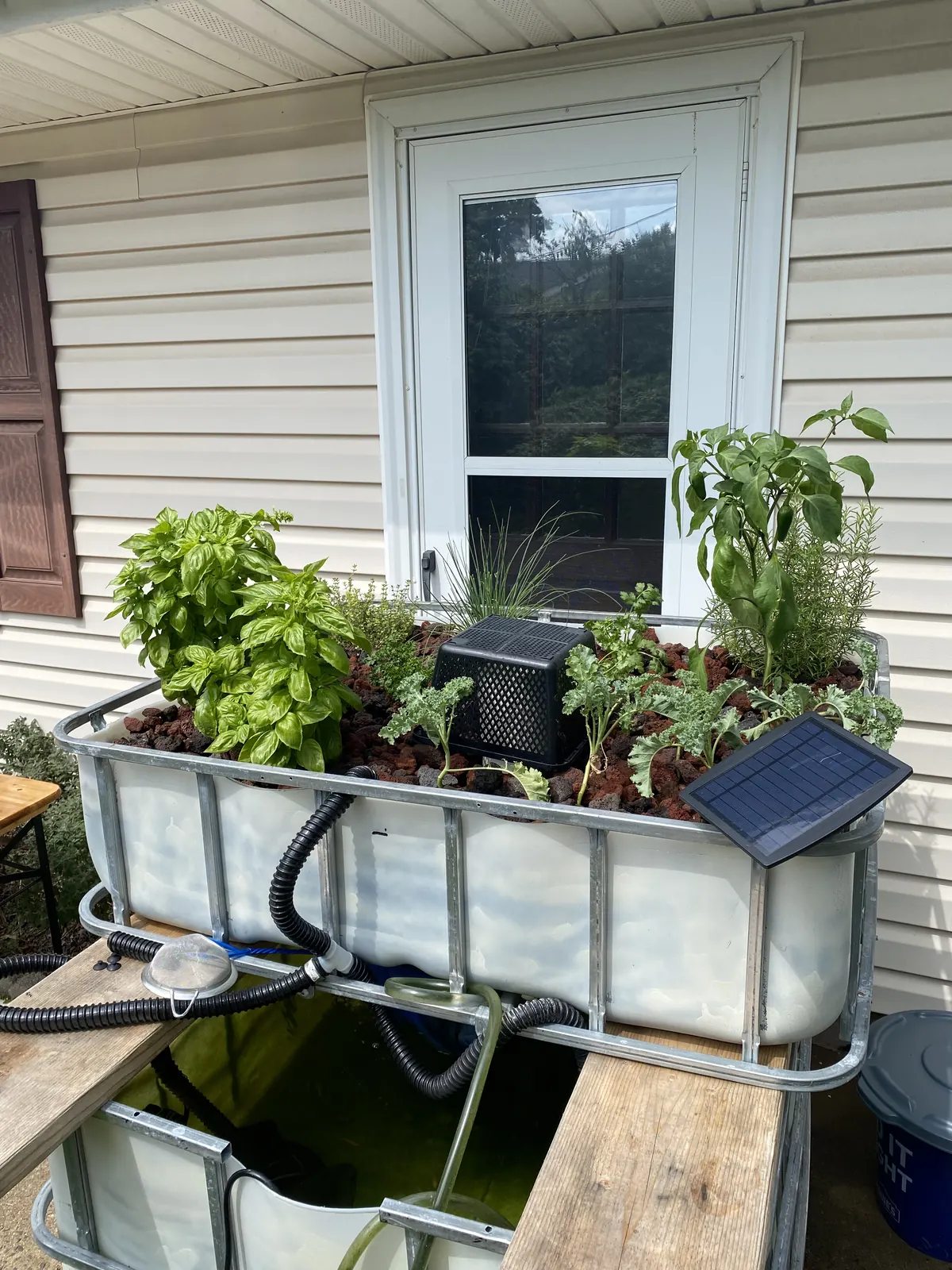
Media beds are forgiving for beginners because the bed supports roots, provides biological surface area, and captures some solids. They are heavy and require thoughtful drainage, but their plumbing is visible and understandable. Review grow-bed media basics before pricing bags by volume.
Deep Water Culture
DWC or raft systems float plants above aerated water. They can produce leafy greens efficiently, but usually benefit from separate solids removal and biofiltration. Root-zone oxygen and raft cleanliness become central maintenance jobs.
Nutrient Film Technique
NFT moves a shallow flow through channels. It is compact and attractive for smaller-rooted crops, but narrow passages can clog and plants lose their water supply quickly during a pump interruption. It is often better as an expansion than as a first and only growing method.
Set a Realistic Starter Budget
Spend first on containment, circulation, aeration, testing, safe plumbing, and backup planning. Decorative controls and automation can wait until the basic system has produced boringly stable readings. The equipment guide separates essential purchases from tempting early extras.
A sensible starter kit may include a freshwater liquid test kit, backup-capable air pump, and water thermometer. The correct pump and plumbing depend on the design, so calculate before buying.
The Eight-Week Mental Model
- Plan: choose layout, site, tank, bed, and service access.
- Build: support every water-filled component and protect electrics.
- Wet test: find leaks, drain-back problems, and unreliable siphons.
- Cycle: establish nitrification without risking a full fish load.
- Plant lightly: begin with forgiving leafy greens and herbs.
- Add fish conservatively: acclimate and feed lightly.
- Measure: watch ammonia, nitrite, nitrate, pH, and temperature trends.
- Expand only after stability: let the first system teach you what the second needs.
Water Quality Without Number-Chasing
Fish, plants, and nitrifying microorganisms overlap rather than share one perfect number. The useful habit is consistent testing, written trends, and small corrections. A single surprising result should be confirmed before a large intervention, unless fish are visibly distressed and immediate aeration or dilution is clearly necessary.
Start with water-testing basics. Learn what pH, ammonia, nitrite, and nitrate mean before buying meters for every possible ion. Dissolved oxygen deserves special respect because a low-oxygen failure can become serious long before a weekly spreadsheet notices.
Fish: Match the Climate Before the Menu
Warm-water fish may require expensive winter heating, while cool-water species may struggle through hot summers. Availability and local regulations can narrow the list further. Goldfish are practical for ornamental learning systems; edible species make sense only when temperature, tank volume, oxygen, filtration, and harvest plans support them.
Compare goldfish with tilapia, catfish, and bass before ordering fingerlings. The cheapest fish is not cheap after a season of heating unsuitable water.
Plants: Earn Tomatoes Later
Leafy greens and many herbs are sensible first crops because their nutrient demand and structural needs are modest. Fruiting crops can thrive in mature systems, but they require stronger light, longer timelines, physical support, and closer nutrient management. The plant-selection guide helps match crops to system maturity.
The Failure-Proofing Walkaround
- Can water overflow safely without entering a building?
- Will the fish still receive oxygen if the main return clogs?
- Can the pump be removed without draining the entire system?
- Are cords protected with drip loops and ground-fault protection?
- Can every drain and filter be opened after plants are mature?
- Who receives an alarm or checks the system during an outage?
Read common beginner mistakes before filling the tank. It is much cheaper to recognize someone else’s mistake while holding a tape measure.
Your Next Guide
| If you are… | Read next |
|---|---|
| Building with an IBC tote | Chop-and-flip build guide |
| Choosing a pump | Pump sizing |
| Planning pipe and drains | Plumbing guide |
| Ready to establish bacteria | Fishless cycling |
| Preparing for winter | Greenhouse guide |
Technical Sources
The system overview is grounded in Oklahoma State University Extension’s Aquaponics overview and the FAO small-scale aquaponics manual.
Choose the Location Before Choosing the Tank
Aquaponics needs a level load-bearing surface, safe electricity, a suitable water source, drainage for maintenance, and enough light for the intended crops. It also needs frequent human observation. A system hidden behind a shed may enjoy excellent sun and terrible ownership.
Measure the route from delivery point to final location, including gates, steps, and turns. Plan where wet media, replacement pumps, harvested plants, and fish nets will move. Protect the system from roof runoff, lawn chemicals, vehicle traffic, and curious children or animals without making routine access miserable.
What Not to Automate Yet
Automation is valuable after the owner understands the manual process. Automatic feeders can overfeed during a pump failure; automatic top-off can hide a leak and dilute water chemistry; dosing pumps can turn a small sensor error into a large chemical error. Begin with alarms and observation before granting equipment permission to make irreversible decisions.
A timer, temperature alarm, or power-failure alert can reduce risk without pretending to run the ecosystem alone. Add one control at a time, document its normal behavior, and make sure the system fails into a safe condition when the device loses power or connectivity.
A Sustainable Weekly Routine
Daily, look at fish behavior, circulation, aeration, water level, leaks, and plant condition. Weekly, test the parameters appropriate to the system’s maturity, inspect pump intakes and drains, remove dead leaves, and review feed. Monthly, clean components by need rather than by a schedule that destroys healthy biofilm.
Seasonally, prepare for heat, freezing, storms, vacations, and changing crop loads. Keep critical spares labeled and dry. Maintenance becomes manageable when it is a short rhythm; neglected tasks wait patiently and then arrive together wearing tiny emergency hats.
Five Purchases to Delay
- A large fish order before cycling is complete
- A powerful pump chosen without a head-height calculation
- Expensive nutrient meters before basic liquid testing is understood
- A greenhouse before summer ventilation is planned
- More grow beds before the first bed stays balanced
What Success Looks Like in Year One
Success is not maximum density. It is stable water, healthy fish, useful harvests, and the confidence to notice a change before it becomes a loss. A modest system that runs through four seasons teaches more than an ambitious build that is dismantled after one dramatic summer.
Before you commit: Read the 16-month IBC case study and the real maintenance schedule for the operating reality behind the build.