
Start With a Rule of Thumb, Then Test the Real System
A useful backyard starting point is to think in terms of system turnover: how much water actually circulates through the system over time.
Oklahoma State says it is generally recommended to choose flow capable of cycling the entire system in about an hour and, in its example sizing method, accounts for both grow-bed demand and fish-tank circulation. [1]
That is a starting rule—not a law of physics.
The flow your system actually needs depends on fish load, feeding, aeration, filtration, grow-bed design, pipe size, vertical lift and how the drains behave.
Most importantly, the number printed on the pump box is not the number you automatically get in the system.
Pump Rating Is Not Actual Flow
Pump flow falls as the pump has to lift water higher. Pipe length, diameter, elbows, valves, fittings, filters and fouling add resistance.
OSU specifically identifies flow rate and head pressure as key pump-selection factors. [1]
So if a pump is advertised at 1,000 GPH, the useful question is:
1,000 GPH at what head—and what will it deliver through my actual plumbing?
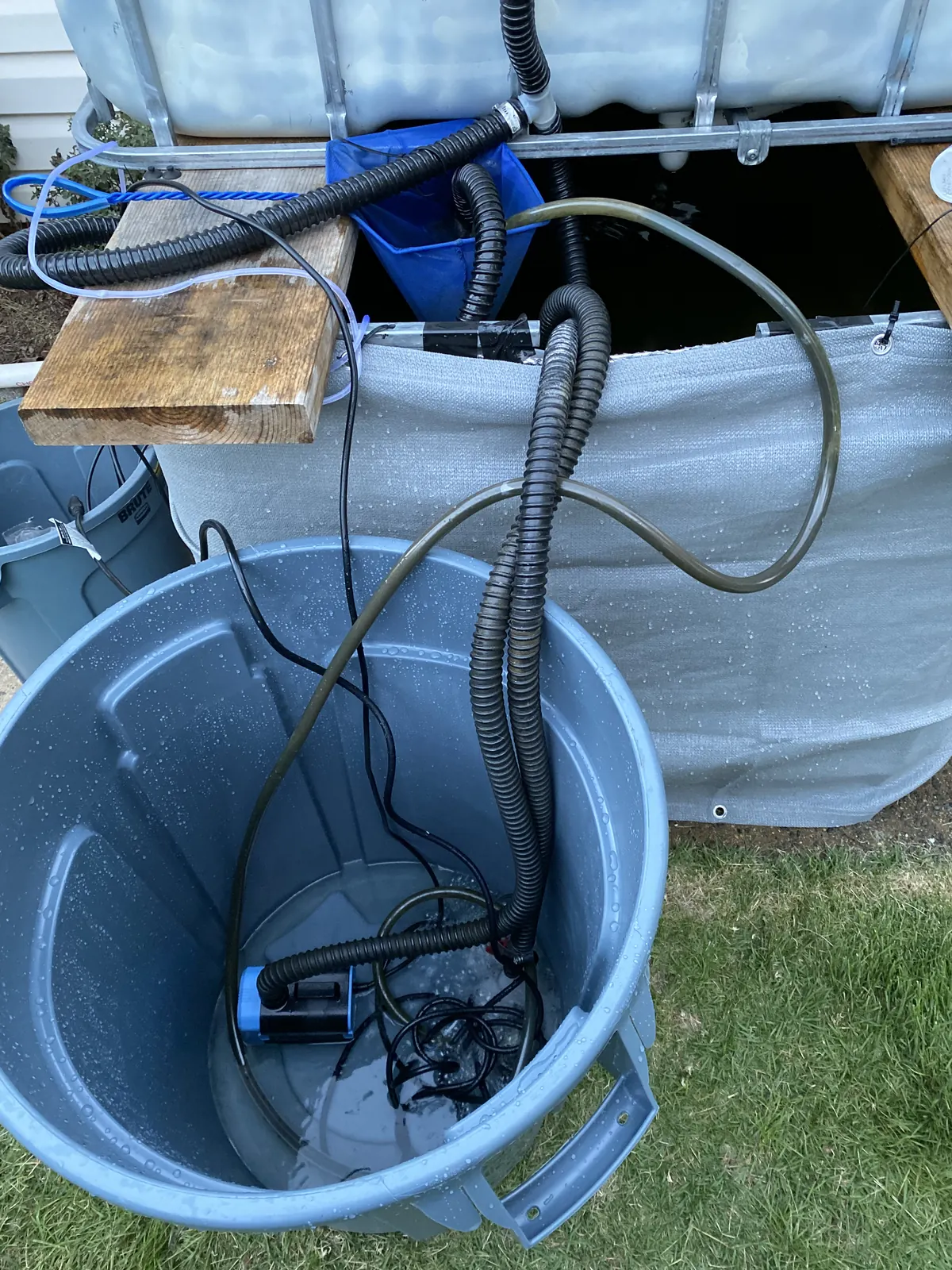
I Learned This by Buying the Wrong Pump Twice
My first pump was too small for the flood-and-drain behavior I wanted. It took roughly 35–40 minutes to fill the grow bed.
So I went bigger.
The replacement pump swung too far the other way and could fill the bed in roughly 2–3 minutes at full flow.
I ended up using valves to throttle the system until the bed filled in roughly 9–10 minutes and drained in about 45 seconds to a minute.
Those numbers are not my recommendation for your grow bed. They are the point: real flow has to work with the actual system.
The bigger pump gave me adjustment room. The valves let me tune the branches instead of accepting whatever the pump wanted to do.
Flood-and-Drain Flow Has to Work With the Drain
With a bell siphon, inflow is part of the siphon’s operating window.
Too little flow and water can trickle over the standpipe without establishing a reliable siphon. Too much inflow and the bed may not drain far enough for the siphon to break cleanly.
I spent about a day tuning mine. Pump flow was one variable; outlet geometry was another.
That is why a flow page cannot be reduced to “buy X GPH.”
Flow Also Has to Serve the Fish and Biofilter
Water movement transports fish waste toward treatment and brings treated, oxygenated water back through the system. FAO’s basic aquaponics guidance explicitly calls for adequate water circulation and aeration to support fish, bacteria and plants. [2]
OSU likewise describes water movement as a combination of the pump, piping and gravity and recommends using gravity where practical. [3]
The required circulation therefore changes as fish biomass and feeding change. A lightly stocked backyard system and a high-density recirculating aquaculture system do not belong on the same one-number rule.
More Flow Is Not Automatically Better
Excessive flow can create its own problems:
- drains may not keep up;
- bell siphons can become difficult to tune;
- settling devices can lose the calm hydraulic conditions they need;
- branches can become hard to balance;
- energy use rises;
- maintenance becomes noisier and less forgiving.
OSU notes that solids-settling design depends on both flow and retention time. [3] A section intended to settle solids does not benefit from simply blasting water through it faster.
Pipe and Gravity Capacity Can Become the Limit
The pump only controls the pressurized side.
Once water has to return by gravity, pipe diameter, slope, fittings, biofilm, roots and debris determine what that drain can safely carry.
A larger pump connected to an undersized gravity return is a flood generator with good marketing.
prevention.
Measure What You Actually Built
Where you have an accessible outlet, a bucket-and-stopwatch test is often enough to sanity-check actual flow:
1. collect a known volume of water; 2. time how long collection takes; 3. convert that to gallons or liters per minute/hour; 4. repeat with the system in its normal valve positions and operating head.
Example: if a 5-gallon bucket fills in 30 seconds, that outlet is delivering about 10 gallons per minute, or roughly 600 gallons per hour.
Do not perform the test in a way that risks draining a fish tank, running a pump dry or causing an overflow elsewhere.
Size for Head, Then Leave Yourself a Sensible Adjustment Range
A pump should meet the required flow at the actual head, not merely at zero lift.
Some reserve can be useful because real systems accumulate resistance and because a valve or bypass can reduce excess branch flow. But wildly oversizing a pump wastes electricity and can create hydraulic problems.
The goal is controllable flow, not maximum flow.
Contextual product/link opportunities
Brian’s verified firsthand plumbing inventory includes a barbed ball valve and hose-barb tee used in his system. Those are legitimate contextual affiliate candidates in the section about branch balancing if the current product records remain available and the link is useful.
Do not turn the article into a pump shopping list. Pump-model recommendations belong on the pump-sizing/equipment pages where the commercial intent is stronger.
Firsthand / Research Boundary
Mixed. Brian’s pump mistakes, fill/drain timing and valve tuning are firsthand from one IBC system. General turnover, head, circulation, filtration and gravity-flow guidance is research-led.
For pump selection, see how to size a pump for an aquaponics system and the aquaponics plumbing guide. Compare this flow path with sump tanks, CHOP, and CHOP2. Troubleshoot a pump at aquaponics pump problems and a siphon at bell siphon troubleshooting. Design safe drains with pipe and drain sizing and overflow prevention; then plan mechanical and biological filtration.
n