
If you are building an IBC aquaponics system, finding the tote can be one of the first real challenges.
The internet makes the actual construction look easy. Find a 275-gallon tote, cut the top off, flip it over for a grow bed, add some plumbing, and you are in business.
There is one important step hiding in there:
You need the right IBC tote.
A cheap used tote that previously contained a food product may be an excellent starting point. A cheap tote with an unknown history may be something I would walk away from, especially when the water will eventually support fish and plants you intend to eat.
Fortunately, food-grade IBC totes are not particularly rare. Once you know where to look and what questions to ask, you can often find them locally without paying the freight charges associated with buying a brand-new tote.
My basic rule: I would rather pay a little more for an IBC tote with clearly known previous contents than save money on a mystery container.
What Is a Food-Grade IBC Tote?
From my system: Field note: I bought my IBC through Craigslist and hauled it home on a borrowed trailer. I remember paying around 0, but that was roughly five or six years ago. Treat that number as history, not current buying guidance.
An IBC, or Intermediate Bulk Container, is a large tank commonly used for transporting and storing liquids.
The familiar aquaponics version normally consists of a plastic inner tank surrounded by a metal cage and mounted on a pallet. The common 275-gallon version is roughly 48 inches by 40 inches at the base, which is one reason it has become so popular for DIY aquaponics systems.
Most plastic IBC bottles are made from high-density polyethylene, or HDPE.
But HDPE by itself does not tell you that a used tote is safe for aquaponics.
For a used aquaponics tote, I care about two things:
- Was the tote suitable for food contact when it was manufactured?
- What was actually stored in it before you bought it?
The second question is every bit as important as the first.
The Best Used IBC Tote Has Known Previous Contents
For aquaponics, my first choice is usually a used tote with clearly identified previous contents that were themselves food products or food ingredients.
Examples might include:
- Fruit juice or juice concentrate
- Corn syrup
- Other food syrups
- Vinegar
- Edible oils
- Food flavorings
- Beverage ingredients
- Other clearly identified food-production ingredients
I would still clean the tote thoroughly before using it.
“Previously contained food” does not mean “ready to add fish.”
Nobody wants a 200-gallon fish tank that smells faintly of Caesar dressing.
Where to Find Food-Grade IBC Totes Near You
The cheapest IBC tote is often not sitting in an online industrial-supply warehouse. It may be twenty minutes from your house.
1. Facebook Marketplace
This would probably be my first search.
Try several searches rather than just IBC tote:
- food grade IBC tote
- 275 gallon food grade tote
- food safe IBC tote
- IBC water tote
- 275 gallon water tank
- IBC totes near me
Do not assume that a Marketplace seller knows what “food grade” actually means. Ask what the tote contained.
“I don’t know, but we washed it.”
That is not the answer I want.
Cleaning an unknown tote does not magically give it a known history.
2. Craigslist and Local Classifieds
Craigslist and other local classified sites can still be surprisingly useful for finding IBC totes, especially in agricultural and industrial areas.
Search both farm and garden listings and the general for-sale section. Use several variations of the name because sellers are not always using the same terminology.
One person calls it an IBC tote, another calls it a water tank, another calls it a 275-gallon container, and somebody will inevitably call it “that big plastic cube thing.”
You want to find all four sellers.
3. Food and Beverage Manufacturers
This is one of my favorite potential sources because you may be able to establish exactly what was in the container.
Look around your area for businesses such as:
- Beverage manufacturers
- Juice processors
- Bakeries and commercial baking suppliers
- Syrup manufacturers
- Food-processing facilities
- Sauce manufacturers
- Breweries
- Wineries
- Ingredient distributors
- Edible-oil distributors
These businesses may receive ingredients in IBC totes and have no use for the empty container.
Some already have contracts for tote collection or recycling, so do not expect every company to sell them. But it costs very little to ask.
Instead of simply asking, “Do you have any IBC totes?” try something more specific:
“Do you ever sell or dispose of used 275-gallon IBC totes that held food ingredients, and would the original product label still be available?”
That tells them exactly what you are looking for.
4. Local IBC Tote Dealers and Reconditioners
Search for terms such as:
- IBC tote dealer near me
- used IBC totes near me
- food grade totes near me
- IBC tote recycling
- IBC container reconditioning
This may cost more than buying from a private seller, but you may get better information about the tote’s condition and previous use.
Used IBC Totes
The bottle, cage, and pallet have all been used. For aquaponics, I would want a documented food-use history.
Reconditioned IBC Totes
A used IBC has been cleaned, inspected, and repaired or refurbished as necessary.
Do not assume the word reconditioned automatically means suitable for aquaponics. Ask about the bottle’s previous contents.
Rebottled IBC Totes
This can be a particularly interesting option for aquaponics.
A rebottled IBC normally combines a new inner plastic bottle with a used or reconditioned cage and pallet.
You get the part that actually holds your water new without necessarily paying for an entirely new IBC.
New IBC Totes
Everything is new. This gives you the least ambiguity, but usually at the highest price.
For a backyard aquaponics build, I would check local used food-grade and rebottled options before paying to ship a brand-new IBC across the country.
5. Farm, Garden, and Industrial Sellers
Do not limit your search to aquaponics suppliers. IBC totes are used in many industries.
- Irrigation
- Livestock water
- Rainwater collection
- Maple syrup
- Food processing
- Brewing
- Manufacturing
- Commercial gardening
- Pressure washing
- Bulk liquid handling
A seller advertising a 275-gallon water tank may have exactly what you want without ever using the word aquaponics.
Ask What Was in the Tote Before You Buy It
This is the question I would put above every other buying criterion:
What did this tote contain?
Ideally, I want the seller to tell me specifically.
- Not enough: “Food stuff.”
- Better: “Corn syrup.”
- Best: “Corn syrup, and here is the original product label.”
An original label or other documentation is far more useful than somebody pointing at the plastic and saying, “Yep, food grade.”
Why I Avoid Totes With Unknown Contents
I would not use a tote with unknown previous contents for my fish tank or grow bed.
That includes the bargain tote where the seller says:
- “It was probably food grade.”
- “I think it just had soap.”
- “We rinsed it three times.”
- “There’s no smell anymore.”
- “The guy I got it from said it was safe.”
- “I don’t know what was in it.”
For storing scrap metal? Fine.
For an aquaponics system where fish live in the water and edible plants share that water?
I would spend a little more and find a container whose history I know.
Totes I Would Avoid for Aquaponics
I would pass on any used IBC that previously contained:
- Pesticides
- Herbicides
- Petroleum products
- Solvents
- Industrial chemicals
- Automotive fluids
- Unknown cleaning chemicals
- Concentrated detergents
- Paint products
- Adhesives
- Anything poisonous
- Anything whose identity cannot be established
And I would not change my mind because the tote was pressure washed.
If I cannot establish what was previously stored in the tote, I do not use it for fish or edible aquaponic crops.
Do UN Markings Mean an IBC Tote Is Food Safe?
No.
This is an easy point to misunderstand.
Markings molded or printed onto an IBC can tell you useful things about its manufacture and transport rating, but a UN-rated IBC is fundamentally a transport certification. It is not proof that a particular used tote is suitable for your aquaponics system.
Similarly, seeing an HDPE recycling symbol does not tell you what was previously stored inside the tote.
For a used aquaponics tote, you still need the previous-content history.
Inspect the Tote Before Handing Over the Money
Once I am comfortable with the tote’s history, I inspect the actual container.
Check the Inner Bottle
- Cracks
- Deep gouges
- Unexplained discoloration
- Bulging
- Brittle plastic
- UV damage
- Repairs
- Stains
- Strange odors
Pay special attention to the bottom of the tank around the outlet valve.
A tiny leak on a dry tote can become much more interesting after you add a ton of water.
And yes, 250 gallons of water weighs more than 2,000 pounds. This is not the time for “eh, that crack will probably hold.”
Check the Cage
Surface rust does not automatically bother me. Structural damage does.
- Badly bent cage tubing
- Broken welds
- Missing crossbars
- Crushed corners
- Severe corrosion
If you intend to do a chop-and-flip build, the cage eventually becomes part of the structural support for the grow bed.
Check the Pallet
IBC pallets may be metal, plastic, wood, or composite depending on the design.
Make sure the base is structurally sound and appropriate for your intended installation.
Check the Valve
- Valve body
- Valve handle
- Outlet
- Cap
- Gaskets
- Visible leakage
Also look at the outlet style before buying plumbing parts.
IBC valves and outlet threads are not all identical. This is one of those lessons that can turn a six-dollar adapter into a three-trip hardware-store adventure.
For more on planning the rest of the system, see the Aquaponics Plumbing Guide.
275 Gallons or 330 Gallons?
Both sizes can work for aquaponics.
The 275-gallon IBC is particularly common and is the size most people picture when they think of an IBC aquaponics system.
A 330-gallon tote offers additional volume while often retaining approximately the same pallet footprint, although exact dimensions and construction should always be checked before designing around one.
For a chop-and-flip build, I care more about the tote’s condition, known previous contents, dimensions, cage design, and valve position than I do about chasing the largest possible gallon number.
How Much Should a Used Food-Grade IBC Tote Cost?
There is no universal price because these are very local items. Condition, previous use, cleaning, seller type, location, and transportation all affect the price.
| IBC Tote Type | Relative Cost |
|---|---|
| Used tote with questionable or unknown history | Cheapest |
| Used food-grade tote with known contents | Low to moderate |
| Cleaned or better-condition food-grade tote | Moderate |
| Rebottled tote with new inner bottle | Moderate to higher |
| Completely new IBC | Highest |
This is exactly why I would search locally before ordering one online.
Freight can eat the bargain before the tote ever reaches your driveway.
Should You Buy a $50 IBC Tote?
Maybe.
If somebody five miles away has a $50 tote that demonstrably held a harmless food ingredient, still has its label, does not leak, and has a good cage, I would be interested.
If a $50 tote has no label and nobody knows whether it contained corn syrup or industrial solvent, I would leave it there.
The important number is not just the purchase price.
Purchase price + risk + cleanup + replacement parts + transportation.
A known-history $120 tote can easily be a better deal than a mystery $50 tote.
Before You Drive to Pick One Up
IBC totes are large. A standard tote footprint is roughly four feet by a little over three feet, and the complete cage can be close to four feet high.
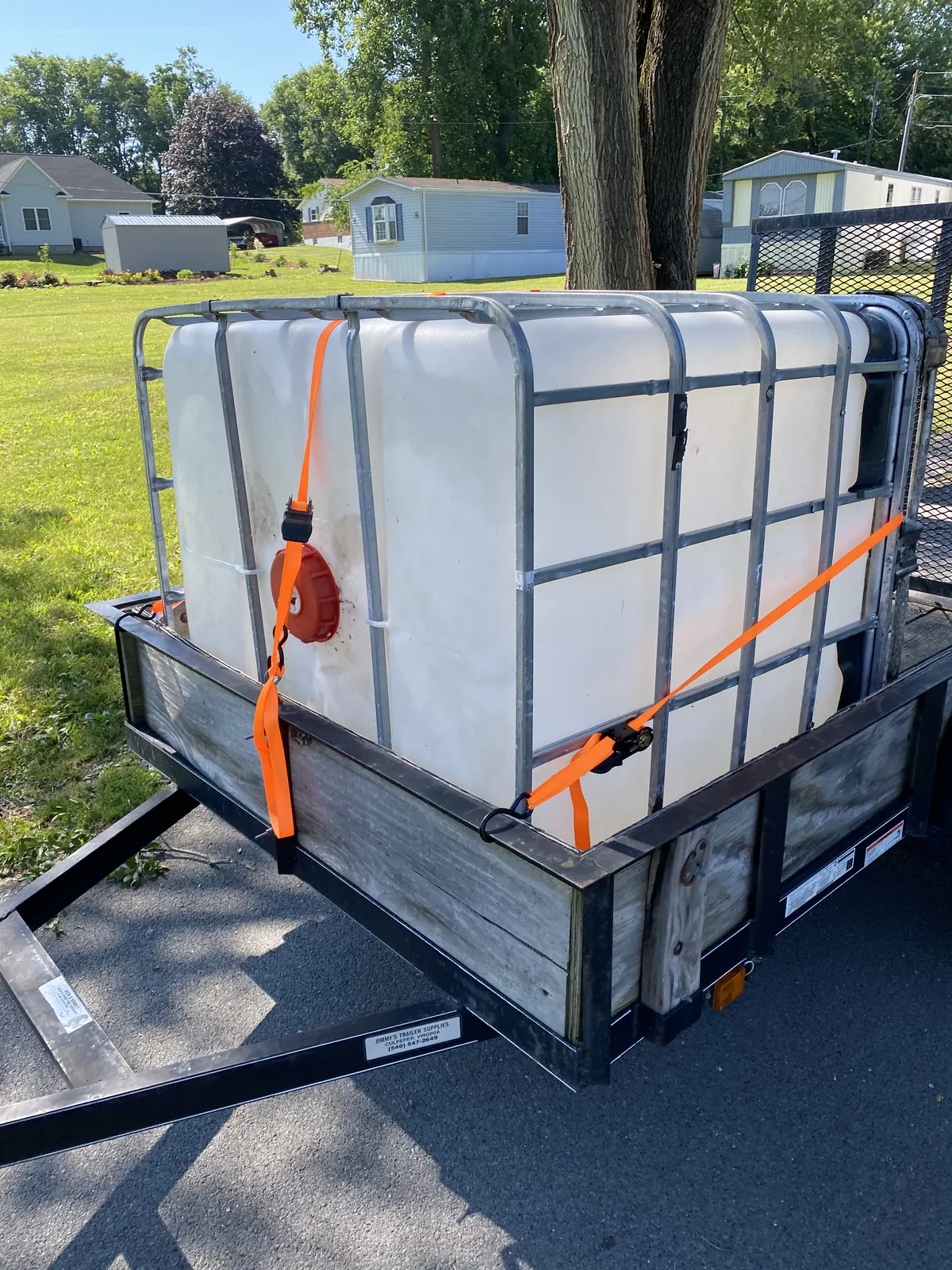
Before driving an hour to pick one up:
- Measure your truck, trailer, or van.
- Measure gates and access points at home.
- Ask whether the seller can load it.
- Determine how you will unload it.
- Confirm the exact tote dimensions.
- Bring proper straps or tie-downs to secure it for transport.
Most importantly, think about where your finished aquaponics system is going before cutting anything.
Once an IBC becomes a fish tank with plumbing hanging from it, moving it stops being a casual Saturday activity.
Clean Even a Food-Grade Tote Before Using It
“Food grade” does not mean “skip the cleaning.”
A tote that held syrup, juice concentrate, vegetable oil, or another food ingredient can still contain substantial residue.
Before putting fish anywhere near it, clean and rinse the tote thoroughly until there is no visible residue or odor remaining.
If I cannot determine what the residue actually is, I am back to the previous rule:
I do not use mystery containers for aquaponics.
What I Would Buy for an Aquaponics System
First Choice
A good-condition, once-used 275-gallon IBC from a local food or beverage operation with the original product label still attached.
Second Choice
A used food-grade tote from an established local IBC seller who can document the previous contents.
Third Choice
A rebottled tote with a new inner bottle and a sound used cage.
Fourth Choice
A completely new IBC if local prices are terrible or I simply want to eliminate the uncertainty.
What I Would Not Buy
A cheap tote with an unknown history.
There are too many food-grade IBC totes in circulation to build an entire aquaponics system around a mystery tank.
Found Your Tote? Build the Aquaponics System
Once you have a suitable IBC, the container becomes only the beginning.
The next step is the IBC Tote Aquaponics Chop-and-Flip Build Guide.
That guide covers cutting the tote, arranging the fish tank and grow bed, plumbing the system, leak testing, and getting it ready for startup.
Related Aquaponics Guides
- Aquaponics for Beginners: Start Here
- Aquaponics Plumbing Guide
- Aquaponics Grow Bed Media Basics
- How to Size a Pump for an Aquaponics System
- How a Bell Siphon Works in Aquaponics Systems
- How to Cycle an Aquaponics System Without Fish
Bottom line: Finding a food-grade IBC tote is usually not difficult. The important part is finding one with a history you can trust. Buy the known container, inspect it carefully, clean it thoroughly, and then build around it.