
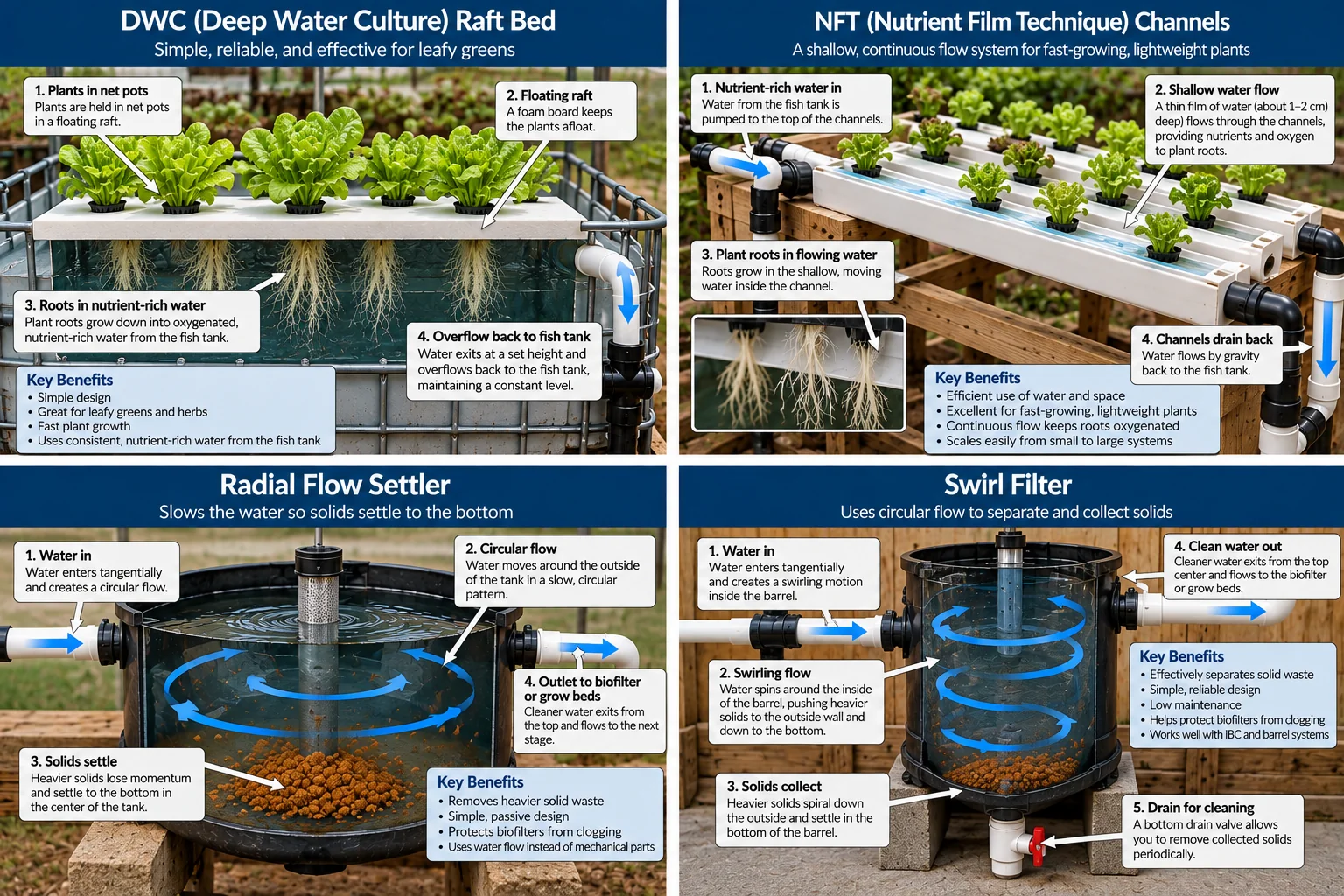
A radial-flow settler is a barrel-shaped traffic cop for fish waste.
Dirty water enters near the center, gets redirected, slows across a larger settling area, and gives heavier particles a chance to fall instead of following the water out.
It is mechanical filtration. It does not replace a biofilter.
> Experience note: I did not build or test a radial-flow settler in my documented IBC system. This guide is based on aquaculture engineering and extension sources.
What the settler is trying to accomplish
Settleable particles drop only when the hydraulics give them the opportunity.
A useful radial-flow design reduces incoming energy, changes the water’s direction, creates a comparatively calm settling zone, withdraws clarified water gently, and provides a low point where captured sludge can be removed.
The device is not working because the barrel is round. It is working because of what happens to velocity and flow direction inside it.
The basic layout
A home-scale radial-flow settler typically needs:
1. an inlet carrying solids-laden water toward the center;
2. a center stilling or distribution section;
3. a flow redirection that spreads water radially;
4. a broad, calm settling zone;
5. a high, low-velocity clarified-water outlet;
6. a bottom sludge drain.
The approved page graphic shows that flow path directly.
Do not size it by folklore
“Use a 55-gallon drum” is not a design calculation.
Settling performance depends on water flow, effective settling area, particle characteristics, and internal hydraulics.
Published aquaculture research comparing radial-flow and swirl separators under equivalent loading found substantially better average total suspended solids removal from the radial-flow design. That result does not guarantee a DIY barrel will reproduce the study’s performance. It demonstrates why controlled hydraulic geometry matters. (Davidson & Summerfelt, Aquacultural Engineering)
The USDA Agricultural Research Service also summarizes the radial-flow separator work in the context of solids removal in recirculating aquaculture. (USDA ARS)
Measure the actual flow
Know how much water is really passing through the settler.
Two identical barrels can behave completely differently if one is pushed at much higher flow.
If solids are being swept out, possible fixes include lowering flow through that vessel, increasing effective settling area, splitting flow, or improving the internal inlet/outlet hydraulics.
Do not solve every filtration problem by buying a larger pump.
Calm the inlet
The inlet should not shoot a jet across the settling zone.
A center stilling tube or similar distribution arrangement can carry incoming water into the vessel and redirect it more gently.
The objective is to dissipate energy, not create impressive turbulence.
Withdraw clarified water gently
A tiny outlet concentrates velocity.
A broader collection perimeter, multiple openings, or another low-velocity withdrawal design can reduce the tendency to pull settling material back upward.
Whatever outlet you choose needs enough capacity to pass design flow even when biofilm and debris begin to appear.
Put the sludge drain where sludge actually goes
Captured solids need an exit.
Place the purge at the lowest practical point and make it easy enough to use that it will actually get used.
A separator that captures waste and then stores it in the recirculating loop until it decomposes has only moved the problem into a barrel.
See Aquaponics Sludge and Mineralization.
Where it belongs in the system
A radial-flow settler belongs early in a filtration train, close to the fish-waste source and before a dedicated biological filter or solids-sensitive DWC/NFT plant stage.
See Aquaponics Solids Filtration Basics and How to Arrange Mechanical and Biological Filtration.
Commission it by watching the water
Before trusting the separator, observe:
- whether the inlet short-circuits toward the outlet;
- whether a strong rotating current keeps solids suspended;
- where sludge actually accumulates;
- whether draining re-suspends material;
- whether the outlet pulls particles upward;
- whether the vessel can safely handle downstream blockage or overflow.
The label “radial flow” does not fix bad hydraulics.
Radial-flow build checklist
Verify:
- measured operating flow is known;
- inlet energy is dissipated;
- flow spreads into a calm settling region;
- clarified water leaves at low local velocity;
- the outlet cannot easily clog;
- sludge drains from the low point;
- the vessel is easy to isolate and clean;
- overflow behavior is safe;
- captured solids are removed on a deliberate schedule.
Radial flow vs swirl
Both are gravity separators.
The radial-flow design deliberately redirects water through a larger settling region rather than relying on a persistent vortex. Controlled aquaculture testing found the radial design more effective than the swirl separator tested under equivalent loading. (Davidson & Summerfelt)
See How to Build a Swirl Filter for Aquaponics for the simpler tangential-flow approach.
Bottom line
A radial-flow settler is not complicated because it has many parts. It is demanding because the water has to behave correctly.
Build around actual flow, calm settling area, gentle withdrawal, and easy sludge removal. Copying barrel dimensions without copying the hydraulic conditions is how a good design idea turns into a decorative bucket.
For related practical guidance, see Solids filtration basics and Flow and pump sizing.