
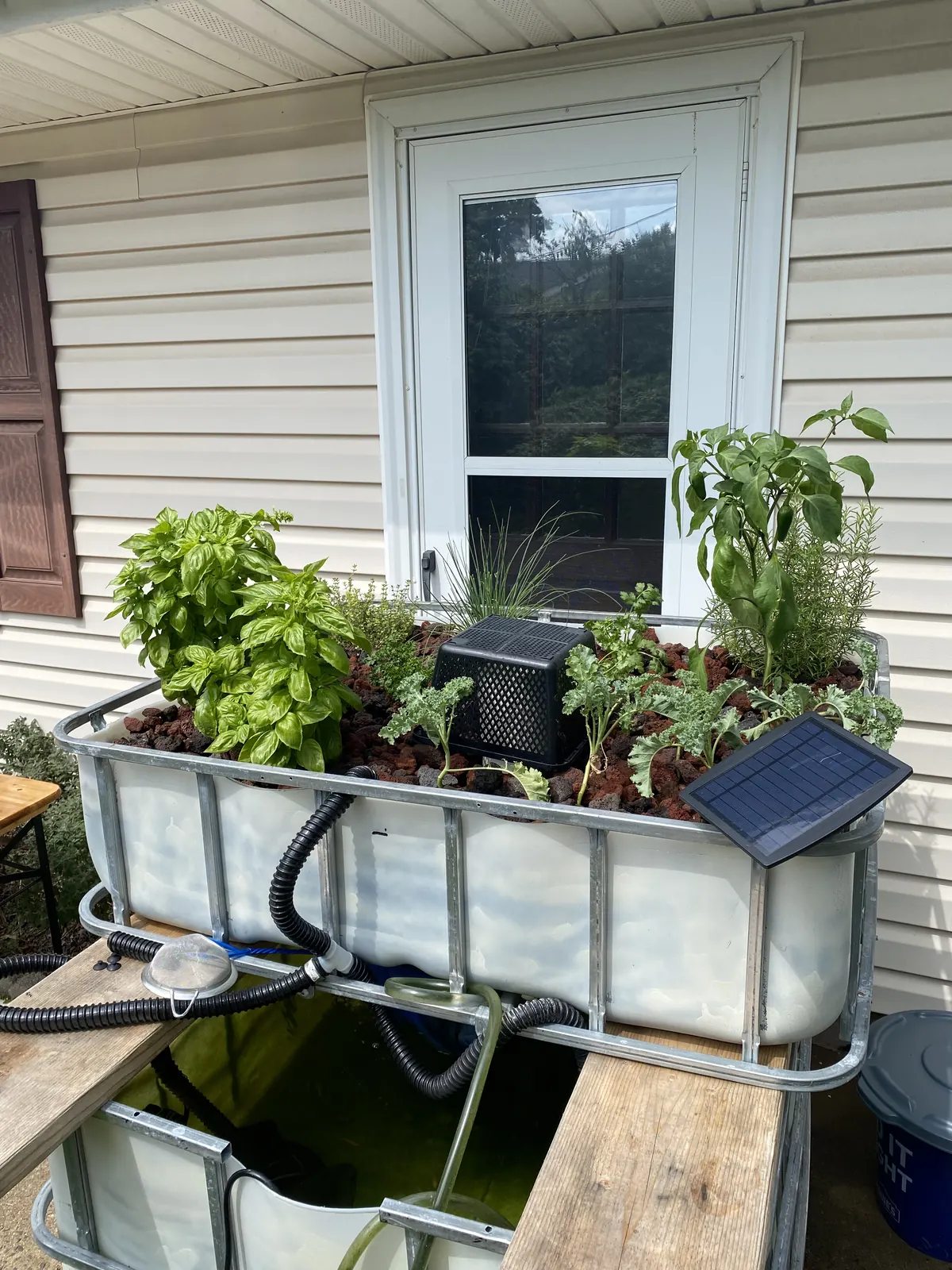
You do not need an IBC tote to build aquaponics.
An IBC is convenient because it combines large water volume, structural support and a rectangular footprint. If you cannot source one safely—or cannot fit one through the gate—that is a container problem, not an aquaponics dead end.
What the replacement tank must do
Any alternative needs to solve the same basic jobs: Source
- safely hold water continuously;
- use a material suitable for fish/water contact;
- withstand the filled load;
- allow plumbing connections;
- tolerate the installation environment;
- provide enough usable volume;
- be cleanable;
- have a known enough history that you are not gambling with contamination.
Livestock stock tanks
Polyethylene stock tanks are one of the easiest IBC alternatives for a backyard system.
Advantages:
- wide open top;
- good access;
- available in multiple sizes;
- easy to plumb through flat wall sections on many models;
- purpose-built to hold water.
Limitations:
- usually no structural cage;
- shape may consume more floor area;
- UV rating and wall thickness vary;
- the tank still needs a safe base and cover.
Purpose-built aquaculture tanks
Fiberglass and polyethylene aquaculture tanks are the cleanest technical option when budget allows.
SRAC describes fiberglass as durable, non-toxic, movable and easy to plumb, while polyethylene is also common because of cost.
Round tanks can improve circulation and solids collection, especially as stocking density increases.
The downside is cost and shipping.
Food-grade barrels and drums
Known-history food-grade barrels can work for small systems, filters, sumps or paired fish/grow components.
They are inexpensive and compact, but their usable volume is limited and curved walls complicate some plumbing connections.
Do not assume a blue plastic drum is food-safe because it is blue.
Rigid polyethylene water tanks
Water-storage tanks can offer substantial volume in shapes that differ from an IBC.
Check:
- material rating;
- previous use;
- UV resistance;
- outlet size/location;
- whether the tank is intended for above-ground use;
- access for cleaning and fish capture.
Lined wood or masonry tanks
A lined structure can create a custom footprint for DWC, sump or fish use.
The liner then becomes the actual water-contact material. Protect it from puncture, folds, sharp fasteners and incompatible chemicals.
This approach adds construction complexity and should not be treated as the cheap option automatically.
Generic storage totes are not automatically fish tanks
A household storage bin may be made of a chemically acceptable plastic and still be structurally unsuitable for hundreds of pounds of water.
Side walls bow. Lids do not provide hoop strength. UV exposure can embrittle plastics that were designed for a closet.
Material safety and structural suitability are separate questions.
Known history matters
For any used container, ask: Source
- What was stored in it?
- Can the previous contents be documented?
- Is residue visible or detectable by odor?
- Has the material been damaged?
- Can every surface be cleaned and inspected?
If the previous contents are unknown, walking away is often cheaper than trying to prove a mystery tank is safe.
What my IBC experience does—and doesn’t—transfer to
I built and operated one IBC tote system. That firsthand experience gives me a practical basis for identifying what an alternative container has to replace:
- enough water volume to buffer the system;
- a reliable support structure;
- plumbing access;
- space for fish;
- a cover/shade strategy;
- maintainable geometry.
It does not make me a firsthand reviewer of stock tanks, fiberglass aquaculture tanks or every barrel design.
Choose the container after choosing the system
A DWC build, media-bed build and compact ornamental-fish system do not need the same tank shape. Source
Decide the system layout and space constraints first. Then choose the container that fits those jobs without forcing the rest of the build around a cheap tank you happened to find.
This comparison is research-led outside my one IBC system. I have not personally tested the alternative tank types discussed here.
For related practical guidance, see IBC sourcing and Tank bulkhead fittings.