
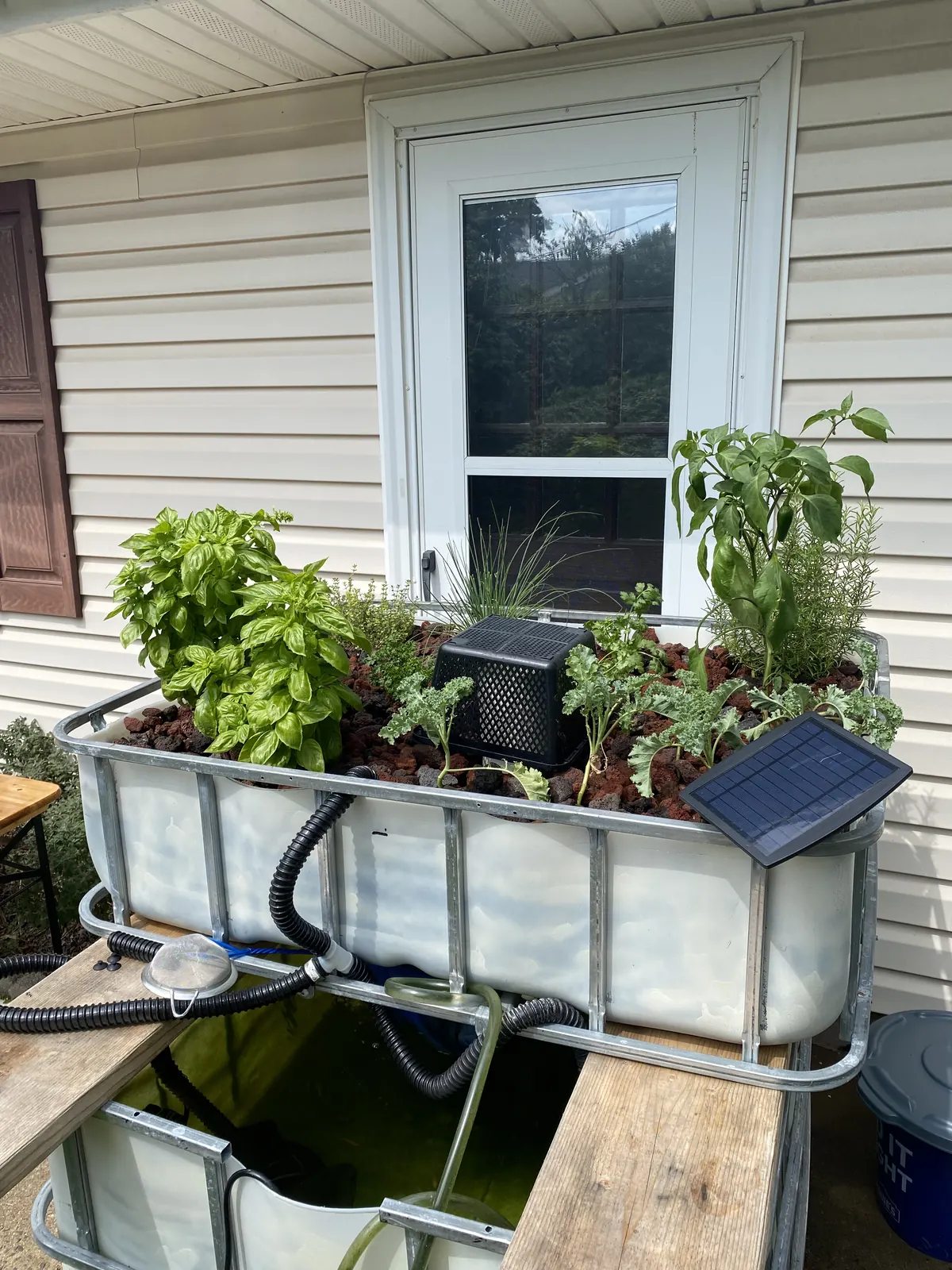
An IBC tote is popular in DIY aquaponics for a good reason: one container can give you substantial water volume and a straightforward path to a chop-and-flip media bed.
That does not make an IBC the right system for every home.
I built and operated one IBC system. I did not run a collection of smaller systems beside it for comparison. So the IBC side below includes firsthand experience; the smaller-system side is research-led.
Quick comparison
| Constraint | IBC system | Smaller home system |
|---|---|---|
| Footprint | Larger | Easier to fit into tight spaces |
| Water volume | Higher | Lower |
| Portability | Poor once built | Often easier |
| Build work | Cutting, cage work and plumbing | Can be simpler depending on design |
| Climate control | Large outdoor volume can be expensive to heat/cool | Smaller indoor volume may be easier to control |
| Grow area | Chop-and-flip can provide a substantial media bed | Usually less unless expanded |
| Appearance | Industrial | More design choices |
| Future expansion | Useful base for a substantial backyard system | Modular options vary |
Where an IBC works well
Useful water volume
A larger water volume generally changes temperature and chemistry less abruptly than a very small system, although it does not eliminate water-quality management. Oklahoma State University — Principles of Small-Scale Aquaponics
A built-in grow-bed option
With a chop-and-flip build, the top portion of the tote can become a substantial media grow bed instead of requiring a separate purchased tray.
That was the basic architecture I used.
A protective cage
The cage supports the tote and gives you convenient structural attachment points, assuming the tote and cage are suitable and in sound condition.
If you are shopping used, container history matters. See Where to Find Food-Grade IBC Totes for Aquaponics.
Where an IBC becomes a pain
It is big
An empty tote is awkward. A filled and plumbed system is effectively permanent.
It looks like an IBC
There is no delicate way to say this. It is a steel-caged industrial container. I eventually wrapped mine partly for insulation and partly because the exposed setup was not exactly landscaping.
Winter does not care how clever your build is
My outdoor system needed insulation and heating. During severe winter weather, the water briefly fell into the 40s °F despite the measures I had in place.
More water gives thermal mass. It also gives you more water to heat.
Cutting one commits you to the build
Once you cut the tote and cage, you have crossed from “container” into “project.” Safe edges, plumbing penetrations, support and access all matter.
See IBC Tote Aquaponics Chop-and-Flip Build Guide.
Where smaller systems make more sense
Smaller systems can be built around stock tanks, barrels, aquaculture tanks, compact media beds, DWC or NFT components. Oklahoma State University — Principles of Small-Scale Aquaponics
Their practical advantages can include:
- easier indoor placement;
- easier relocation;
- lower total water volume;
- less intimidating construction;
- easier climate control in conditioned space.
The tradeoff is that very small water volumes can change more quickly. Small does not mean maintenance-free.
My IBC experience
My system ran for roughly 16–18 months. Basil and peppers did particularly well. I also dealt with algae, winter weather, equipment choices, plumbing changes and a greenhouse that ultimately lost a fight with a blizzard.
The system ended because I moved, not because I decided aquaponics did not work.
If I built again, I would prioritize a permanent location, easy access and fewer unnecessary complications.
Those are legitimate IBC lessons. They are not firsthand evidence that an aquarium, barrel or stock-tank system is better or worse.
Which is better for a beginner?
Choose the IBC when you have:
- a permanent location;
- adequate support;
- room to work around it;
- a reason to want substantial water and grow-bed volume;
- willingness to cut, plumb and maintain a larger system.
Choose smaller when you have:
- tight space;
- an indoor location;
- a realistic chance of moving;
- limited appetite for a major build;
- a learning goal that does not require IBC scale.
Also read What Size Aquaponics System Should You Build? before deciding.
Affiliate note: equipment I actually used on the IBC
For aeration, I used an AQUANEAT dual-outlet aquarium air pump and Waycreat 4-inch air stones. They are examples of equipment from my build, not proof that the same equipment is correctly sized for every IBC or smaller system.
For winter temperature control, I used a Farm Innovators W-409 submersible heater in the main tank. Heating needs are system- and climate-specific, so this is historical firsthand use rather than a universal heater recommendation.
As an Amazon Associate, Aquaponics411 may earn from qualifying purchases.
IBC construction, operation, climate problems and hindsight are firsthand. Smaller-system comparisons and general design principles are research-led.
For related practical guidance, see Real Cost of an IBC Aquaponics System.