
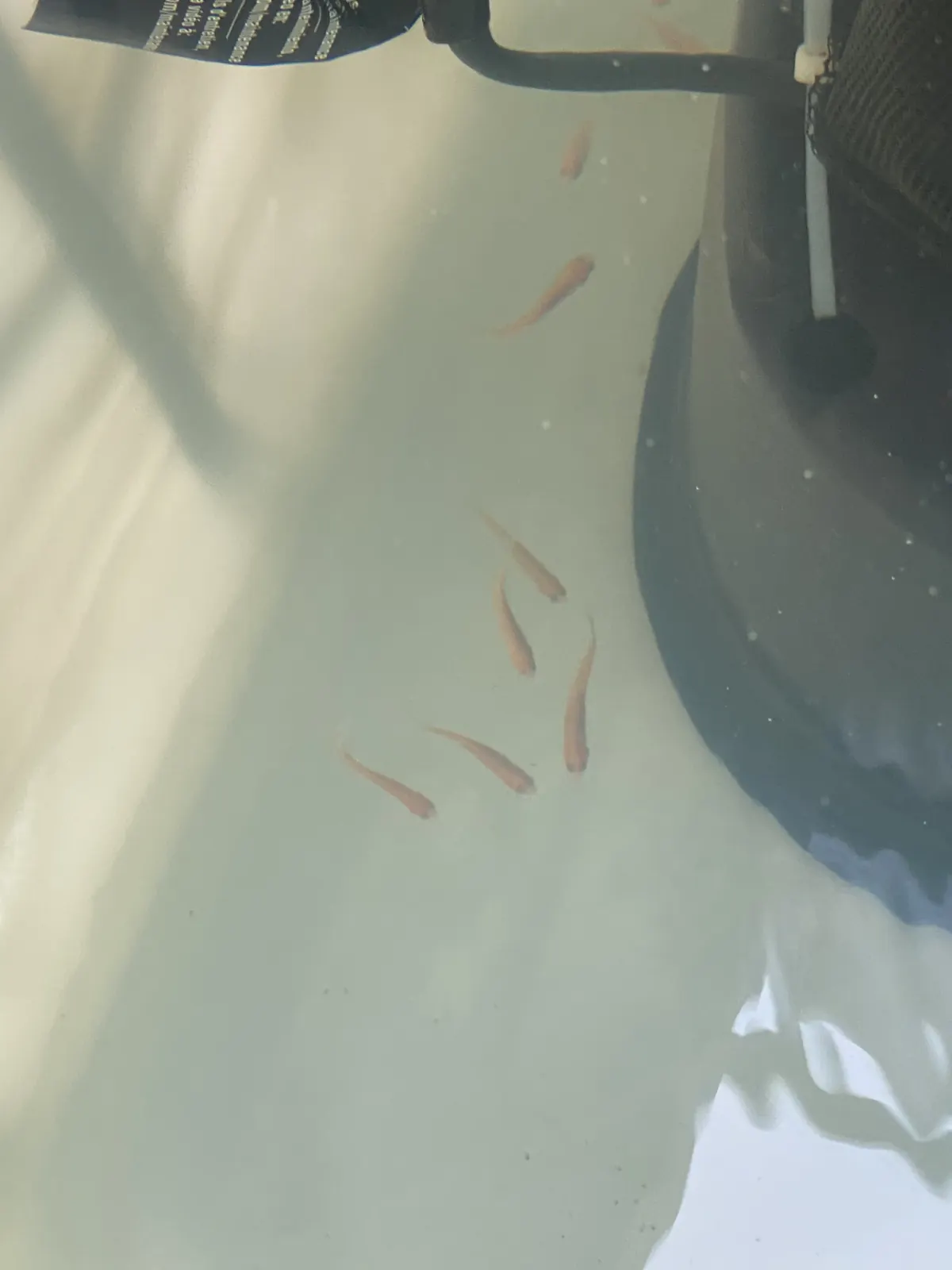
Yes. You can run an aquaponics system without raising fish for food.
The biological loop does not require an edible species.
Fish eat feed, excrete nitrogenous waste, and support the microbial processes that convert ammonia to nitrite and then nitrate. Plants take up nitrate and other available nutrients. That process works whether the fish are tilapia, koi, goldfish or another appropriately managed species. (Oklahoma State: https://extension.okstate.edu/fact-sheets/aquaponics)
What changes is the purpose and economics of the fish side.
Edibility is not part of the nitrogen cycle
Aquaponics needs a source of nutrient input and a healthy biological system.
The fish’s role in that loop is primarily to:
- consume feed;
- produce waste;
- contribute nutrients that are processed by the system.
A fish does not have to be harvested for dinner for that process to occur.
Oklahoma State’s small-scale aquaponics guidance explicitly notes that fish may be produced for food, ornamental use or other purposes.
Why people use ornamental fish
They do not want to harvest fish
Some people like aquaponics as a gardening and water-management system but have no interest in killing or processing fish.
There is nothing inconsistent about that.
They already keep koi or goldfish
An ornamental pond or tank can provide a nutrient source for plant production if the system is designed appropriately.
Local climate favors cool-water ornamentals
In a cold climate, maintaining tilapia temperatures can be expensive. Goldfish or koi may fit the available temperature range better, depending on the system. (Oklahoma State: https://extension.okstate.edu/fact-sheets/aquaponics)
Fish are part of the display
Koi and goldfish can be an aesthetic part of the system rather than a harvest crop.
What does not change
Using ornamental fish does not remove the need for: (Oklahoma State: https://extension.okstate.edu/fact-sheets/principles-of-small-scale-aquaponics)
- appropriate stocking density;
- species-appropriate feed;
- aeration;
- ammonia and nitrite control;
- biofiltration;
- solids management;
- temperature management;
- disease prevention;
- backup planning.
An ornamental fish is still a living animal producing waste in a closed-loop system.
What does change
You may keep the same fish for years
With food fish, harvesting removes biomass from the system.
With long-lived ornamental fish, the fish may remain and grow for years. That means the original stocking plan needs to account for their eventual adult size.
Harvest no longer controls biomass
If fish are never removed, the tank can become overstocked as they grow.
You may need to:
- start with fewer fish;
- move fish to a larger system;
- rehome fish;
- design around adult size from the beginning.
The economics change
Food fish can offset some grocery or production value. Ornamental fish may provide enjoyment or aesthetic value instead.
Oklahoma State notes that without a food-fish or sale component, pure hydroponics may sometimes be more economically straightforward if the only objective is vegetable production.
That is a fair tradeoff to acknowledge.
Aquaponics without edible fish can still be worth doing. It just should not be sold as automatically cheaper than hydroponics.
Koi for aquaponics
Koi can work well in aquaponics when:
- the tank is large enough;
- long-term adult size is considered;
- filtration and oxygen are adequate;
- the owner wants ornamental fish.
Koi can live a long time and become large, so they are not a “temporary nutrient source.”
If you are comparing koi directly with tilapia, see Tilapia vs Koi for Aquaponics.
Goldfish for aquaponics
Goldfish are widely available and commonly used in small systems.
But common and comet goldfish can grow much larger than the small fish sold in stores.
For a closer look at ornamental fish, see Using Goldfish in Aquaponics Systems. That guide is research-based.
I did not keep goldfish in my IBC setup, so the goldfish discussion here and in the companion guide is research-led.
Do you need fish at all?
If there are no fish or other aquaculture animals providing nutrients, the system is no longer operating in the usual fish-based aquaponics model.
It can still be a recirculating plant system, but you would need another nutrient source. At that point the system begins to resemble hydroponics or another soilless growing method rather than conventional aquaponics.
So the useful distinction is:
- non-edible fish: still aquaponics;
- no aquatic animal nutrient source: a different production model unless another aquaculture component is present.
Will ornamental fish provide enough nutrients?
That depends on feed input, fish biomass and plant demand.
The same balancing principles apply as with food fish.
A lightly stocked koi or goldfish system may not produce enough nutrients for a large bed of heavy-feeding fruiting crops.
Do not solve low nitrate automatically by adding more fish. First assess:
- actual plant demand;
- feeding rate;
- fish biomass;
- ammonia and nitrite;
- biofilter capacity;
- whether another nutrient deficiency is limiting growth.
Can you mix ornamental and food fish?
It is biologically possible in some systems, but it adds management questions:
- species compatibility;
- temperature overlap;
- feed requirements;
- adult size;
- disease/quarantine;
- harvest logistics;
- legal restrictions.
A simple backyard system is usually easier to manage when the fish population has similar requirements.
When ornamental fish make sense
Aquaponics without edible fish is a reasonable choice when:
- you want plants plus ornamental fish;
- fish harvest is not appealing;
- local climate favors the selected species;
- the tank can support adult size;
- you accept that the fish side still requires real husbandry and maintenance.
It is not a shortcut around fish management.
This is a research-led decision guide. I did not operate an ornamental-fish aquaponics system, and my comments on goldfish and koi are not firsthand observations.
For related practical guidance, see Using Goldfish in Aquaponics Systems and Tilapia vs Koi for Aquaponics.