
The Fish Tank Changes the Pest-Control Rules
Aphids do not care that your basil shares plumbing with tilapia.
You should.
In aquaponics, the plant side and fish side are connected. A product applied to leaves can become a system problem if spray, runoff or treated debris reaches the recirculating water.
That is why aquaponics pest control starts with identification, exclusion, scouting and physical/biological controls, not “what can I spray?”
Oklahoma State lists aphids, whiteflies, spider mites, thrips and caterpillars among common aquaponics pests and recommends an integrated pest-management approach. citeturn0search0
I Had Pests. I Did Not Turn the Grow Bed Into a Chemistry Experiment.
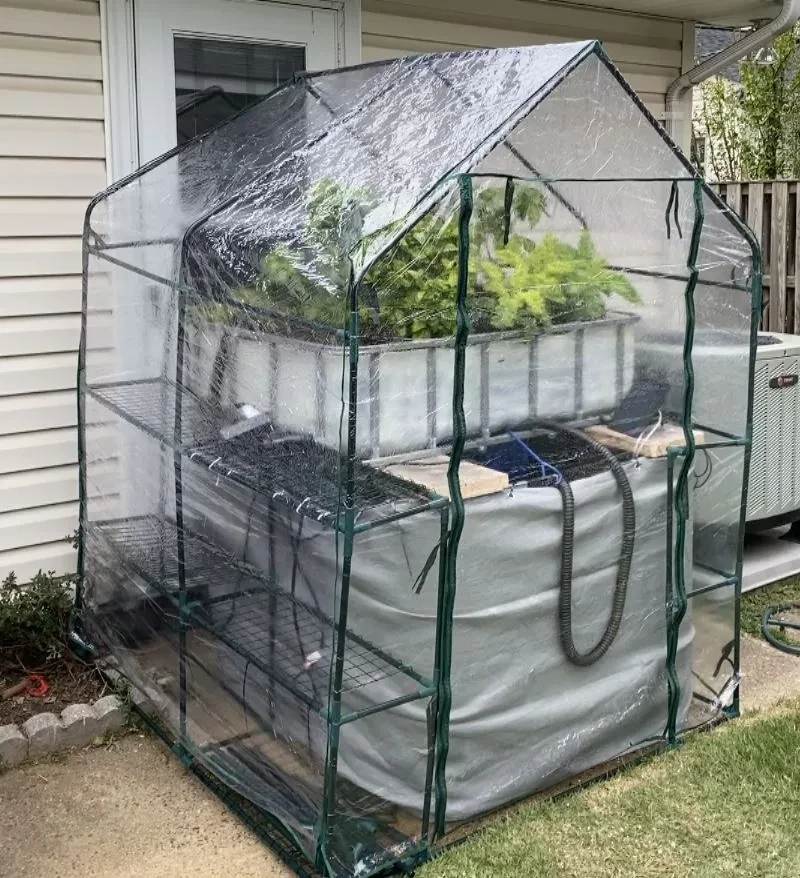
In my IBC setup I encountered flies, mosquitoes, a caterpillar, and pressure from squirrels/birds around the system.
I did not use conventional pesticides or fertilizer in the grow bed.
That is useful experience, but it does not make my system a controlled test of every “fish-safe” pest remedy on the internet.
This page is intentionally conservative.
First, Figure Out What Is Eating the Plant
Look under leaves and around:
- growing tips;
- flowers;
- stem junctions;
- damaged leaves;
- sticky residue;
- webbing;
- curled or distorted new growth.
OSU specifically recommends scouting under leaves and in blooms and notes yellow/blue sticky cards as useful monitoring tools. citeturn0search0
A sticky card can tell you insects are present.
It does not identify every pest or solve the infestation by itself.
Physical Removal Is a Real Control Method
A backyard aquaponics grow bed is small enough that boring methods can work surprisingly well.
Depending on the pest:
- remove a caterpillar by hand;
- remove heavily infested leaves;
- wipe or rinse a localized colony away from the fish water;
- use insect screening or other physical barriers;
- quarantine/inspect incoming plants;
- remove plant debris that gives pests places to persist.
Do the easy thing while the problem is small.
Sanitation Helps You See Problems Earlier
Remove dead leaves, fallen fruit and heavily damaged material.
Keep enough space around plants to inspect them.
Clean up spilled fish feed and organic debris around the system.
This is not glamorous pest control. It is the part that makes the glamorous problem less likely.
Greenhouses Help—and Create Their Own Pest Environment
An enclosure can reduce some outside pressure and makes screening more practical.
It can also create a protected environment where an introduced pest population has very few reasons to leave.
That is why new plant material deserves inspection before it enters a protected system.
Beneficial insects can also be particularly useful in greenhouse environments. OSU notes that matched biological controls can be effective and emphasizes understanding the target pest rather than releasing random predators. citeturn0search0turn0search3
Be Very Careful With Chemical Controls
This is where aquaponics differs sharply from an ordinary garden bed.
Older recirculating-aquaculture/aquaponics guidance takes a very conservative position on pesticides because of risk to fish and the integrated food system. citeturn0search5
AQP should therefore not publish casual household-spray recipes.
Before any pesticide or biological pesticide is used, the operator needs to verify the current product label and whether the intended use is legal and appropriate for the crop, environment and proximity to aquatic organisms.
“Natural” does not mean harmless to fish.
“Organic” does not mean dump it into a recirculating system.
Plant Pests and Tank Intruders Are Related but Different Jobs
An aphid colony on peppers is a crop-pest problem.
A squirrel, bird, mosquito breeding area or debris entering the fish tank is a sanitation/exclusion problem.
This page owns plant IPM.
Insects and Debris.
My Default Order of Attack
For a home aquaponics system:
1. Identify what you are dealing with. 2. Determine whether it is a real infestation or an isolated visitor. 3. Physically remove pests or infested material where practical. 4. Improve exclusion and sanitation. 5. Monitor whether the population is increasing. 6. Use a pest-specific biological or other IPM control where appropriate. 7. Treat chemical control as a high-caution decision because the plants share a system with fish.
The fish are not an unrelated aquarium sitting across the yard.
They are downstream.
What I Would Not Do
I would not spray an unidentified pest.
I would not assume a garden remedy is aquaponics-safe because a forum calls it natural.
I would not let spray drift into the fish tank.
I would not buy beneficial insects before identifying the pest they are supposed to eat.
And I would not turn one caterpillar into a chemical emergency.
Firsthand / Research Boundary
Mixed. Brian’s encounters with nuisance insects/animals and avoidance of conventional pesticides in his grow bed are firsthand. Pest identification, IPM efficacy, biological control and pesticide safety are research-led.
Related maintenance: maintenance schedule, plants not growing, seeds and transplanting, lettuce, tomatoes, peppers, and tank protection from animals and insects.
n