
Aquaponics Is Not Maintenance-Free
When my IBC system was behaving, I could do the basic daily check in about five minutes.
That sounds wonderfully low-maintenance until you leave out the rest of the story.
Some weekends or water-change days could take roughly two hours. A freeze, leak, clogged pump, greenhouse problem or fish problem did not care what the maintenance schedule said.
Aquaponics is not constant hard labor. It is constant responsibility.
That distinction matters.
My Five-Minute Day
A normal quick pass was simple:
- look at the fish and how they were behaving;
- feed them;
- make sure water was moving;
- make sure aeration was working;
- look for a leak or something obviously wrong;
- look over the plants and greenhouse.
That was the easy version of ownership.
Oklahoma State’s maintenance guidance looks remarkably similar: its daily list includes checking pumps and flow, maintaining water level, watching for leaks, monitoring temperature, feeding, observing fish behavior and appearance, scouting plants, and removing dead material. [1]
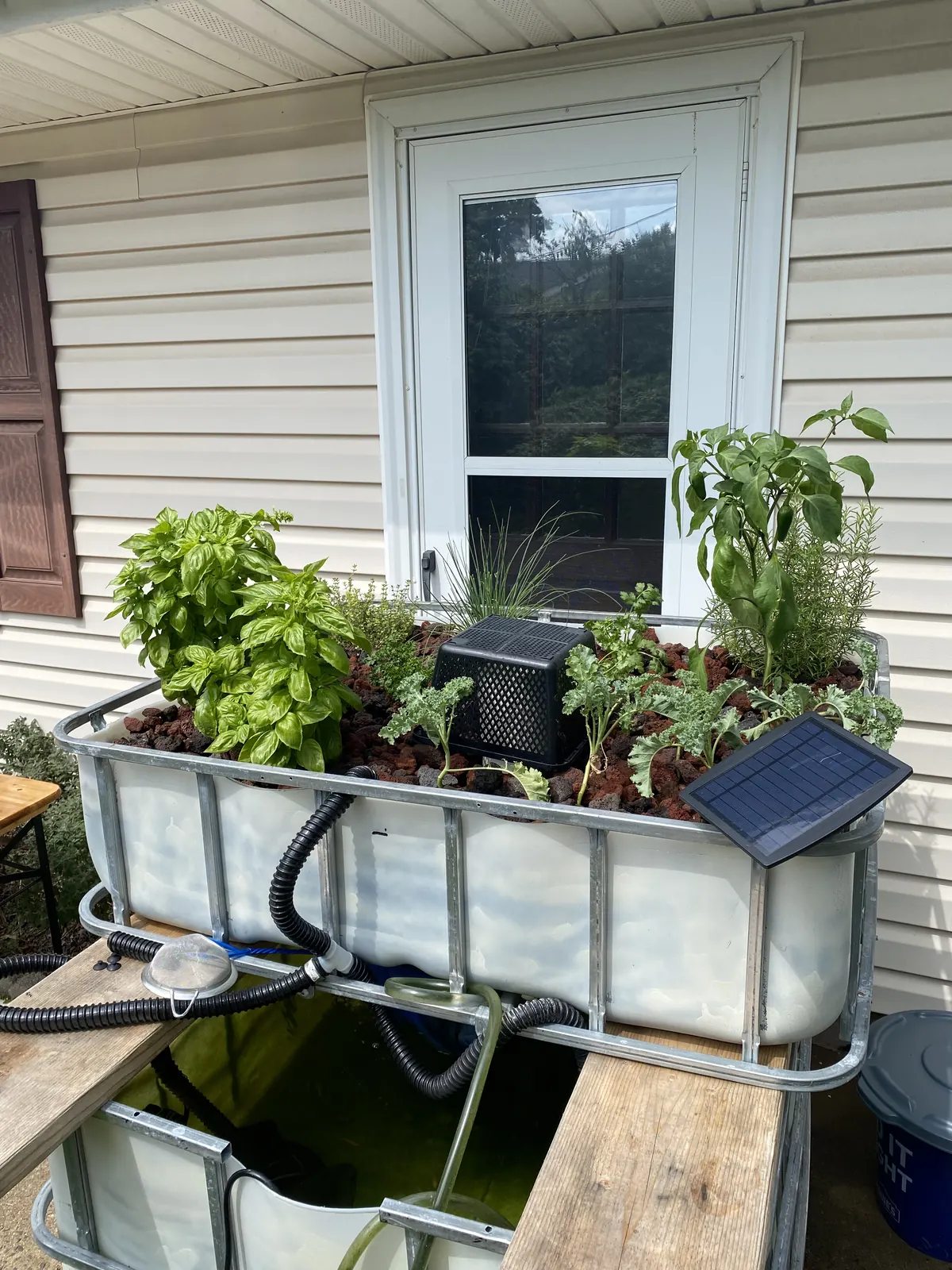
Daily Work Is Mostly Observation
The most valuable daily maintenance tool is not a wrench. It is noticing that today’s system does not look like yesterday’s.
Check:
- fish appetite and behavior;
- pump and return flow;
- aeration;
- temperature;
- water level;
- leaks;
- drains and grow-bed level;
- dead fish or plant material;
- obvious pests or plant stress.
The goal is not to perform a complete inspection every morning. It is to catch changes while they are still small.
Weekly Work Gets More Deliberate
I generally tested water at least weekly and more often when something looked wrong.
A weekly pass can include:
- pH, ammonia, nitrite and nitrate testing;
- closer plant inspection;
- checking roots near drains;
- checking valves and siphon behavior;
- cleaning intake protection;
- removing accumulated solids or dead material;
- inspecting filters.
OSU likewise places water-quality testing, plant inspection, waste removal and root-obstruction checks in recurring maintenance. [1]
is a verified firsthand AQP product and is directly relevant here. Link contextually in the water-testing section, with normal affiliate disclosure.
Periodic Jobs Are Where Time Hides
Some work does not happen every day, which makes it easy to forget when somebody says aquaponics takes “five minutes.”
Depending on the design, periodic work includes:
- mechanical-filter cleaning;
- pump cleaning;
- air-stone inspection;
- root trimming;
- heater/controller checks;
- electrical inspection;
- backup-aeration or power testing;
- tank-cover and pest-exclusion repair;
- harvesting and replanting;
- seasonal greenhouse work.
None of those is necessarily difficult. They just arrive on top of the normal routine.
Water Changes Were Part of My Routine, but Not a Universal Rule
During my IBC experiment I historically changed roughly a quarter of the water about every two weeks and used a separate container to condition and, in cold weather, preheat replacement water.
That is what I did.
It is not a recommendation that every aquaponics system should dump 25 percent of its water every two weeks.
Modern operation should distinguish ordinary top-offs from deliberate water exchange and use actual water quality and system conditions to decide when exchange is warranted.
Winter Can Completely Change the Workload
The day-to-day system was not the hardest part of my experiment.
Winter was.
The greenhouse, insulation, heaters, water temperature and storm exposure created a second layer of work that does not show up in cheerful descriptions of a closed-loop garden.
OSU warns that aquaponics requires daily maintenance and that systems have multiple ways to fail. [2] That is not an argument against aquaponics. It is an argument for designing one you can realistically maintain.
Access Is a Maintenance Decision
A pump will eventually need to come out.
A valve will eventually need to be turned.
A drain will eventually need to be inspected.
A heater will eventually need to be replaced.
If reaching those parts requires draining half the system or moving a grow bed, the maintenance burden is partly a design mistake.
Leave room for wet hands, tools and replacement parts.
What Beginners Underestimate
The jobs themselves are usually manageable.
The issue is recurrence.
Fish still need observation when you are busy. Pumps still need electricity when you are away. Roots continue growing into wet plumbing. A tiny leak does not improve because you decided to look at it Saturday.
If you want something you can ignore for a week, fish are a questionable design feature.
Is the Work Worth It?
For me, yes. I got food, fish, a working biological system and a hell of an education out of one IBC tote.
But if your only goal is the cheapest possible lettuce, there are easier ways to get lettuce.
Build aquaponics because operating the system itself has value to you—not because somebody sold you “maintenance-free.”
Firsthand / Research Boundary
Firsthand-heavy for Brian’s workload estimates and operating routine. General maintenance schedules and water-quality practices are research-led.
Use water-testing basics, backup power, and an aquaponics maintenance schedule to plan recurring work. Check water temperature, compare what I’d do differently, use the maintenance checklist, and distinguish water changes from top-offs.
n