
A top-off and a water change are not the same job.
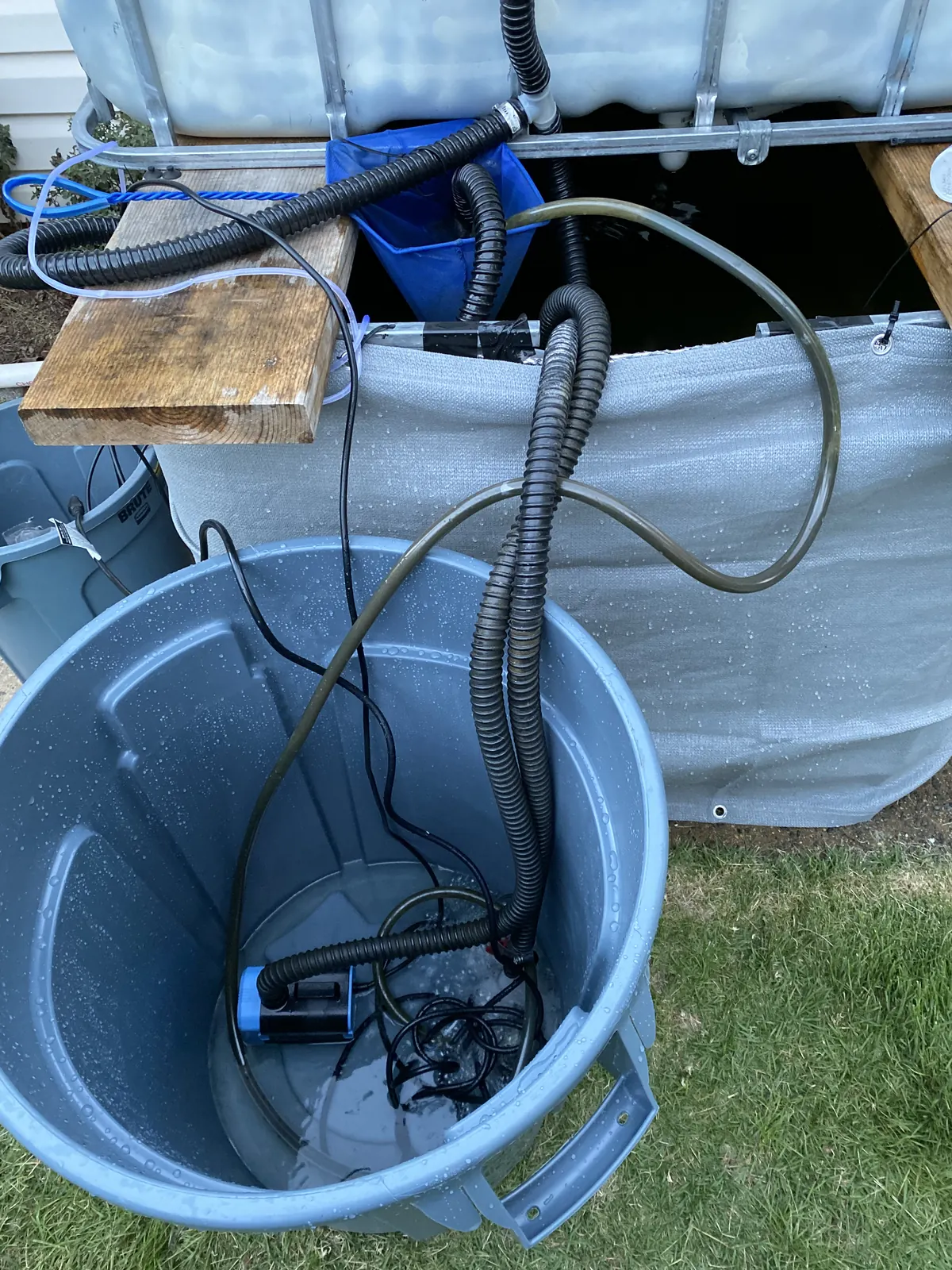
A top-off replaces water the system lost.
A water change deliberately removes system water and replaces it.
That sounds obvious, but treating them as interchangeable can hide what is actually happening to the chemistry.
Aquaponics is a recirculating system. The default goal is not to dump good water on a schedule for no reason.
At the same time, “never change the water” is too absolute. Contamination, dangerous water chemistry or a serious management problem can justify deliberate exchange.
Why aquaponics systems need top-offs
Water leaves a system through:
- evaporation;
- plant transpiration;
- harvested plant material;
- splashing;
- leaks;
- filter cleaning and solids removal.
Oklahoma State notes that small aquaponics systems can lose roughly 1–5 percent of their water per day through evaporation, transpiration, plant assimilation and splashing.
Replacing that loss is normal operation.
It does not remove accumulated dissolved material from the system. It simply restores volume.
Why source water matters
Every top-off adds whatever is in the source water.
That can include alkalinity, hardness, salts and disinfectants.
Municipal water may contain chlorine or chloramine. Oklahoma State notes that treated municipal water may need dechlorination before use in aquaponics.
I used water conditioners during my own system operation, including ATM Paradigm Vitamin C Dechlorinator and Natural Rapport Aquarium Water Conditioner. Those are verified firsthand products from my purchase/use history.
That does not mean every reader needs either product. The treatment depends on the actual source water.
Know what is coming out of the tap before repeatedly adding it to a recirculating system.
When a water change can make sense
A deliberate partial water exchange can be a response to a specific problem, including:
- unsafe ammonia or nitrite;
- known contamination;
- an accidental chemical introduction;
- excessive dissolved accumulation that cannot be corrected through
normal system management;
- a serious source-water or treatment mistake;
- certain emergency fish-health situations where dilution is
appropriate.
Oklahoma State’s maintenance guidance lists water exchange among responses to elevated nitrite and also discusses changing water when nitrate becomes excessive.
The important word is response.
A water change should have a reason.
Do not use water changes to avoid fixing the cause
If ammonia or nitrite repeatedly rises, changing water can reduce the concentration temporarily.
It does not repair an undersized or damaged biofilter, excessive feed input, dead fish, accumulated solids or poor oxygenation.
If the same problem returns, keep diagnosing.
Dilution is not a substitute for system balance.
My historical routine is not a universal rule
During my IBC experiment I did perform water changes and used a separate container to hold or preheat replacement water, particularly during cold weather.
That is useful firsthand context.
It is not evidence that every aquaponics system should follow the same water-change schedule.
My system was one system, operated under my conditions, with my source water, fish load and management choices.
Use measurements and actual conditions to decide what your system needs.
Match replacement water to the system
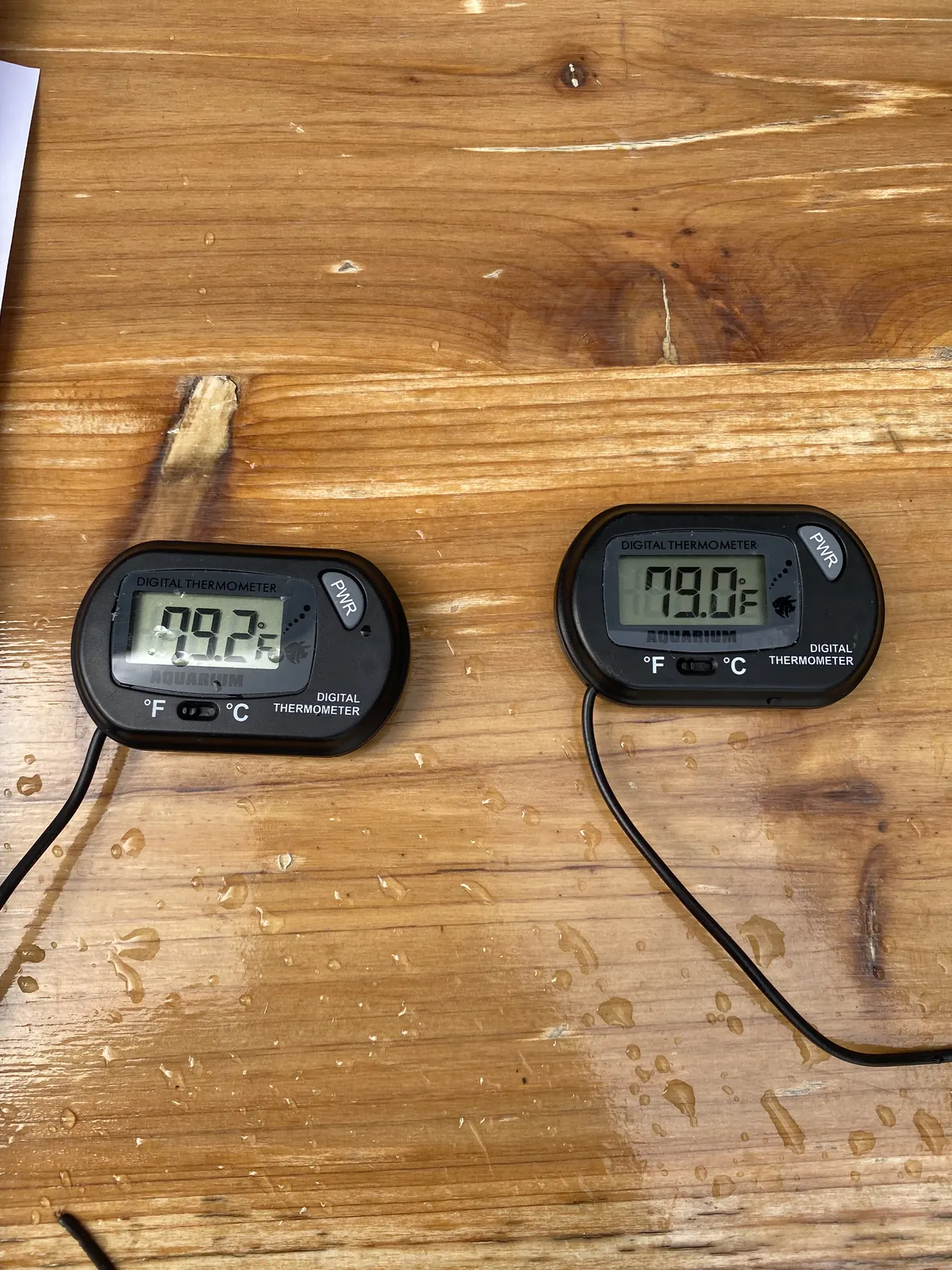
Large, abrupt differences in temperature or chemistry can stress fish.
Before adding substantial replacement water:
- treat source water as needed;
- check temperature;
- understand its pH and alkalinity;
- add it at a rate appropriate for the situation;
- monitor the fish and water quality afterward.
During winter I used a 1000-watt immersion heater in a 55-gallon trash can to preheat replacement water. That original heater is discontinued. A currently available GESAIL replacement in the product inventory is not something I personally used.
Do not blur those two facts.
Top-offs can change chemistry over time
Evaporation removes water but leaves most dissolved minerals behind.
If replacement water is mineral-rich, repeated top-offs can increase some dissolved constituents over time.
Plant uptake, nitrification, solids removal and other processes complicate the picture, so there is no useful one-rule answer based on evaporation alone.
This is why pH, alkalinity, hardness and source-water testing matter.
What to test before reaching for the hose
At minimum, know the reason you think water should be replaced.
Depending on the problem, check:
- ammonia;
- nitrite;
- nitrate;
- pH;
- temperature;
- source-water disinfectant status;
- alkalinity/KH;
- hardness/GH where relevant;
- fish behavior;
- recent feeding, mortality or maintenance events.
A water change is a tool.
Use it because the evidence points there, not because Saturday arrived.
Research Sources
- Oklahoma State University, Principles of Small-Scale Aquaponics:
https://extension.okstate.edu/fact-sheets/principles-of-small-scale-aquaponics
- Oklahoma State University, Nitrification and Maintenance in Media
Bed Aquaponics: https://extension.okstate.edu/fact-sheets/nitrification-and-maintenance-in-media-bed-aquaponics
- FAO, Small-scale aquaponic food production: