
Aquaponics backup power is not an optional convenience once fish depend on electric pumps and aeration. When the power fails, water circulation stops, filtration slows, heaters and cooling equipment shut down, and dissolved oxygen can fall quickly.
The first priority during most outages is keeping the fish supplied with oxygen. A battery-powered air pump may be enough for a short interruption. Longer outages may require a UPS, portable power station, generator, battery-and-inverter system, or a combination of several backups.
The correct setup depends on fish load, water temperature, equipment wattage, outage length, and how quickly someone can respond. The goal is not to keep every piece of equipment running normally. The goal is to keep the biological system alive until full power returns.
Affiliate disclosure: This page contains affiliate links. As an Amazon Associate I earn from qualifying purchases.
Emergency priority: Keep aeration running first. Restore enough water circulation to protect fish and biological filtration second. Add heating, cooling, monitoring, and other loads only when the backup system has enough capacity.
Why Aquaponics Systems Are Vulnerable to Power Outages
From my system: Field note: the longest outage I remember was roughly four to five hours. In warm weather I treated aeration as the immediate fish-survival priority. I kept normal electric air stones plus a separate solar/battery pond aerator.
A soil garden can survive a power outage without noticing. An aquaponics system may lose several life-support functions at the same time.
- Water pumps stop circulating fish waste toward filtration.
- Air pumps stop supplying oxygen.
- Biological filters receive less oxygenated water.
- Heaters and cooling equipment stop controlling temperature.
- Automatic feeders, alarms, and controllers may shut down.
- Water may drain or back-siphon into unintended areas.
Fish continue breathing after the electricity stops. Bacteria continue consuming oxygen. Warm water holds less oxygen than cool water, and heavily stocked systems can become dangerous much faster than lightly stocked ponds or stock tanks.
A short outage may be harmless in a cool, lightly stocked system with strong surface area. The same outage can kill fish in a warm greenhouse system carrying a heavy tilapia load. Backup planning must account for the actual system rather than a generic number of gallons.
What Must Keep Running?
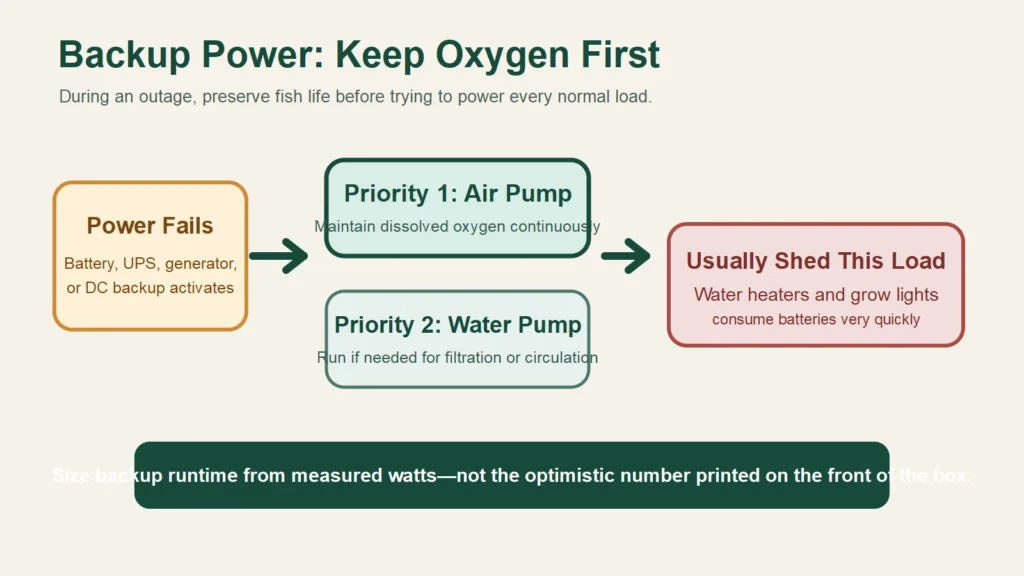
Not every electrical load deserves equal priority. Rank equipment by how quickly its loss threatens fish and system stability.
| Priority | Equipment | Why It Matters |
|---|---|---|
| 1 | Air pump or emergency aerator | Maintains dissolved oxygen for fish and bacteria |
| 2 | Primary or reduced-flow water pump | Moves water through filtration and prevents stagnation |
| 3 | Temperature control | Protects fish during extreme heat or cold |
| 4 | Monitoring and alarms | Provides warning and confirms that backup equipment is operating |
| 5 | Grow lights and convenience equipment | Usually safe to leave off during an emergency |
Grow lights, automatic feeders, decorative lighting, and nonessential controllers can usually remain off. Plants tolerate temporary darkness much better than fish tolerate oxygen loss.
Aeration Comes First
For most backyard systems, emergency aeration provides the greatest survival benefit for the least electrical demand. A small air pump may use only a few watts while keeping fish alive long enough for utility power to return or a generator to be started.
Aeration becomes more urgent when:
- The water is warm
- The fish are large or heavily stocked
- Feeding has been heavy
- Algae is present
- Solids have accumulated
- The system has little exposed water surface
- The biological filter depends on forced aeration
See aeration in aquaponics systems for pump selection, diffuser placement, dissolved oxygen, and maintenance.
Battery-Powered Air Pumps
A battery-powered air pump is the simplest form of aquaponics backup power. Some models run only when manually switched on. Better emergency models plug into household power and automatically start when the outlet loses electricity.
These pumps are best for:
- Short utility outages
- Small stock tanks and IBC systems
- Supplementing a larger backup system
- Providing oxygen while a generator is being started
- Protecting fish when nobody is present at the moment power fails
Their main limitation is airflow. A battery aquarium pump may keep a small or moderately stocked system alive, but it may not provide enough output for a large pond, several stock tanks, or a heavily loaded greenhouse system.
Use at least two diffusers when the pump can support them. Keep fresh replacement batteries on site, and test the automatic switching function rather than trusting the label.
View battery-backup aquarium air pumps on Amazon.
Rechargeable and Solar Aerators
Rechargeable aerators use an internal battery that charges from household power, USB, or a solar panel. They can provide longer runtime than disposable-battery pumps and may be easier to maintain when tested regularly.
Solar-backed aerators are useful during daylight outages and can extend runtime when the battery and panel are properly matched. They are less dependable when several cloudy days follow a storm, when the panel is shaded, or when the battery has aged.
Do not confuse solar-assisted with unlimited: A small panel may slow battery depletion without producing enough power to run the air pump continuously through cloudy weather and overnight hours.
A solar aerator works well as one layer of protection. It should not be the only emergency plan for a heavily stocked system unless its output and overnight runtime have been tested under real conditions.
View solar pond aerators with battery backup on Amazon.
Using a UPS for Aquaponics
An uninterruptible power supply, commonly called a UPS, contains a battery and inverter. Equipment plugged into it continues running when utility power fails.
A UPS is useful because switching is automatic. The air pump or small circulation pump may continue running without anyone being present.
Most computer UPS units are designed to keep electronics operating long enough to save work and shut down. They are not designed to run a large water pump for many hours. Runtime can be surprisingly short when the connected load is high.
Best Loads for a UPS
- Small air pumps
- Low-wattage circulation pumps
- Temperature and water-level alarms
- Internet equipment used for remote alerts
- Controllers that must restart correctly
Poor Loads for a Small UPS
- Large water pumps
- Electric water heaters
- Greenhouse space heaters
- High-output grow lights
- Compressors and motors with high starting demand
View pure sine-wave UPS units on Amazon.
Portable Power Stations
Portable power stations combine a rechargeable battery, inverter, charging system, and several outlets in one enclosure. They are easier to use than a separate battery-and-inverter setup and can run air pumps, circulation pumps, monitoring equipment, and some temperature-control equipment.
Power stations are rated in watt-hours. A 1,000-watt-hour unit does not deliver all 1,000 watt-hours to connected AC equipment because the inverter and internal electronics consume energy. A practical estimate should allow for losses and reserve capacity.
They work well for:
- Quiet backup power
- Indoor or greenhouse use where generator exhaust is unsafe
- Short and moderate outages
- Running several low-wattage devices
- Charging from household power, a vehicle, or solar panels
- Systems where fuel storage is undesirable
View portable power stations on Amazon.
How to Calculate Backup Runtime
Runtime depends on battery capacity, equipment wattage, inverter efficiency, battery condition, temperature, and how deeply the battery is allowed to discharge.
Basic estimate: Usable watt-hours ÷ connected watts = approximate runtime in hours.
For example, assume a portable power station has 1,000 watt-hours of rated capacity. After allowing for inverter losses and reserve capacity, estimate 800 usable watt-hours.
- A 10-watt air pump may run for roughly 80 hours.
- A 40-watt air pump and water pump combination may run for roughly 20 hours.
- A 200-watt load may run for roughly 4 hours.
- A 1,000-watt heater may run for less than one hour.
These are planning estimates, not guarantees. Test the actual equipment on the actual backup unit.
| Equipment | Example Wattage | Estimated Runtime on 800 Usable Wh |
|---|---|---|
| Small air pump | 10 watts | 80 hours |
| Pond air pump | 25 watts | 32 hours |
| Air pump plus small water pump | 50 watts | 16 hours |
| Medium circulation pump | 100 watts | 8 hours |
| Water heater | 500 watts | 1.6 hours |
| Large heater | 1,000 watts | 0.8 hours |
Heating consumes battery capacity quickly. During a winter outage, insulation, tank covers, reduced exposed plumbing, and a generator may be more practical than trying to run electric heaters from a small battery.
Generators for Longer Outages
A portable generator is usually the most practical solution for extended outages when the system must run pumps, heaters, greenhouse fans, or several tanks.
Generators can operate for many hours as long as fuel, oil, and maintenance are available. They also produce noise, heat, carbon monoxide, and electrical hazards.
Generator Advantages
- Runs larger pumps and heaters
- Supports extended outages
- Can power other household or greenhouse equipment
- Refuels faster than large batteries recharge
- Provides more capacity per dollar than many battery systems
Generator Limitations
- Requires fuel storage
- Must be started unless an automatic system is installed
- Needs routine maintenance
- Produces dangerous exhaust
- Cannot be operated inside a greenhouse, garage, shed, or enclosed porch
- May not be suitable when nobody is available to respond
Carbon monoxide warning: Never run a gasoline, propane, or diesel generator inside a greenhouse, basement, garage, shed, or other enclosed or partly enclosed area. Generator exhaust can kill people and animals even when doors or windows are open.
Use outdoor-rated extension cords, weather protection approved for the equipment, and proper transfer equipment when connecting a generator to building circuits. Never backfeed power through a wall outlet.
Inverter Generators
Inverter generators are often quieter and more fuel-efficient at light loads than conventional generators. They also provide cleaner electrical output for controllers, chargers, and sensitive electronics.
View portable inverter generators on Amazon.
Battery and Inverter Systems
A larger custom backup system uses one or more batteries connected to an inverter and charger. This approach provides more flexibility than a sealed portable power station and may be economical when substantial runtime is required.
Common components include:
- Deep-cycle lead-acid or lithium batteries
- Pure sine-wave inverter
- Battery charger
- Fuses or circuit breakers
- Appropriately sized cables
- Battery monitor
- Ventilated and protected enclosure
- Automatic transfer or switching equipment
Large battery systems involve high current and serious fire risk. Incorrect cable size, loose terminals, missing overcurrent protection, or damaged batteries can cause dangerous failures. Use properly rated components and qualified electrical help when necessary.
Solar Charging
Solar panels can recharge portable power stations or battery banks during a prolonged outage. They can also support low-wattage loads directly through a battery system.
Solar performance depends on:
- Panel wattage
- Hours of usable sunlight
- Cloud cover
- Panel angle and shading
- Charge-controller efficiency
- Battery capacity and condition
- Continuous equipment load
A 200-watt panel does not produce 200 watts all day. Output changes with sun angle, weather, temperature, dirt, and shading. Plan from realistic daily energy production rather than the panel’s laboratory rating.
Solar makes the most sense when the emergency load has already been reduced. Keeping a 10-watt air pump running is much easier than trying to power a large water heater.
Automatic Transfer vs Manual Response
The best emergency equipment is useless when it depends on someone noticing the outage six hours later.
Automatic backup is most important for:
- Air pumps
- Systems left unattended
- Overnight outages
- Heavily stocked tanks
- Remote greenhouses
- Areas with frequent short interruptions
A common layered setup is:
- A battery air pump starts automatically.
- A UPS or power station keeps monitoring and a small pump running.
- An alert notifies the owner.
- A generator is started if the outage continues.
This avoids depending on one device for every possible outage length.
Power-Failure Alarms and Remote Monitoring
A power-failure alarm can notify you when electricity stops, when temperature moves outside a safe range, or when water level changes. Alerts are especially valuable when the system is outside, in a greenhouse, or away from the house.
Useful monitoring options include:
- Plug-in power-failure alarms
- Cellular outage monitors
- Wi-Fi smart plugs with offline alerts
- Water-temperature alarms
- High- and low-water sensors
- Leak detectors
- Remote cameras aimed at water returns or air diffusers
A Wi-Fi alert depends on the router and internet connection remaining powered. Put the modem, router, and monitoring hub on a small UPS when remote alerts are part of the emergency plan.
View power-failure and temperature alarms on Amazon.
What to Do When the Power Fails
- Confirm the outage. Check breakers, ground-fault outlets, cords, and equipment switches.
- Start emergency aeration. Do not wait for fish to begin gasping.
- Stop feeding. Fish can go without food, and feeding increases oxygen demand and waste production.
- Check water temperature. Warm water increases oxygen risk, while cold weather creates heating concerns.
- Reduce unnecessary electrical loads. Disconnect lights, feeders, and convenience equipment.
- Restore limited circulation. Run the smallest pump that maintains essential flow when battery capacity is limited.
- Start the generator or larger backup. Move to the next layer if the outage continues.
- Watch fish behavior. Gasping, crowding around bubbles, and sluggish movement require immediate attention.
- Test water after restoration. Check ammonia, nitrite, pH, and temperature.
Do not resume heavy feeding immediately after a long outage. Allow circulation, aeration, and filtration to stabilize first.
Reduce the Emergency Load
A smaller emergency load produces longer runtime and lowers backup cost.
- Use a dedicated low-wattage emergency air pump.
- Run one smaller circulation pump instead of the normal full-flow pump.
- Turn off grow lights.
- Stop automatic feeders.
- Insulate stock tanks, IBC containers, and exposed plumbing.
- Cover part of the water surface during cold weather while preserving gas exchange.
- Use gravity flow where practical.
- Separate critical equipment onto clearly marked outlets.
Knowing which plug controls which device matters during an outage. A tangle of unlabeled cords is not a backup plan. It is an electrical scavenger hunt in the dark.
Protect the System From Restart Problems
Power restoration does not guarantee that every device restarts correctly.
- Some pumps lose prime.
- Bell siphons may restart unpredictably.
- Filters may overflow when flow returns.
- Check valves may stick.
- Controllers may reset to default settings.
- Heaters may restart at the wrong temperature.
- Water may siphon backward when pumps stop.
After power returns, inspect every major component. Verify visible water flow, air output, filter level, sump level, temperature settings, and drain operation.
For pump flow and head-height planning, see how to size a pump for an aquaponics system.
Test the Backup Before You Need It
A backup system should be tested under real load. Unplug utility power and verify what actually happens.
| Test | What to Verify | Frequency |
|---|---|---|
| Automatic battery air pump | Starts immediately and produces useful airflow | Monthly |
| UPS | Switches cleanly and reports realistic runtime | Every few months |
| Portable power station | Runs intended equipment and charges properly | Every few months |
| Generator | Starts, carries load, and has fresh fuel | Monthly or per manufacturer |
| Solar charging | Produces expected output in real sunlight | Seasonally |
| Alarms | Sends alerts when utility power is removed | Monthly |
| Restart procedure | Pumps, siphons, filters, and controls recover correctly | Several times per year |
Write down the runtime. Batteries lose capacity with age, cold temperatures, heat exposure, and repeated use. A unit that ran twelve hours when new may not do that three years later.
Common Backup-Power Mistakes
Backup equipment works best when the ordinary system is not already balanced on a knife edge. See the broader aquaponics beginner mistakes checklist.
Trying to Run Everything
Grow lights, heaters, pumps, fans, and accessories can overwhelm a small battery quickly. Protect oxygen and essential circulation first.
Buying by Peak Watts Alone
Maximum inverter output tells you what the unit can power briefly. Watt-hour capacity tells you more about how long it can run.
Ignoring Motor Startup Demand
Some pumps draw more power when starting than while running. The inverter must handle that surge.
Depending on Wi-Fi Alerts Without Backing Up the Router
The alert system cannot report an outage when the network equipment shuts down with everything else.
Storing a Generator Without Testing It
Old fuel, a dead starter battery, clogged carburetor, or missing extension cord can turn a generator into expensive garage furniture.
Forgetting Weather Exposure
Most UPS units and power stations are not designed to sit in rain, condensation, or greenhouse splash zones. Keep backup equipment dry and ventilated.
A Practical Three-Level Backup Plan
| Outage Length | Primary Response | Equipment |
|---|---|---|
| Minutes to a few hours | Maintain oxygen automatically | Battery air pump or UPS |
| Several hours to one day | Maintain aeration and reduced circulation | Portable power station or larger battery system |
| One day or longer | Run critical pumps, temperature control, and recharge batteries | Generator, fuel supply, and optional solar charging |
For most backyard systems, this layered plan is more reliable than expecting one device to cover every outage.
What I Would Buy First
- Automatic battery-backup air pump
- Power-failure alarm
- Portable power station sized for aeration and reduced circulation
- Inverter generator for extended outages
- Spare air stones, airline tubing, extension cords, fuel, and written operating instructions
The first purchase should keep oxygen moving automatically. The larger backup should extend runtime after someone has been notified and can respond.
For a broader equipment overview, see the Aquaponics Equipment Guide.
Frequently Asked Questions
How long can aquaponics fish survive without power?
There is no universal safe time. Survival depends on fish density, water temperature, oxygen level, species, tank shape, algae, and system condition. A warm, heavily stocked tank can become dangerous much faster than a cool, lightly stocked pond.
What should run first during an outage?
Aeration is usually the first priority. Restore enough water circulation to protect fish and biological filtration next.
Can a UPS run an aquaponics water pump?
Yes, but runtime may be short. Check the pump’s running wattage, startup surge, and the UPS battery capacity. A UPS is often more effective when powering a low-wattage air pump.
How large a power station do I need?
Add the wattage of the equipment you intend to run, multiply by the required hours, then add capacity for inverter losses and reserve. Test the final setup under real load.
Can solar panels run an aquaponics system during an outage?
Solar panels can support low-wattage emergency loads and recharge batteries, but output depends on sunlight and system size. A battery is still needed for clouds and nighttime operation.
Should I feed fish during a power outage?
No. Stop feeding until aeration, circulation, and filtration are stable. Fish can tolerate missed meals better than increased waste and oxygen demand.
Can I run a generator inside a greenhouse?
No. Fuel-burning generators produce carbon monoxide and must remain outside, well away from doors, vents, windows, and occupied spaces.
Do I need backup heating?
Backup heating depends on fish species, climate, system insulation, and outage length. Electric heaters consume batteries quickly, so insulation and generator power are often more practical during extended winter outages.
Final Takeaway
Aquaponics backup power should protect the equipment that keeps fish alive, not attempt to reproduce normal operation indefinitely. Start with automatic emergency aeration, add enough battery capacity for reduced circulation, and use a generator or larger energy system for prolonged outages.
Calculate the load, test the runtime, maintain the batteries, exercise the generator, and verify that every pump and filter restarts correctly. The worst time to discover that a backup plan exists only on paper is when the fish are already at the surface.