
Aquaponics aeration keeps oxygen available for the fish, the nitrifying bacteria that process waste, and the plant roots sharing the same water. Water movement helps, but a stocked pond, large stock tank, converted IBC container, or greenhouse chop tank should normally have dedicated aeration running continuously.
The basic setup is simple: an air pump, airline tubing, check valves, and two or more air stones or diffusers. The important part is matching the equipment to the water depth, fish load, temperature, and number of outlets rather than buying the smallest pump that produces visible bubbles.
Affiliate disclosure: This page contains affiliate links. As an Amazon Associate I earn from qualifying purchases.
Practical baseline: For most backyard aquaponics systems, use a continuous-duty air pump feeding at least two diffusers. Place them in different parts of the fish-holding water, protect the pump from moisture, and keep a separate backup aerator ready for power outages.
Why Aquaponics Systems Need Aeration
From my system: Field note: I used a normal aquarium air pump with air stones and also gained some agitation from the bell-siphon return falling roughly 4–5 inches into the tank. In warm weather I still preferred dedicated aeration and kept a solar/battery backup path.
Fish consume dissolved oxygen as they breathe. Nitrifying bacteria need oxygen while converting ammonia into nitrite and then nitrate. Plant roots also perform better when the water moving around them does not become stagnant and oxygen-poor.
If oxygen drops far enough, the fish show distress first. They may gather near a water return, hang near the surface, stop feeding, or become sluggish. The biofilter can also lose efficiency, allowing ammonia or nitrite to rise. A system that looked stable can become a water-quality problem quickly because several parts of the biological cycle are being stressed at once.
Water returning from a grow bed, spraying from a pipe, or falling into a sump adds oxygen by disturbing the surface. That is useful, but it is not the same as having independent aeration. If the circulation pump stops, the oxygen supplied by that water movement stops with it. A separate air pump provides another layer of protection.
What Aeration Actually Does
The bubbles themselves do not inject large amounts of oxygen directly into the water. Their main value is moving water upward and disturbing the surface, where gas exchange occurs. A properly placed diffuser creates circulation, breaks up stagnant areas, and continually brings lower water toward the surface.
A basic aquaponics aeration system includes:
- A continuous-duty air pump
- Airline tubing sized for the pump and distance
- A manifold when several outlets are needed
- Check valves where back-siphoning is possible
- Air stones, diffuser discs, or diffuser tubing
- A dry, protected location for the pump
More bubbles are not automatically better. A pump must have enough pressure to work at the actual water depth, and the diffusers must distribute air where the fish and water need it. One aggressive column of bubbles in a corner may leave the opposite side of a wide stock tank comparatively stagnant.
What I Used
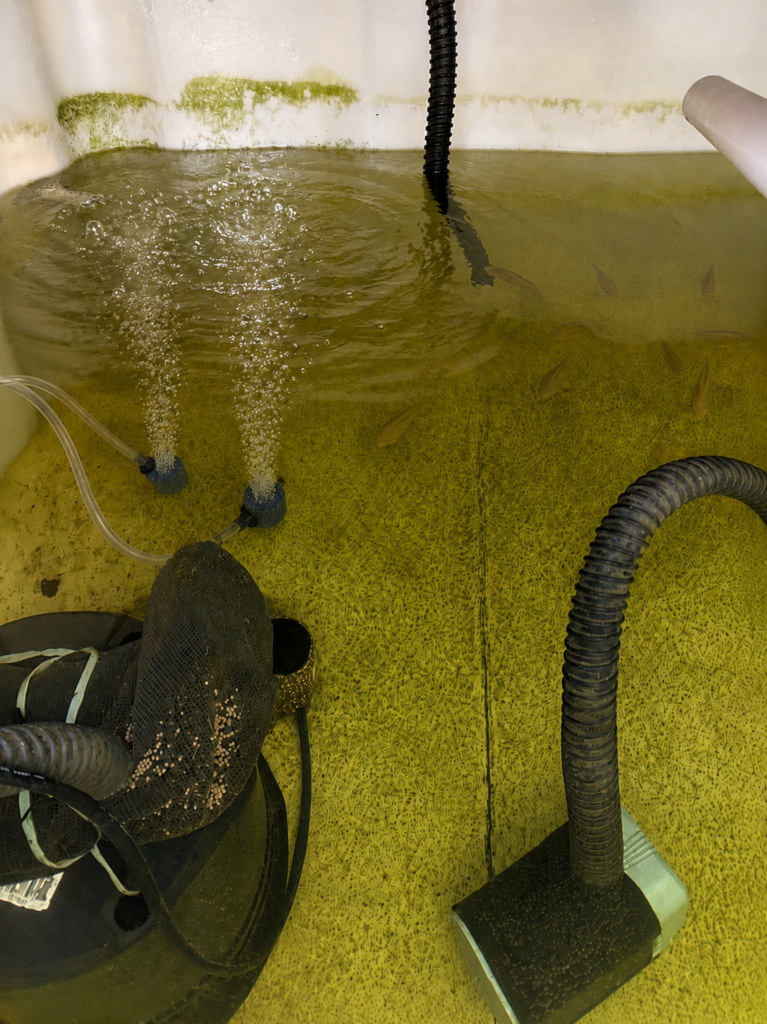
In my greenhouse system, I used two air stones with a straightforward air pump setup. Two diffusers gave me better coverage than one small bubbler sitting in a corner. It also created some redundancy if one stone clogged or one section of the chop tank developed weaker movement.
The setup was not elaborate, but it worked. In aquaponics, reliable usually beats impressive, especially when the equipment is responsible for keeping fish alive.
How Much Aeration Does an Aquaponics System Need?
There is no single air-pump size that fits every system. Required output changes with water volume, fish biomass, water temperature, stocking density, diffuser resistance, and water depth.
Use the following as a practical starting framework rather than a rigid formula:
| System | Typical Aeration Approach | Recommended Distribution |
|---|---|---|
| Small indoor or protected system | Quality dual-outlet aquarium air pump | Two small air stones |
| Converted IBC container | Continuous-duty pond-style air pump | Two to four diffusers |
| 100- to 300-gallon stock tank | Pond air pump with manifold | Two to four large air stones or discs |
| Greenhouse chop tank with growing fish | Pond or linear-diaphragm air pump | Several diffusers spread across the tank |
| Large pond or multiple connected tanks | Higher-output linear or regenerative blower system | Independent lines or manifolds for each area |
A pump advertised for a large aquarium may lose much of its usable output when pushing air through deep water, long tubing, a manifold, and several fine-pore diffusers. Check the manufacturer’s pressure and output specifications rather than relying only on the tank-size claim printed on the box.
Water Depth Matters
The deeper the diffuser sits, the more pressure the air pump must produce. A pump that works well in a shallow raft bed may struggle at the bottom of a deep IBC container. If bubbles become weak after lowering the stone, the pump may not have enough pressure for that depth.
Fish Load Matters More Than Container Size Alone
A lightly stocked 250-gallon pond does not have the same oxygen demand as a 250-gallon stock tank containing rapidly growing tilapia and receiving heavy daily feeding. Oxygen demand rises as fish grow, feeding increases, waste production increases, and bacteria process more ammonia.
Design for the fish load you expect later, not only for the fingerlings you have today.
Dissolved Oxygen Targets
Dissolved oxygen is measured in milligrams per liter, often written as mg/L. Different fish species tolerate different conditions, but a practical aquaponics system should generally aim to remain above approximately 5 mg/L. Warm-water species may survive lower readings for a period, but survival is a poor design target.
Low dissolved oxygen becomes more dangerous when:
- Water temperature rises
- Fish density increases
- Feeding increases
- Algae or microbial activity is heavy
- Water circulation slows
- Solids accumulate
- A pump or diffuser begins failing
A dissolved-oxygen meter is useful in heavily stocked systems, commercial systems, and greenhouse systems that experience large temperature changes. Smaller systems can often operate without one, but visual observation should never replace proper aeration and routine aquaponics water testing.
Why Warm Water Makes Aeration More Important
Warm water holds less dissolved oxygen than cooler water. At the same time, warm-water fish may become more active, eat more, and consume more oxygen. Bacteria also become more active within their preferred temperature range.
This combination makes summer greenhouse conditions risky. Oxygen stress may appear overnight or near sunrise after plants, algae, fish, and microorganisms have consumed oxygen for hours without photosynthesis adding any back.
Algae can make the swing worse. During daylight, algae may release oxygen. After dark, it consumes oxygen along with everything else. That is one reason algae control and aeration should be treated as connected parts of system management. See how to prevent algae growth in aquaponics systems for the underlying causes and practical corrections.
Where to Place Air Stones and Diffusers
Diffusers should create useful circulation, not simply produce bubbles where they are easiest to see.
- Use more than one diffuser. Two or more outlets distribute oxygen across a wider area and provide some protection if one stone clogs.
- Separate the diffusers. Place them in different sections rather than clustering every stone beside the water return.
- Target stagnant areas. Corners, areas behind plumbing, and deep spots may receive less circulation.
- Keep them accessible. Air stones need inspection and replacement. Do not bury them under structures that require draining the system to reach.
- Avoid interfering with solids removal. Excessive turbulence can keep solids suspended when the system depends on settling or a bottom drain.
In a round stock tank, diffuser placement can support a gentle circular current. In a rectangular IBC container, multiple diffusers help prevent dead areas in corners. In a pond, spreading several diffusers across the bottom usually provides better coverage than one oversized diffuser near the edge.
Choosing an Air Pump Without Overbuying
The right air pump must run continuously, handle the intended depth, feed the planned number of diffusers, and survive the environment where it will be installed.
Aquarium Air Pumps
A dual-outlet aquarium pump can work for a small indoor or well-protected system with a light fish load. These pumps are inexpensive and quiet, but many are designed for shallow aquariums and dry indoor rooms.
Do not assume an aquarium pump is suitable for a greenhouse merely because the greenhouse has walls. A greenhouse is warmer, wetter, dustier, and more likely to expose equipment to condensation and splashing.
Pond-Style Air Pumps
A small pond aerator is usually a stronger choice for stock tanks, converted IBC systems, and greenhouse chop tanks. Pond pumps generally provide more output, better pressure, and support for larger diffusers or manifolds.
View pond air pumps suitable for aquaponics on Amazon.
Linear-Diaphragm and Linear-Piston Pumps
These pumps are common in larger ponds and aquaculture systems because they are designed for continuous operation and can feed several diffusers. They cost more than small aquarium pumps but may be more efficient and serviceable for a larger system.
Before buying any pump, check:
- Air output at the required pressure
- Maximum operating depth
- Number and type of outlets
- Continuous-duty rating
- Indoor or outdoor installation requirements
- Availability of replacement diaphragms or rebuild kits
- Noise level
- Electrical consumption
Recommended Aeration Components
A reliable setup is more than the pump. Weak tubing, bad check valves, or clogged air stones can reduce output even when the pump is working normally.
- Air pump: Choose a continuous-duty pond or aquarium pump appropriate to the system size and depth.
- Air stones or diffuser discs: Use at least two when practical.
- Airline tubing: Use tubing that fits securely and resists kinking.
- Manifold: A valved manifold helps balance airflow between several outlets.
- Check valves: Install them where water could siphon backward during shutdown.
- Spare parts: Keep at least one spare diffuser, a length of tubing, and replacement connectors.
View air stones, manifolds, and airline kits on Amazon.
Backup Aeration
I also used a small solar-backed pond pump as a backup. It was not intended to replace the main aeration system. It was a practical layer of protection during summer thunderstorms and short power interruptions.
Backup aeration is not about building a control room full of switches. It is about keeping oxygen available when the main power or primary pump stops.
The smaller model I used worked well as temporary support, but I would not depend on it as the sole full-time aerator for a heavily stocked system.
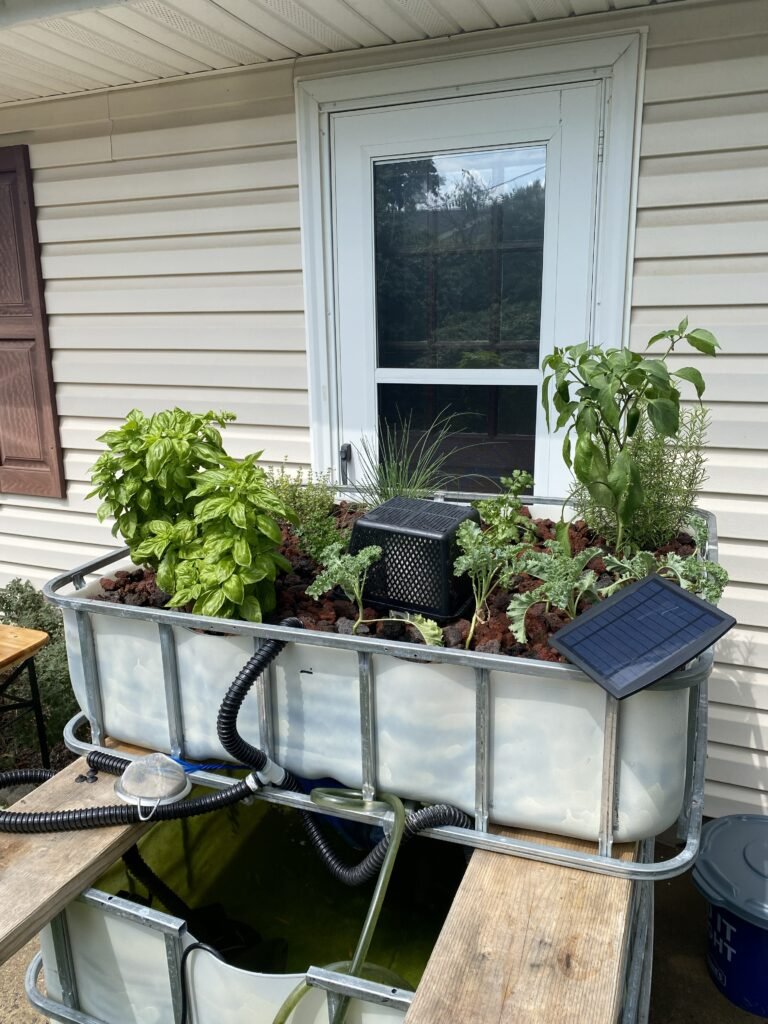
Other practical backup options include battery-powered aquarium pumps, rechargeable pond aerators, uninterruptible power supplies, portable power stations, and generators. The correct choice depends on total wattage and the outage duration you need to cover. See backup power for aquaponics systems before buying a battery based only on the largest number printed on the case.
View battery-backup aeration options on Amazon.
Air Pump Installation and Electrical Safety
Place the air pump above the water line when practical. If the pump must sit below the water level, use check valves and inspect them regularly. A failed check valve can allow water to siphon backward through the airline.
Keep the pump dry, elevated, ventilated, and protected from direct sun, rain, condensation, and splash. Do not seal an air pump inside an airtight container because the pump needs cooling airflow.
Electrical safety: Use grounded equipment, ground-fault circuit-interrupter protection, drip loops, and weather-rated outlets or enclosures where required. Keep plugs and connections away from standing water. Permanent greenhouse or outdoor wiring should comply with local electrical codes.
Aeration Maintenance
Aeration systems lose performance gradually. Because the pump may still make noise and some bubbles may still appear, the decline can be easy to miss.
| Maintenance Task | What to Check | Typical Timing |
|---|---|---|
| Observe bubble output | Weak outlets, uneven flow, stopped stones | Daily visual check |
| Inspect airline tubing | Kinks, cracks, loose fittings, condensation | Monthly |
| Clean or replace diffusers | Mineral buildup, algae, biofilm, clogging | As flow declines |
| Test check valves | Restricted airflow or failed backflow protection | Every few months |
| Clean pump intake | Dust, debris, restricted cooling | According to manufacturer instructions |
| Inspect diaphragms | Reduced output, noise, vibration | According to pump service schedule |
| Test backup equipment | Battery condition and actual runtime | Monthly and before storm season |
Fine-pore air stones can clog faster than coarse diffusers. Cleaning may restore some output, but air stones are inexpensive enough that replacement is often the more dependable solution.
Signs the System Needs More Aeration
- Fish gasping or piping at the surface
- Fish gathering around water returns or diffusers
- Sluggish behavior or reduced feeding
- Stress appearing after hot days
- Problems appearing near sunrise
- Warm or stagnant areas in the pond or container
- Uneven or weak bubble output
- Ammonia or nitrite problems despite an established biofilter
- Foul-smelling areas in filters or grow beds
Fish gasping is an emergency sign, not an early warning. Increase aeration immediately, stop feeding temporarily, verify water temperature, and test ammonia and nitrite. Do not wait for the normal maintenance schedule when fish are already showing oxygen distress.
Common Aeration Mistakes
Aeration is one part of the safety margin. Review the complete common aquaponics beginner mistakes guide for related stocking, feeding, pump, and testing problems.
Relying Only on the Water Pump
A falling return can add useful oxygen, but it stops when the circulation pump stops. Dedicated aeration creates redundancy and protects fish during partial equipment failures.
Using One Small Air Stone
One stone may leave large areas with weak circulation. Multiple diffusers improve distribution and reduce dependence on one clog-prone component.
Buying by Water Volume Alone
Water depth, fish biomass, feeding rate, temperature, and diffuser resistance affect demand. A lightly stocked pond and a heavily stocked stock tank may contain the same number of gallons but require very different aeration.
Putting an Indoor Pump in a Wet Greenhouse
Protect equipment that is not weather-rated. Greenhouse humidity and condensation can damage pumps and create electrical hazards.
Ignoring Backup Oxygen
The main air pump will eventually stop because of a power outage, worn diaphragm, damaged cord, or plain mechanical failure. A tested backup is part of the system, not an optional gadget.
Frequently Asked Questions
Should an aquaponics air pump run all the time?
Yes. In most stocked aquaponics systems, dedicated aeration should run continuously. Turning it off at night is especially risky because plants and algae consume oxygen after dark.
Can water movement replace an air pump?
Water movement can add oxygen, but it should not be the only source in a stocked backyard or greenhouse system. If the circulation pump stops, the oxygen contribution from the return flow stops too.
How many air stones should an aquaponics system have?
Use at least two when practical. Larger stock tanks, IBC containers, ponds, and chop tanks may need several diffusers distributed across the water. The goal is even circulation and redundancy, not a specific stone count.
Where should air stones be placed?
Place them low enough to move deeper water upward, but within the pressure capability of the pump. Spread them across the container, target stagnant areas, and keep them accessible for cleaning or replacement.
Can an aquaponics system have too much aeration?
Excess aeration is uncommon in backyard systems, but aggressive turbulence can disturb fish, keep solids from settling, or interfere with delicate roots. The objective is strong gas exchange and circulation without turning the pond into a washing machine.
Do plant roots need aeration?
Yes. Roots need oxygen for respiration. Deep-water culture and other water-based plant areas benefit from oxygenated water, especially when water temperature is high or roots are dense.
Does aeration change pH?
Aeration can release dissolved carbon dioxide, which may cause pH to rise slightly in some water. It does not replace proper alkalinity management or routine testing.
What is the best backup aeration method?
A battery-powered or solar-backed air pump is practical for short outages. A portable power station, generator, or larger battery system may be needed for longer outages or heavier fish loads. Test the equipment under real conditions before relying on it.
Final Takeaway
Aquaponics aeration is basic life-support equipment. Use a continuous-duty pump, distribute air through more than one diffuser, protect the pump from moisture, maintain the tubing and air stones, and keep a tested backup available.
Size the system for the fish and water conditions you will have at full operation, not for the small fingerlings or cool spring water you have on the first day. A few extra bubbles are cheap. Replacing a stock tank full of fish because the oxygen system was barely adequate is not.
For a broader look at pumps, filtration, water testing, heaters, backup systems, and other supporting equipment, see the Aquaponics Equipment Guide.