
Fish-to-Plant Ratio and Stocking Density in Aquaponics
“How many fish can I put in my aquaponics system?” sounds like it ought to have one clean answer.
It does not.
The number of fish is only one piece of the load. Ten fingerlings and ten harvest-size fish are ten fish on paper, but they do not ask the same thing of the tank, the air supply, the bacteria, the grow bed or the person cleaning up after them.
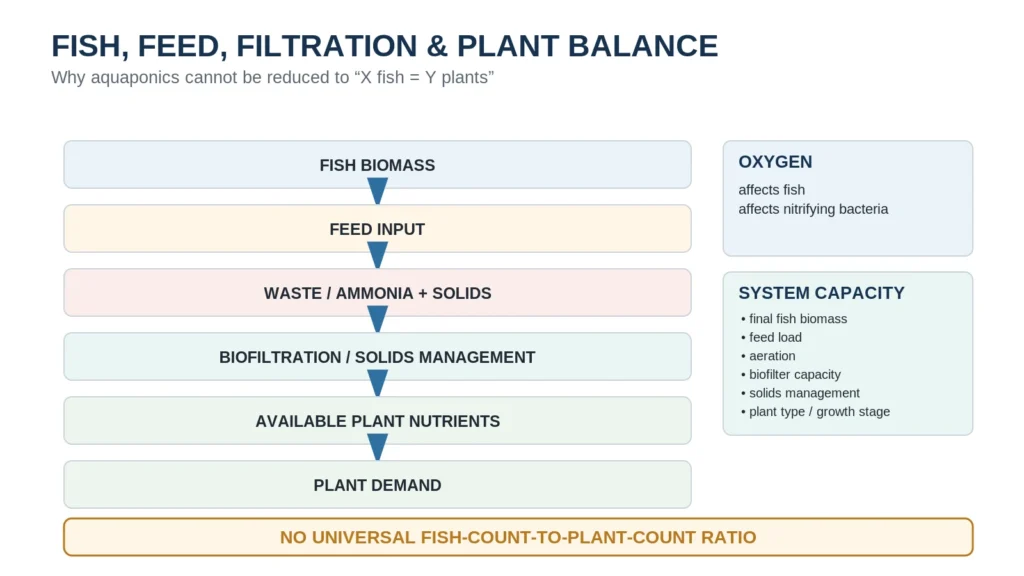
A better stocking plan starts with final fish biomass, feed input and system capacity. The plant side matters too, but not as a magic “one fish equals X plants” formula.
Start with the fish you expect to have later
One of the easiest beginner mistakes is to size around the fish on stocking day.
Small fish are forgiving because their combined biomass and feed demand are still low. If those fish grow well, that changes. They eat more, excrete more nitrogen, use more oxygen and produce more solids.
Oklahoma State’s small-scale aquaponics guidance gives one pound of fish per 10 gallons of water as a common final harvest density for new or inexperienced growers, while emphasizing that real density varies with experience, system design and solids removal.
That is useful as a conservative reference point. It is not a command to fill every ten gallons with a pound of fish.
For a 150-gallon fish tank, that reference corresponds to about 15 pounds of fish at final size. Before treating even that as reasonable, ask whether the system can actually support the feed, oxygen demand, biofiltration and solids load.
Why “fish per gallon” breaks down
Fish count hides the thing that matters: biomass.
Thirty two-ounce fish total 3.75 pounds. Thirty one-pound fish total 30 pounds. The head count is identical. The biological load is not.
As biomass rises, so do the consequences of getting something wrong. A circulation failure, clogged intake or dead air pump leaves less reserve in a heavily loaded system than it does in a lightly loaded one.
That is why conservative home aquaponics is usually more pleasant than trying to turn an IBC into an intensive aquaculture tank.
Feed is the bridge between the fish and plants
The plants do not receive nutrients because a particular number of fish happen to be swimming below them.
Feed goes in. Fish use some of it for growth. Waste and metabolic byproducts enter the water. Microorganisms convert ammonia through the nitrification process. Plants take up nitrate and other available nutrients.
Research and commercial aquaponics therefore often relate daily feed input to plant-growing area. Oklahoma State/SRAC guidance explicitly describes the feed-rate-to-growing-area relationship as a key design criterion.
For a backyard media bed, the useful lesson is the relationship, not copying a commercial raft-system number.
If the feed load increases, the rest of the system has to process what follows.
The five practical limits on stocking
Oxygen
Fish use oxygen. Nitrifying bacteria use oxygen. Roots use oxygen.
Higher fish biomass and heavier feeding reduce the room for error when aeration or circulation fails. Strong aeration is not an excuse for unlimited stocking, but weak aeration is a very good reason to stay conservative.
See Aeration in Aquaponics Systems for the mechanical side of oxygen delivery.
Biofiltration
The bacterial population has to convert the ammonia generated by the actual feed and fish load.
A biofilter that is stable at one load can be overwhelmed by a large jump in biomass or feeding. This is one reason stocking and feeding should increase gradually rather than in one heroic leap.
Solids management
More feed eventually means more solid waste.
Depending on the design, solids may settle, collect in filters or accumulate in media. Excess organic material can restrict flow and consume oxygen as it breaks down.
The existing Aquaponics Solids Filtration Basics page covers that side of the system.
Plant demand
A mature bed full of aggressively growing plants does not have the same nutrient demand as a freshly harvested bed or a tray of seedlings.
Crop choice matters too. Fruiting plants and leafy greens are not interchangeable nutrient sinks.
Fish species and final size
Species differ in temperature range, oxygen demand, adult size, behavior and feeding.
Choose the fish first, then plan around what they become. The existing Tilapia, Catfish, or Bass guide provides species context.
The fish-to-plant ratio is a management relationship, not a fixed number
It is tempting to write down a ratio and be finished with it.
Aquaponics does not cooperate.
A useful balance is observed through trends:
- feed input and fish growth;
- ammonia and nitrite;
- nitrate trend;
- dissolved oxygen and aeration;
- solids accumulation;
- plant growth and crop stage.
If nitrate keeps climbing while the plants look healthy, nutrient input may be running ahead of plant uptake.
If nitrate is low, that does not automatically mean “add fish.” The plants may be using nitrate effectively, feeding may be light, or the system may be immature.
Use Aquaponics Water Testing Basics to establish a consistent testing routine.
Brian’s IBC system eventually showed why load matters
The useful part of my own IBC experience is not a remembered fish count. I do not have a reliable enough record to turn that one system into a stocking formula, and I am not going to manufacture one six years later.
What I do remember is the system getting harder to keep balanced as the fish got larger.
Late in the experiment I was regularly chasing ammonia, nitrite and nitrate readings, and green-water algae became more of a problem when the fish load got ahead of what the plant side was taking up. At the time, I described it pretty simply: the tank had become overcrowded.
That is one system, not a controlled stocking trial. But it is a useful reminder that the problem often arrives after the fish have grown, not when the fry first go into the tank.
A conservative stocking method for a home system
Start with usable fish-tank volume and the expected harvest size of the species.
Then work backward:
- estimate the final biomass you are planning to carry;
- compare it with a conservative small-system reference rather than an intensive-production number;
- confirm you have strong aeration and circulation;
- establish the biofilter before loading it heavily;
- increase feed gradually;
- watch ammonia and nitrite as biomass rises;
- monitor solids and plant response;
- harvest or thin fish before the system loses its operating margin.
- Oklahoma State University — Principles of Small-Scale Aquaponics: https://extension.okstate.edu/fact-sheets/principles-of-small-scale-aquaponics
- Oklahoma State University — Nitrification and Maintenance in Media Bed Aquaponics: https://extension.okstate.edu/fact-sheets/nitrification-and-maintenance-in-media-bed-aquaponics
- Oklahoma State/SRAC — Aquaponics: Integrating Fish and Plant Culture: https://extension.okstate.edu/fact-sheets/recirculating-aquaculture-tank-production-systems-aquaponics-integrating-fish-and-plant-culture
The goal is not to prove how many pounds of fish you can cram into a tank. The goal is a system that stays boring enough to manage.
Signs the fish load may be outrunning the system
Recurring ammonia or nitrite is a warning.
So are fish crowding the surface or inflows, chronic low oxygen, rapid water-quality deterioration after feeding, excessive solids, frequent clogging and a system that becomes fragile every time power or circulation is interrupted.
Do not treat those symptoms as a reason to keep adding equipment while preserving the same fish load. Sometimes the correct capacity upgrade is fewer fish.
For a whole-system diagnostic sequence, use Aquaponics Troubleshooting: What to Check First.
Stocking and feeding belong together
You cannot manage fish biomass without managing feed.
The companion Aquaponics Fish Feeding Guide covers feed choice, feeding response, temperature, oxygen and overfeeding in more detail.
That page and this one should be read together: stocking determines the potential biological load; feeding determines how much of that load is actually being driven through the system today.
Bottom line
There is no trustworthy universal “X fish per plant” rule.
For a backyard aquaponics system, plan around final biomass, appropriate feed, oxygen, biofiltration, solids handling and changing plant demand. Use conservative stocking as operating margin, not wasted tank space.