
Aquaponics Pump Problems: Troubleshooting Low Flow
When an aquaponics pump stops moving water, the pump itself is only one possible cause.
The outlet can lose power. The intake can clog. Water level can fall. A valve can move. A hose can kink. The pump can be perfectly healthy and still deliver much less water than the number printed on the box because the real system adds lift and plumbing resistance.
Start with the simple checks.
And if circulation is seriously reduced, protect the fish first. Make sure aeration is operating while you work on the water-flow problem.
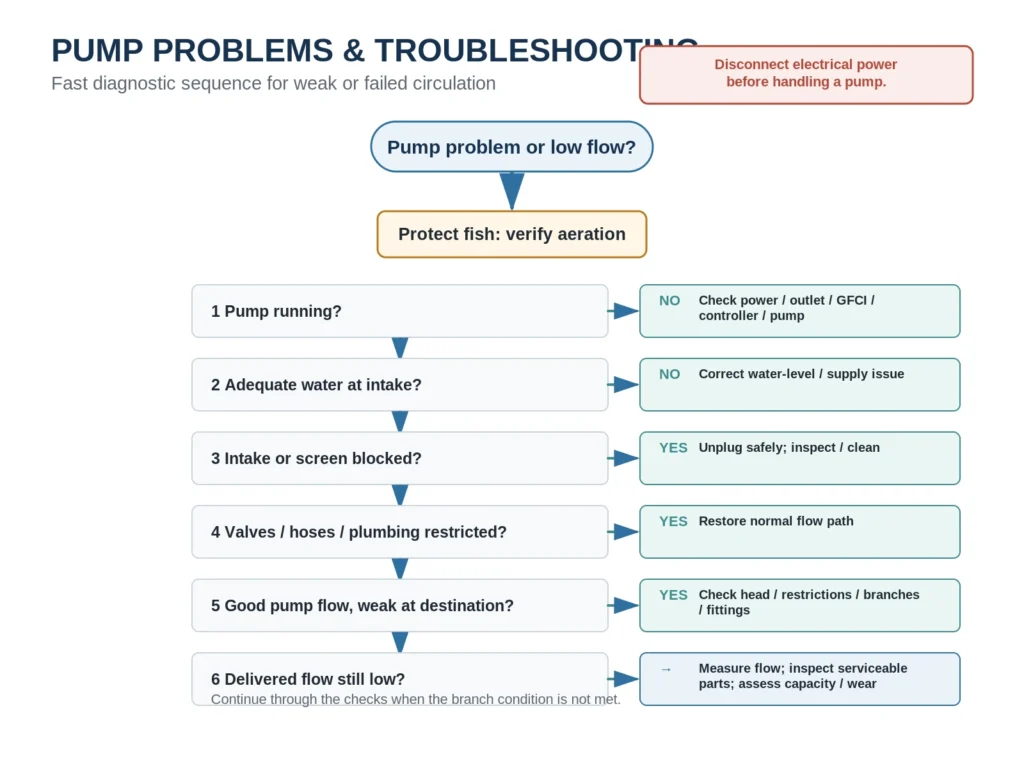
Pump does not run
Start with power.
Check the outlet, GFCI, timer or controller and plug.
Do not reach into water to handle a plugged-in pump.
If the pump repeatedly trips electrical protection, overheats, smells burned or has damaged insulation, stop using it. That is not a problem to bypass.
If power is normal, unplug the pump before removing or inspecting it.
Follow the manufacturer’s instructions for cleaning and accessing any user-serviceable impeller area.
Pump runs, but almost no water moves
This is where intake and plumbing checks pay off.
Look for debris around the intake, a clogged pre-screen, roots, leaves, algae, settled solids or a partially closed valve.
Then check hoses for kinks and restrictions.
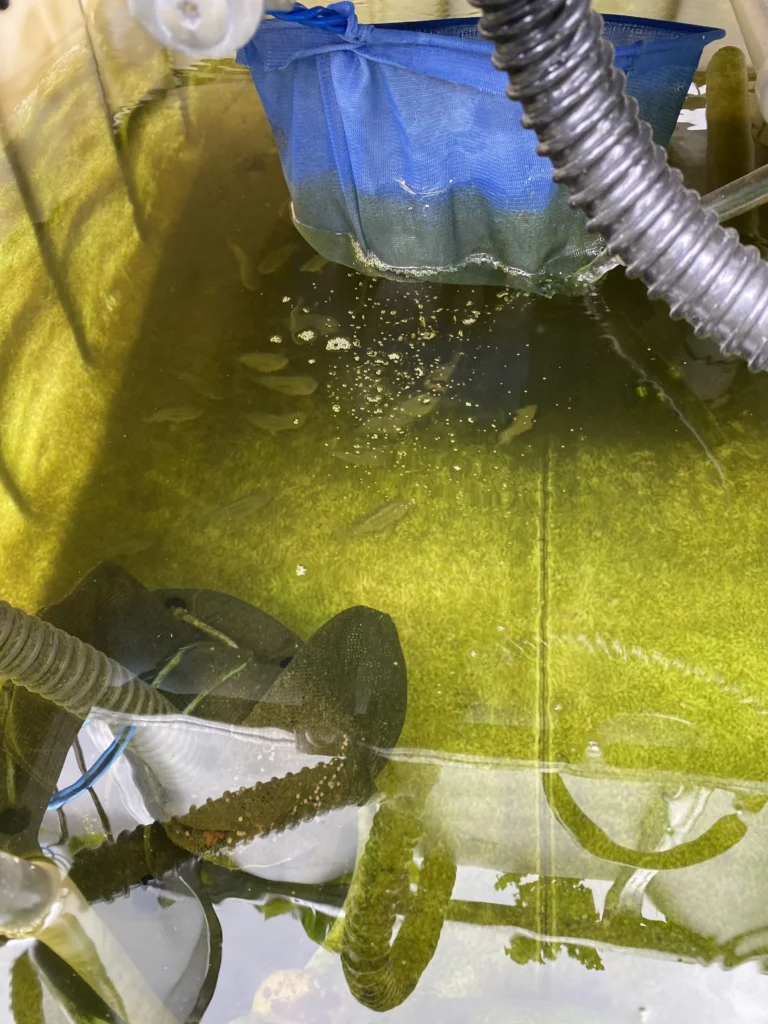
My IBC system used a pond-style dirty-water pump sitting in the lower tank. I put mesh around the intake to keep fish away from it.
That worked, but the mesh also became something that could foul.
The pump clogged badly once. I took it apart, put it back together and it worked again. I never proved exactly what jammed it.
The useful lesson is not “buy my exact pump.” It is that anything protecting an intake also becomes a maintenance point.
Flow used to be good, then slowly declined
Gradual flow loss usually suggests a changing condition.
Check:
- intake fouling;
- debris or biofilm in plumbing;
- root intrusion;
- filter loading;
- moved valves;
- hose kinks;
- pump wear;
- accumulated debris around an impeller.
Do not diagnose flow by sound.
Measure it.
A simple field check is to time how long the discharge takes to fill a container of known volume. That gives an approximate delivered flow under the actual lift and plumbing conditions.
The pump may be too small
The maximum flow printed on a pump box is not the same as the flow it will deliver in your system.
Pumps operate against head.
Vertical lift contributes to head, and pipe length, fittings, valves and restrictions add resistance. Oklahoma State pump guidance describes pump performance as a relationship between flow and head, with the real operating point determined by the pump and system together.
That is why pump selection should consider the manufacturer’s performance curve rather than only the zero-head maximum.
For design rather than troubleshooting, use How to Size a Pump for an Aquaponics System.
The pump can also be too powerful
I managed to demonstrate both ends of that problem.
My first pump took roughly 35–40 minutes to fill the IBC grow bed.
I replaced it with a bigger pump that could fill the bed in roughly 2–3 minutes with the flow wide open.
That was not an improvement.
I used valves to reduce the operating flow until the bed filled in roughly 9–10 minutes, then drained through the bell siphon in about a minute.
Those are not target timings for your system. They are a firsthand example of the difference between pump capacity and useful operating flow.
The bigger pump had the capacity. The system still needed balance.
Should you throttle the pump?
Do not assume every pump should be throttled.
Some centrifugal pumps can be controlled on the discharge side, but the correct arrangement depends on the pump design and manufacturer instructions.
Do not restrict the intake to control flow.
If the design allows excess flow to be managed with a discharge-side valve or bypass/return branch, use the pump manufacturer’s guidance and a system layout that does not create unsafe operating conditions.
My IBC pump tolerated the valve arrangement I used. That is evidence about my system, not a universal pump rule.
Good flow at the pump, weak flow at one branch
If the pump discharge looks strong but one grow bed or branch is weak, inspect distribution.
Different branch lengths, diameters, valve positions and elevations can create unequal resistance.
One low-resistance path can take most of the water.
This is a plumbing-balance problem, not automatically a bad pump.
Use the Aquaponics Plumbing Guide for the layout foundation.
Intermittent flow
A pump that loses and regains flow can point to changing water level, a moving intake restriction, thermal protection, a float/controller problem or a siphon cycle that changes tank/sump level more than expected.
Watch a complete operating cycle.
A thirty-second test can miss the thing that happens every ten minutes.
If the pump is fine but the grow bed is not
Normal pump flow does not mean normal drain behavior.
If the bed fills but the siphon will not start, will not break or drains slowly, move to Bell Siphon Troubleshooting.
If multiple parts of the system look abnormal, go back to Aquaponics Troubleshooting: What to Check First.
A practical pump check order
Protect fish with aeration.
Then check power, water level, intake, valves and hoses, discharge flow, branch flow and real head conditions.
Measure delivered flow before replacing the pump.
Replace the pump after you have ruled out the system-side causes that can make a good pump look bad.
Bottom line
Troubleshoot the water path, not just the pump.
Power, water level, intake restriction, head, plumbing and valve position can all reduce delivered flow.
A pump is part of a hydraulic system. Treating the label GPH as the only number that matters is how I ended up owning both a pump that was too weak and one that was far more pump than I needed.
Sources
- Oklahoma State University — Irrigation Pump System Testing: https://extension.okstate.edu/fact-sheets/irrigation-pump-system-testing
- Oklahoma State University — Aquaponics: https://extension.okstate.edu/fact-sheets/aquaponics
- Oklahoma State/SRAC — Aquaponics: Integrating Fish and Plant Culture: https://extension.okstate.edu/fact-sheets/recirculating-aquaculture-tank-production-systems-aquaponics-integrating-fish-and-plant-culture