
Aquaponics Fish Feeding: How Much and What Food?
Fish feed is not just something you throw into the tank so the fish get bigger.
It is one of the main inputs controlling the entire aquaponics system.
Feed becomes fish growth, fish waste, ammonia, organic solids and eventually part of the nutrient stream available to plants. Feed too little and fish growth and nutrient input can suffer. Feed too aggressively and the system may get an ammonia, solids or oxygen problem faster than it can process the extra food.
So the useful question is not simply “How much food does my tank get?”
It is: How much feed do these fish need under today’s conditions, and can the system process what follows?
Use feed made for the fish you actually keep
Different species and life stages have different nutritional requirements.
A generic pond pellet is not automatically appropriate for tilapia, trout, catfish, koi and every other fish that can appear in aquaponics.
Choose a complete commercial feed intended for the species or an appropriate aquaculture use. Use the feed manufacturer’s table as a starting point, not as permission to ignore temperature, oxygen, appetite or water quality.
For tilapia specifically, Oklahoma State’s small-scale aquaponics guide describes floating pellets in roughly the 28–36% crude-protein range, while noting that other species may require materially different protein levels.
That is a tilapia reference, not a universal aquaponics-feed number.
Pellet size should grow with the fish
A half-inch fry cannot handle the same pellet that an adult fish can.
Pellets that are too large may be ignored or broken apart. Very small feed can be harder to observe and can increase waste if the fish are no longer taking it efficiently.
Match pellet size to the fish’s mouth and growth stage.
Floating pellets have one practical advantage in a backyard system: you can watch what happens. You can see whether the fish come up, how aggressively they eat and whether feed is still floating around after the normal feeding response ends.
That observation is worth something.
There is no single feeding percentage for every aquaponics system
Feeding rate changes with:
- species;
- fish size and total biomass;
- life stage;
- water temperature;
- dissolved oxygen;
- health and stress;
- feed formulation;
- system carrying capacity.
Commercial feeds often provide feeding tables based on fish size or estimated body weight. Use them, but treat actual fish behavior and water-quality data as feedback.
The bag does not know that your air pump failed last night.
Watch the fish before and during feeding
A normal feeding response becomes a useful daily baseline.
Look for fish approaching food promptly, normal swimming, consistent appetite and feed being consumed rather than accumulating.
A sudden appetite change can be an early clue that something else changed.
Potential causes include temperature stress, poor oxygen, ammonia or nitrite, handling stress, illness, recent stocking or a mechanical problem affecting flow.
If fish unexpectedly stop eating, adding more food is not troubleshooting.
Use Aquaponics Troubleshooting: What to Check First when the feeding change is part of a larger system problem.
Overfeeding turns into a water-quality problem
Uneaten feed is organic matter.
It does not vanish because it sank out of sight. It can decompose, add to solids, consume oxygen and increase the waste load the biofilter has to process.
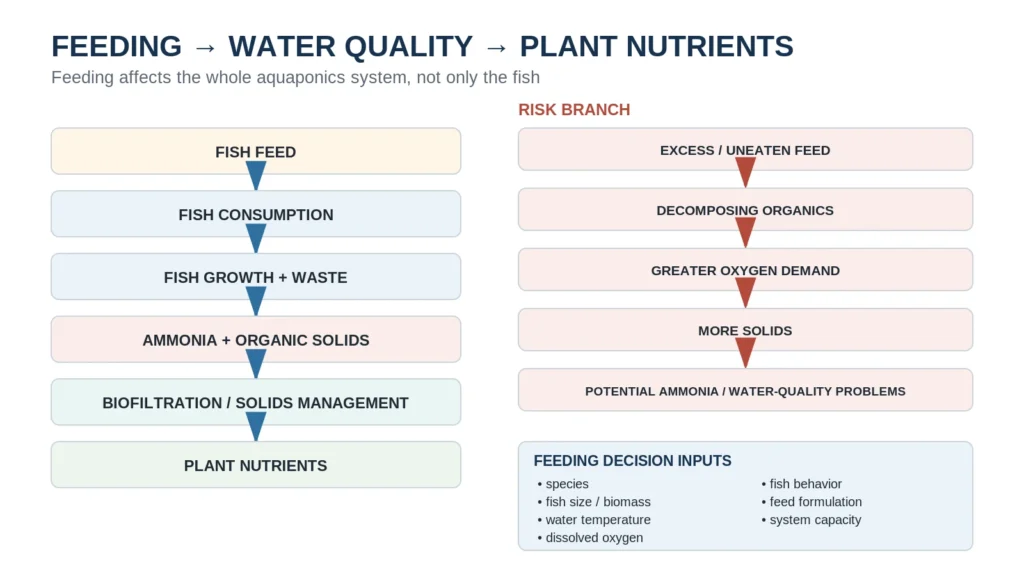
If significant food remains uneaten, remove what you reasonably can, reduce the next feeding and figure out why the normal response changed.
This is where feeding connects directly with Aquaponics Water Testing Basics.
Temperature changes appetite
Fish are ectothermic. Their metabolism and feeding behavior change with water temperature.
A ration that made sense in warm, stable water may be excessive after a major temperature drop.
Brian saw this system relationship firsthand during the Northern Virginia winter experiment. The tank normally spent much of its life roughly in the 65–80°F range, but a severe cold snap drove the water into the 40s for a short period despite heaters. That was an emergency condition, not a feeding experiment, but it is exactly why a fixed year-round feeding number is a bad management habit.
Check the fish and the water, not just the calendar.
Oxygen and feeding are linked
Fish need oxygen. Nitrifying bacteria need oxygen. Decomposing organic material uses oxygen.
Heavy feeding when dissolved oxygen is already marginal can push the system in the wrong direction.
If aeration is failing or fish are showing signs consistent with oxygen stress, reduce or pause feeding while restoring the mechanical problem.
See Aeration in Aquaponics Systems for the equipment side.
The biofilter has to process what you feed
Every increase in feeding creates a downstream job for the biological filter.
If ammonia or nitrite begins appearing after feed intake rises, investigate the whole chain:
fish biomass → feed → waste → oxygen → flow → biofiltration → solids.
Do not reflexively pour in “more bacteria” without finding the actual limiting condition.
Feed also drives the plant side
Fish feed is the major nutrient input in many aquaponics systems.
Oklahoma State/SRAC guidance describes daily feed input relative to plant-growing area as a key balancing relationship. Small-scale guidance also gives feed-to-area examples for raft production.
Those figures are useful in the systems they describe. They are not a universal backyard media-bed ration.
The practical lesson is simpler: plant nutrient production is tied to how much and what kind of feed actually enters the system.
That is why Aquaponics Stocking Density and Fish-to-Plant Ratio treats fish count as only part of the balance.
Brian’s feeding record: useful, but not precise enough to fake
In the IBC experiment, I bought tilapia fry and followed a staged feeding kit from the fish supplier. The kit changed feed as the fish moved from fry through larger growth stages.
I remember that structure because it removed a lot of guesswork at the time.
What I do not remember six years later is the exact daily feeding table or body-weight percentage. In the interview my response was basically, “Dude, that was six years ago. I can’t even remember what I had for breakfast.”
That is a useful boundary.
This page can say that I used staged commercial tilapia feed and watched the fish response. It should not turn fuzzy memory into a precise feeding formula.
A practical feeding routine
Before feeding, glance at the fish and system.
Confirm that circulation and aeration look normal. Note any major temperature change. Feed the correct species/life-stage food. Watch the response. Stop before significant feed is sitting around uneaten.
As the fish grow, periodically re-estimate biomass and adjust feed gradually.
If feeding rises, pay closer attention to ammonia, nitrite, solids and oxygen.
When to cut back or pause feed
Temporarily reducing feed can be sensible while correcting:
- elevated ammonia;
- elevated nitrite;
- severe low-oxygen conditions;
- major temperature stress;
- unexplained fish illness;
- prolonged pump, aeration or filtration failure.
That is a short-term load-reduction measure, not a cure for the underlying problem.
Store feed like food
Keep feed dry, cool and sealed from insects and rodents.
Do not feed wet, moldy or spoiled pellets. A bargain bag is not a bargain if storage turns it into another water-quality problem.
Bottom line
Feed the fish you have, under the conditions you have, with a ration intended for them.
Then watch what the fish and water tell you.
Good aquaponics feeding is not about hitting one perfect percentage. It is about keeping fish nutrition, biomass, oxygen, biofiltration and plant demand in a range the system can actually handle.
Sources
- Oklahoma State University — Principles of Small-Scale Aquaponics: https://extension.okstate.edu/fact-sheets/principles-of-small-scale-aquaponics
- Oklahoma State University — Nitrification and Maintenance in Media Bed Aquaponics: https://extension.okstate.edu/fact-sheets/nitrification-and-maintenance-in-media-bed-aquaponics
- Oklahoma State/SRAC — Aquaponics: Integrating Fish and Plant Culture: https://extension.okstate.edu/fact-sheets/recirculating-aquaculture-tank-production-systems-aquaponics-integrating-fish-and-plant-culture